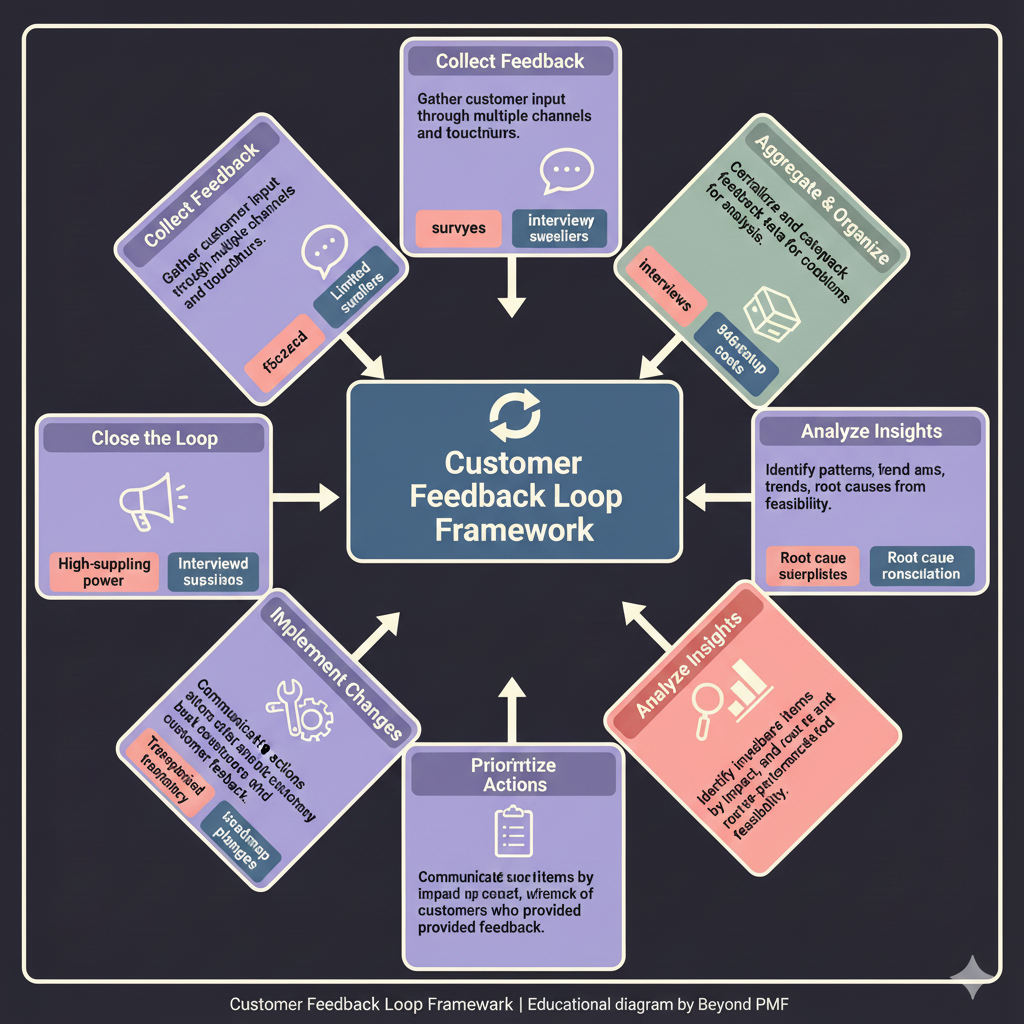
The Customer Feedback Loop Framework is designed to help businesses systematically gather, analyze, and act on customer feedback. This iterative process ensures that customer insights are effectively integrated into product development and service improvement strategies. By continuously engaging with customer feedback, companies can make more informed decisions, enhance customer satisfaction, and foster loyalty. The framework not only helps in identifying areas of improvement but also in recognizing customer needs and expectations, thereby aligning business offerings more closely with market demands.
Collect Feedback: Gather input from various channels such as surveys, social media, and customer support interactions. | Analyze Feedback: Use tools and techniques to analyze the data for patterns and insights that can drive improvements. | Act on Insights: Implement changes based on the feedback analysis to improve products, services, or customer experience. | Follow-up: Re-engage with customers to inform them about the changes made and to gather further feedback on those changes.
Ensure a diverse range of feedback channels to capture a broad spectrum of customer opinions. | Prioritize actionable feedback and set clear objectives for each iteration of the feedback loop. | Communicate back to customers about how their feedback has been used to foster transparency and trust.
Enhances product and service quality through direct customer insights | Increases customer satisfaction and loyalty by showing responsiveness | Drives continuous improvement and innovation within the organization
Can be time-consuming and resource-intensive to implement effectively | Risk of feedback overload where too much data can lead to analysis paralysis | May receive biased or non-representative feedback which can skew results
When launching a new product or service to understand initial user impressions | During regular product updates to gauge ongoing customer satisfaction and areas for improvement
When the feedback collection and analysis process cannot be adequately supported with resources | In highly regulated industries where changes based on feedback may require prolonged validation and compliance checks