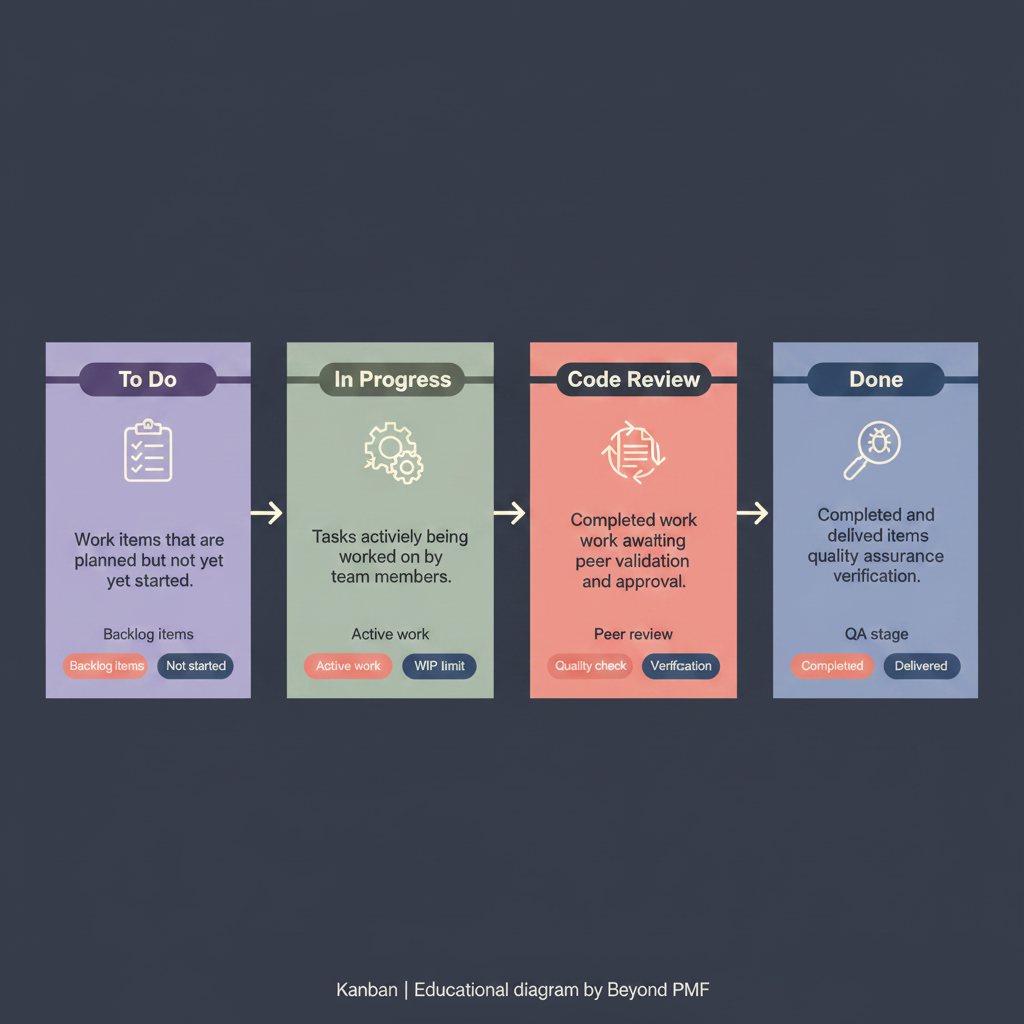
Kanban is a popular framework used primarily in software development and other fields that require task management. It involves visualizing work on a Kanban board, allowing teams to see the state of every piece of work at any time. This transparency helps improve efficiency by limiting work in progress and maximizing flow. The framework is highly adaptable, making it suitable for teams of various sizes and industries.
Visualize the workflow: Map out all steps of your process on a Kanban board. | Limit work in progress: Set limits on the number of tasks in each stage of the process to avoid bottlenecks. | Manage flow: Monitor the movement of tasks across the board and adjust as necessary to improve flow. | Make process policies explicit: Clearly define and display rules for how tasks should be handled at each stage. | Implement feedback loops: Regularly review and adapt the process based on feedback from team members. | Improve collaboratively: Continuously seek ways to optimize and enhance the workflow as a team.
Regularly update and maintain the Kanban board | Use explicit policies for better clarity and consistency | Engage the whole team in the Kanban process for collective responsibility
Increases process transparency | Enhances flexibility and adaptability | Reduces time wasted on multitasking and context switching
Can be less effective in highly unpredictable environments | Requires continuous monitoring and updating of the board | May not provide enough structure for certain types of projects
When needing to manage and optimize a continuous workflow | In environments where work tasks vary in priority and complexity
In projects requiring a strict sequence of tasks with little flexibility | When there is no capacity to update and maintain the workflow visualization