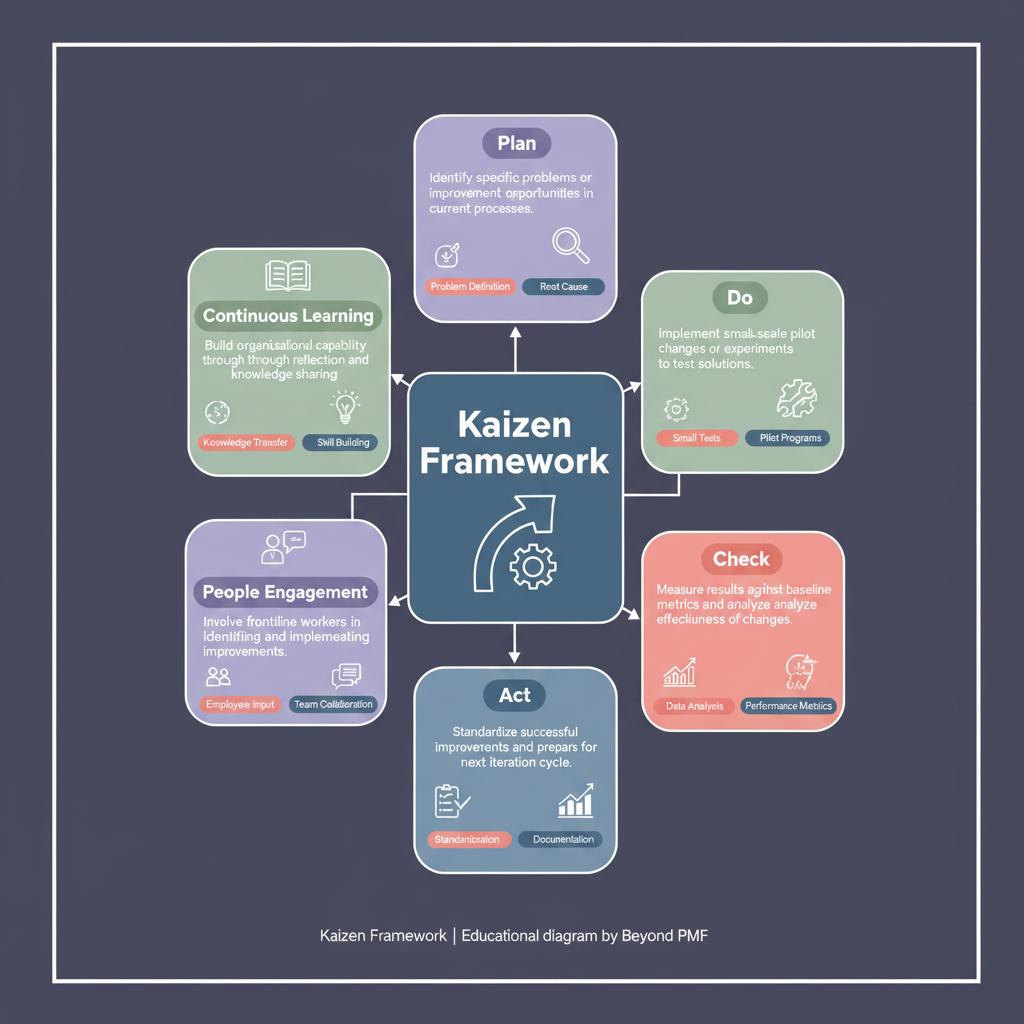
The Kaizen Framework is a philosophy and set of practices centered on continuous improvement in the workplace. Originating in Japan, it emphasizes small, consistent changes that lead to major improvements over time. Businesses adopt Kaizen to boost productivity, reduce waste, and enhance employee satisfaction through a culture that actively engages all members in suggesting and implementing improvements.
Identify Improvement Opportunities: Continuously monitor processes and identify areas for improvement. | Analyze Processes: Use tools like flowcharts and root cause analysis to understand existing processes and pinpoint inefficiencies. | Develop Solutions: Brainstorm potential solutions to the identified problems, often involving cross-functional teams. | Implement Changes: Roll out small changes to see their effect without disrupting the whole system. | Review and Standardize: Assess the impact of changes and standardize successful practices across the organization. | Repeat the Process: Kaizen is a cyclical process, always looking for new improvements.
Encourage open communication and feedback from all employees | Provide training and resources necessary for effective implementation | Regularly review and assess the effectiveness of implemented changes
Improves productivity and efficiency incrementally without major disruptions | Enhances employee morale by involving them in decision-making processes | Reduces costs by eliminating waste and optimizing resources
Can be slow to show significant results | May be met with resistance from employees accustomed to traditional ways | Requires continuous commitment and may falter without constant management support
When seeking to improve process efficiency and quality incrementally | In environments where employee engagement and input are valued
When immediate, radical changes are necessary | In highly unstable environments where long-term planning is impractical