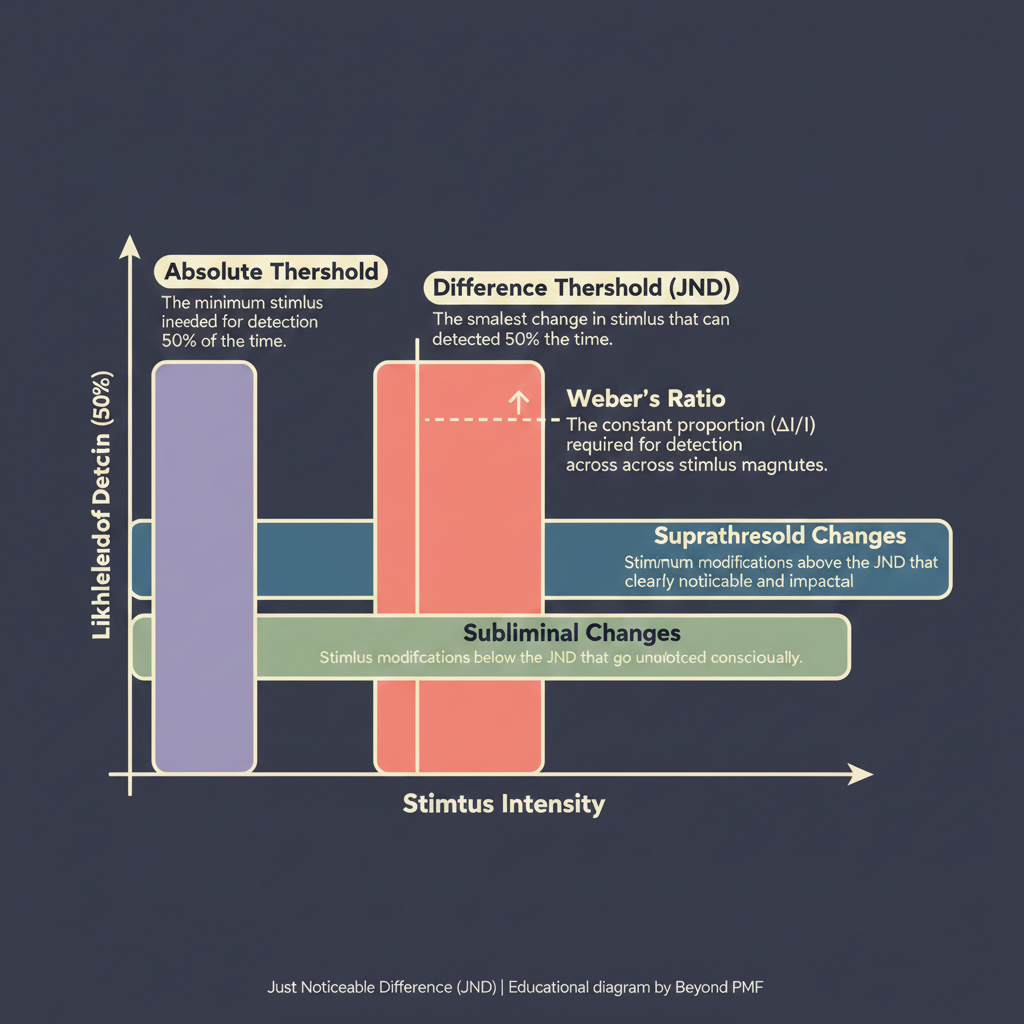
Just Noticeable Difference (JND)

https://ik.imagekit.io/beyondpmf/frameworks/just-noticeable-difference-jnd.png
The JND framework, when applied to a business context, helps to understand the smallest change that customers will perceive. This directly relates to the execution of product updates, pricing adjustments, or marketing campaigns, aiming to optimize customer experience and prevent jarring changes.

The Just Noticeable Difference (JND), also known as the difference threshold, is a principle from psychophysics that quantifies the minimum level of change in a sensory stimulus required to be noticeable at least 50% of the time. This framework is used to understand sensory limits and optimize product designs, marketing, and communication strategies to align with human perception capabilities. The benefits of applying JND include enhanced product design, effective marketing strategies, and improved user experience by aligning changes closely with human sensory perceptions.

Steps / Detailed Description

Identify the stimulus to be tested and define the baseline intensity. | Incrementally increase or decrease the stimulus intensity. | Conduct trials with subjects to determine the point at which changes in the stimulus are consistently detectable. | Record and analyze the results to determine the average smallest detectable difference.

Best Practices

Ensure a controlled environment to minimize external variables. | Use a sufficient sample size to get statistically significant results. | Iteratively test and refine to accurately determine JND.

Pros

Helps in fine-tuning product attributes to meet perceptual thresholds. | Enables marketers to make significant but subtle changes that are perceived by consumers. | Improves user experience by aligning product changes with human sensory capabilities.

Cons

Requires precise experimental conditions to obtain accurate measurements. | Can be resource-intensive in terms of time and participants. | May not be universally applicable across all sensory modalities or demographic groups.

When to Use

In product development to determine perceptible changes in features. | In marketing to assess the impact of changes in advertising stimuli.

When Not to Use

When changes in stimulus are too subtle to be measured reliably. | In situations where broad, qualitative feedback is more valuable than quantitative thresholds.

Related Frameworks

Lifecycle

Not tied to a specific lifecycle stage

Scope

Scope not defined

Maturity Level

Maturity level not specified

Time to Implement

2–4 Weeks
3–6 Months
1–2 Weeks
3–6 Months
1–2 Months
3–6 Months
1–2 Weeks
Less Than 1 Day
1–2 Weeks
Longer Than 6 Months
1–2 Weeks
Longer Than 6 Months
1–2 Weeks
3–6 Months
1–2 Weeks
1–2 Weeks
1–2 Weeks
1–2 Weeks
1–2 Days
1–2 Weeks
1–2 Weeks
1–2 Weeks
1–2 Weeks
1–2 Weeks
1–2 Weeks
3–6 Months
1–2 Weeks
1–2 Weeks
1–2 Weeks
3–6 Months
1–2 Weeks
1–2 Weeks
2–4 Weeks
1–2 Weeks
1–2 Days
1–2 Weeks
Longer Than 6 Months
3–6 Months
Longer Than 6 Months
1–2 Weeks
Longer Than 6 Months
3–6 Months
Less Than 1 Day
3–6 Months
1–2 Months
3–6 Months
Longer Than 6 Months
3–6 Months
Less Than 1 Day
1–2 Weeks
3–6 Months
3–6 Months
1–2 Weeks
3–6 Months
1–2 Weeks
1–2 Weeks
1–2 Days
1–2 Weeks
1–2 Months
Longer Than 6 Months
1–2 Weeks
Longer Than 6 Months
1–2 Weeks
3–6 Months
1–2 Weeks
Less Than 1 Day
1–2 Weeks
3–6 Months
1–2 Weeks
3–6 Months
1–2 Weeks
1–2 Weeks
Longer Than 6 Months
Less Than 1 Day
3–6 Months
Longer Than 6 Months
1–2 Months
1–2 Weeks
Longer Than 6 Months
1–2 Weeks
3–6 Months
1–2 Weeks
1–2 Weeks
3–6 Months
Less Than 1 Day
1–2 Weeks
1–2 Weeks
3–6 Months
3–6 Months
Less Than 1 Day
1–2 Weeks
Longer Than 6 Months
1–2 Months
1–2 Weeks
1–2 Weeks
1–2 Weeks
Longer Than 6 Months

Copyright Information

Autor:
Public Domain
N/A
Publication:
Generic Business Tool