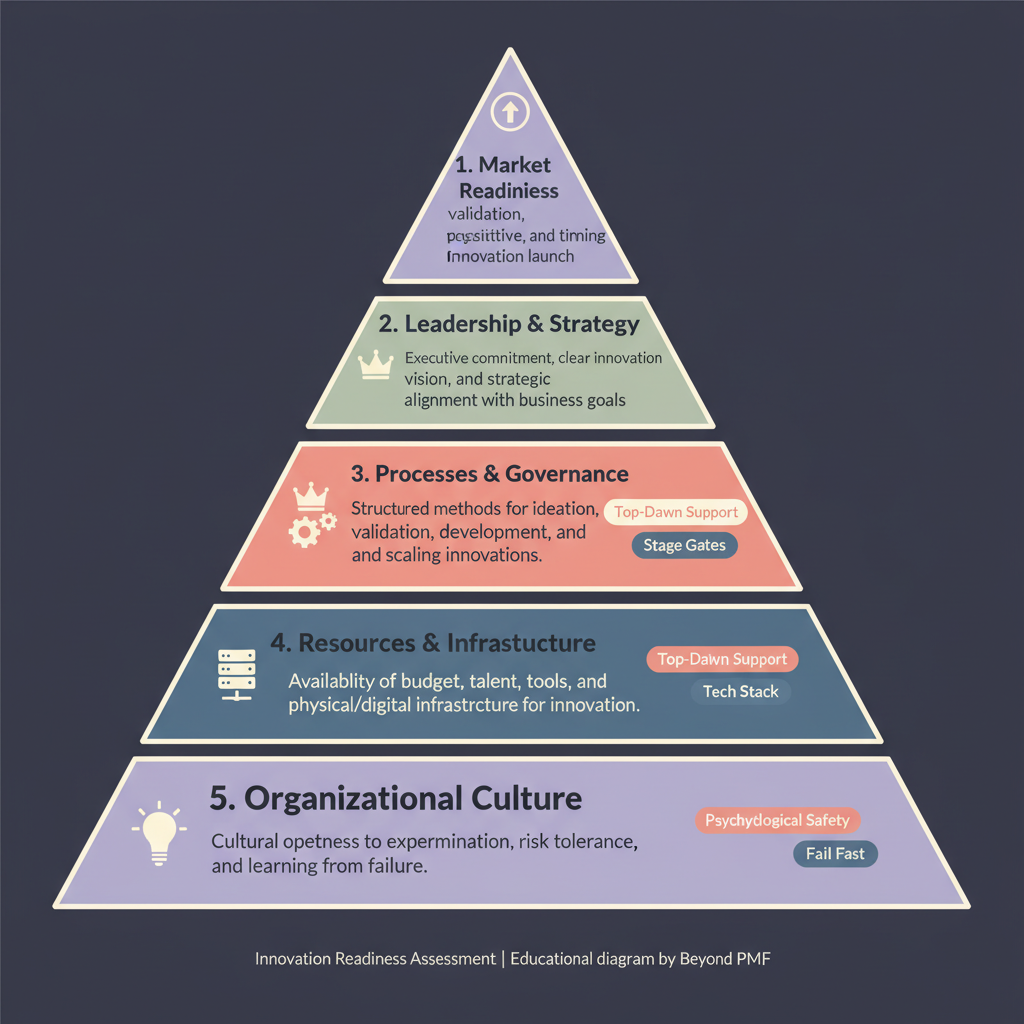
Innovation Readiness Assessment

https://ik.imagekit.io/beyondpmf/frameworks/innovation-readiness-assessment.png
The Innovation Readiness Assessment directly addresses strategic friction by evaluating an organization's capacity to innovate, which inherently includes assessing its strategic alignment, vision, and market positioning. This framework helps identify gaps in the organization's strategic approach to innovation.

The Innovation Readiness Assessment framework is designed to help organizations identify their strengths and weaknesses in fostering innovation. By evaluating key areas such as leadership commitment, strategic alignment, and resource allocation, this framework provides insights into how prepared an organization is to implement and sustain innovative practices. It is used to benchmark current capabilities against best practices and to develop action plans for improvement, thereby enhancing the organization's overall innovation potential.

Steps / Detailed Description

Assess current innovation strategy and objectives. | Evaluate the organizational culture and its support for innovation. | Analyze the processes and structures in place for innovation. | Measure the competencies and capabilities of the workforce related to innovation. | Review technology and infrastructure available to support innovation. | Compile findings and benchmark against industry standards. | Develop an action plan to address gaps and leverage strengths.

Best Practices

Ensure participation from all relevant departments. | Regularly update the assessment to track progress and changes. | Use results to inform strategic decisions and resource allocation.

Pros

Provides a comprehensive view of an organization's innovation capabilities. | Helps in strategic planning and prioritization of innovation efforts. | Facilitates benchmarking against industry standards and competitors.

Cons

Can be time-consuming to gather all necessary data. | May require external expertise to interpret results effectively. | Potentially overlooks unique aspects of the organization not covered by standard metrics.

When to Use

When planning a new innovation strategy. | When seeking to enhance current innovation processes.

When Not to Use

In very small organizations where formal assessments may be too cumbersome. | When immediate action is required, bypassing thorough analysis.

Related Frameworks

Lifecycle

Not tied to a specific lifecycle stage

Scope

Scope not defined

Maturity Level

Maturity level not specified

Time to Implement

2–4 Weeks
3–6 Months
1–2 Weeks
3–6 Months
1–2 Months
3–6 Months
1–2 Weeks
Less Than 1 Day
1–2 Weeks
Longer Than 6 Months
1–2 Weeks
Longer Than 6 Months
1–2 Weeks
3–6 Months
1–2 Weeks
1–2 Weeks
1–2 Weeks
1–2 Weeks
1–2 Days
1–2 Weeks
1–2 Weeks
1–2 Weeks
1–2 Weeks
1–2 Weeks
1–2 Weeks
3–6 Months
1–2 Weeks
1–2 Weeks
1–2 Weeks
3–6 Months
1–2 Weeks
1–2 Weeks
2–4 Weeks
1–2 Weeks
1–2 Days
1–2 Weeks
Longer Than 6 Months
3–6 Months
Longer Than 6 Months
1–2 Weeks
Longer Than 6 Months
3–6 Months
Less Than 1 Day
3–6 Months
1–2 Months
3–6 Months
Longer Than 6 Months
3–6 Months
Less Than 1 Day
1–2 Weeks
3–6 Months
3–6 Months
1–2 Weeks
3–6 Months
1–2 Weeks
1–2 Weeks
1–2 Days
1–2 Weeks
1–2 Months
Longer Than 6 Months
1–2 Weeks
Longer Than 6 Months
1–2 Weeks
3–6 Months
1–2 Weeks
Less Than 1 Day
1–2 Weeks
3–6 Months
1–2 Weeks
3–6 Months
1–2 Weeks
1–2 Weeks
Longer Than 6 Months
Less Than 1 Day
3–6 Months
Longer Than 6 Months
1–2 Months
1–2 Weeks
Longer Than 6 Months
1–2 Weeks
3–6 Months
1–2 Weeks
1–2 Weeks
3–6 Months
Less Than 1 Day
1–2 Weeks
1–2 Weeks
3–6 Months
3–6 Months
Less Than 1 Day
1–2 Weeks
Longer Than 6 Months
1–2 Months
1–2 Weeks
1–2 Weeks
1–2 Weeks
Longer Than 6 Months

Copyright Information

Autor:
Unknown
N/A
Publication:
Unknown