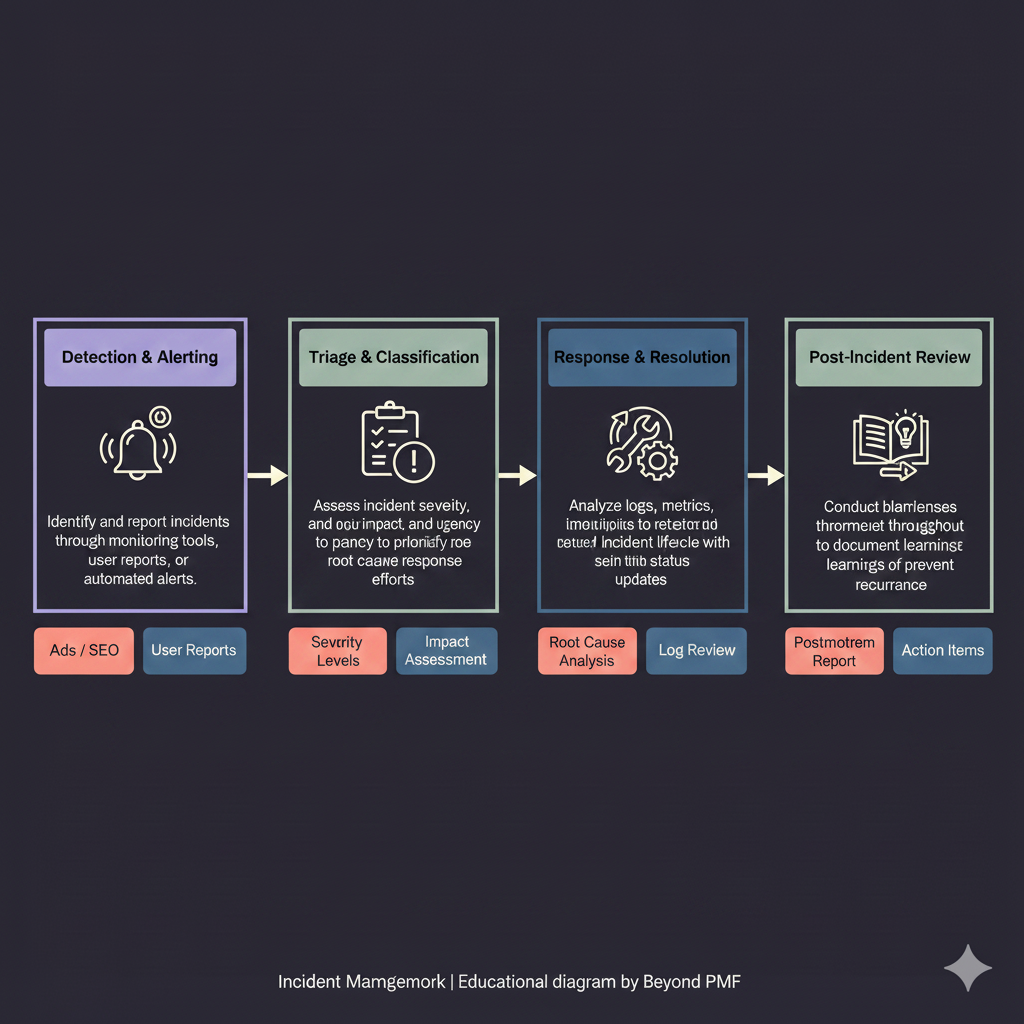
Incident Management Framework

https://ik.imagekit.io/beyondpmf/frameworks/incident-management-framework.png
The Incident Management Framework focuses on efficiently restoring normal operations after disruptions. It addresses operational friction related to processes, workflows, and coordination needed to manage and resolve unexpected events.

The Incident Management Framework is designed to handle and resolve incidents quickly and effectively, minimizing impact on business operations. It outlines a structured process for identifying, analyzing, and responding to incidents, ensuring that they are resolved in a timely manner. The framework is crucial for maintaining continuity and reliability in business operations, enhancing organizational resilience and compliance with regulatory requirements.

Steps / Detailed Description

Identification: Detect and report the incident as soon as it occurs. | Logging: Record all details of the incident for accountability and future reference. | Categorization: Classify the incident based on severity and impact. | Prioritization: Assign urgency to the incident to determine response time. | Response: Allocate resources and coordinate actions to manage the incident. | Resolution: Resolve the incident and restore service to normal levels. | Closure: Close the incident after confirming resolution and gather feedback. | Review: Analyze the incident for lessons learned and process improvement.

Best Practices

Implement a clear communication plan for incident reporting and updates. | Regularly train staff on their roles within the incident management process. | Utilize technology for incident tracking and management to ensure accuracy and efficiency.

Pros

Reduces downtime and minimizes impact on business operations | Improves response times and service quality | Enhances organizational learning and continuous improvement

Cons

Can be resource-intensive to implement and maintain | Requires continuous training and updates | May lead to process rigidity if not managed flexibly

When to Use

In cases of IT service disruptions | During physical security breaches

When Not to Use

When incidents are minor and can be resolved informally | When a specialized response team is more appropriate

Related Frameworks

Categories

Scope

Scope not defined

Maturity Level

Maturity level not specified

Time to Implement

2–4 Weeks
3–6 Months
1–2 Weeks
3–6 Months
1–2 Months
3–6 Months
1–2 Weeks
Less Than 1 Day
1–2 Weeks
Longer Than 6 Months
1–2 Weeks
Longer Than 6 Months
1–2 Weeks
3–6 Months
1–2 Weeks
1–2 Weeks
1–2 Weeks
1–2 Weeks
1–2 Days
1–2 Weeks
1–2 Weeks
1–2 Weeks
1–2 Weeks
1–2 Weeks
1–2 Weeks
3–6 Months
1–2 Weeks
1–2 Weeks
1–2 Weeks
3–6 Months
1–2 Weeks
1–2 Weeks
2–4 Weeks
1–2 Weeks
1–2 Days
1–2 Weeks
Longer Than 6 Months
3–6 Months
Longer Than 6 Months
1–2 Weeks
Longer Than 6 Months
3–6 Months
Less Than 1 Day
3–6 Months
1–2 Months
3–6 Months
Longer Than 6 Months
3–6 Months
Less Than 1 Day
1–2 Weeks
3–6 Months
3–6 Months
1–2 Weeks
3–6 Months
1–2 Weeks
1–2 Weeks
1–2 Days
1–2 Weeks
1–2 Months
Longer Than 6 Months
1–2 Weeks
Longer Than 6 Months
1–2 Weeks
3–6 Months
1–2 Weeks
Less Than 1 Day
1–2 Weeks
3–6 Months
1–2 Weeks
3–6 Months
1–2 Weeks
1–2 Weeks
Longer Than 6 Months
Less Than 1 Day
3–6 Months
Longer Than 6 Months
1–2 Months
1–2 Weeks
Longer Than 6 Months
1–2 Weeks
3–6 Months
1–2 Weeks
1–2 Weeks
3–6 Months
Less Than 1 Day
1–2 Weeks
1–2 Weeks
3–6 Months
3–6 Months
Less Than 1 Day
1–2 Weeks
Longer Than 6 Months
1–2 Months
1–2 Weeks
1–2 Weeks
1–2 Weeks
Longer Than 6 Months

Copyright Information

Autor:
Public Domain
N/A
Publication:
Generic Business Tool