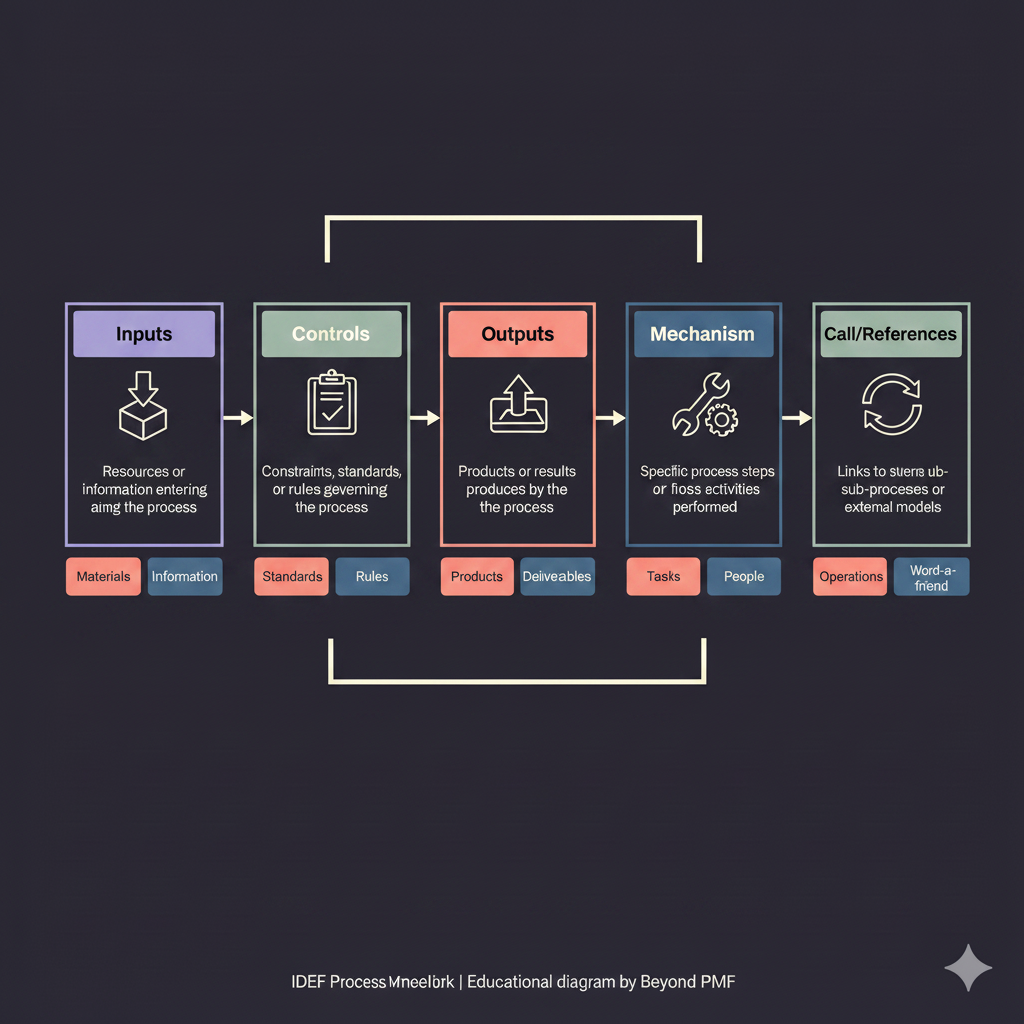
IDEF Process Modeling, or Integration Definition for Process Modeling, is a framework designed to model the decisions, actions, and activities of an organization or system. It is primarily used to establish a common understanding of processes within complex systems and to facilitate systems integration. This framework is beneficial for documenting large-scale processes and promoting organizational efficiency and effectiveness through improved process visualization and communication.
Define the scope and boundaries of the process to be modeled. | Gather relevant information from process stakeholders and subject matter experts. | Create diagrams to represent the process flow, using IDEF0 or IDEF3 methods. | Review and refine the model with stakeholders to ensure accuracy and completeness. | Implement the model for process management or improvement initiatives.
Start with a clear definition of the scope to avoid scope creep. | Engage stakeholders early and often to gather comprehensive input. | Regularly update the models to reflect changes in the processes.
Provides a clear and standardized representation of processes. | Facilitates communication and understanding across different parts of an organization. | Supports the analysis and improvement of business processes.
Can be time-consuming to gather detailed process information. | Requires training or knowledge of the IDEF methodology. | May become overly complex for very large or dynamic systems.
When documenting complex systems for clarity and standardization. | When designing or reengineering business processes.
For small, simple processes where the overhead of modeling is not justified. | In rapidly changing environments where processes are not stabilized.