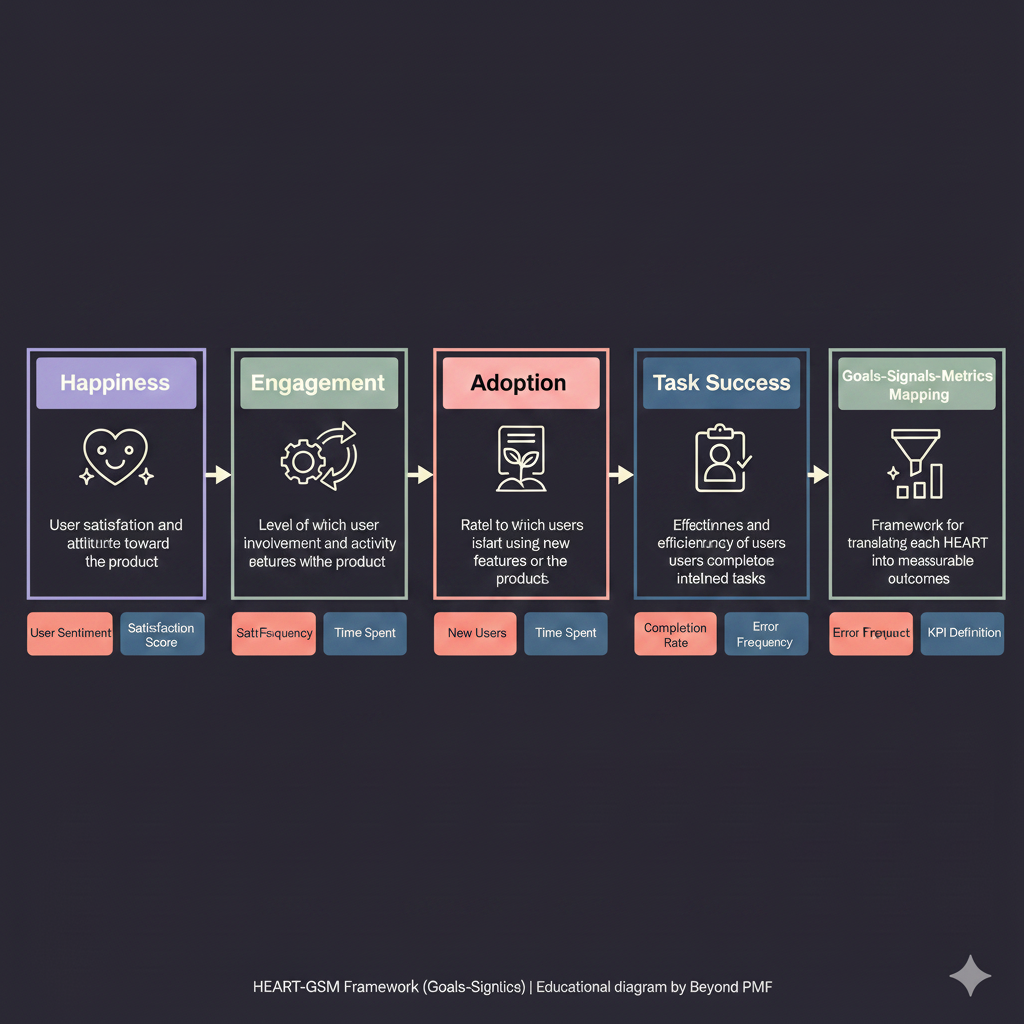
HEART-GSM Framework (Goals-Signals-Metrics)

https://ik.imagekit.io/beyondpmf/frameworks/heart-gsm-framework-goals-signals-metrics.png
The HEART-GSM framework directly addresses issues related to customer experience (UX) and the quality of product design, focusing on measuring and improving user interaction and satisfaction. This places it firmly within the realm of execution-related friction.

The HEART-GSM Framework, standing for Goals-Signals-Metrics, is a structured approach used to assess and enhance user experience in digital products. It helps teams identify specific goals (Happiness, Engagement, Adoption, Retention, Task Success), detect signals indicating user behavior related to these goals, and define metrics to quantitatively measure these signals. This framework is beneficial for its focus on user-centric metrics, making it a powerful tool for improving product design and user satisfaction.

Steps / Detailed Description

Define user experience goals (Happiness, Engagement, Adoption, Retention, Task Success). | Identify signals that indicate user behavior related to each goal. | Establish metrics to quantitatively measure these signals.

Best Practices

Regularly review and adjust goals and metrics based on user feedback | Ensure cross-functional team collaboration | Use qualitative data to complement quantitative metrics

Pros

Improves focus on user satisfaction and experience | Facilitates data-driven decision making | Enhances ability to track and measure product performance

Cons

Requires clear understanding of user behaviors | Can be time-consuming to identify appropriate signals and metrics | May require extensive data collection and analysis

When to Use

When developing or refining a digital product | When seeking to improve user engagement and satisfaction

When Not to Use

In projects with limited access to user data | When quick, superficial product assessments are needed

Related Frameworks

Lifecycle

Not tied to a specific lifecycle stage

Scope

Scope not defined

Maturity Level

Maturity level not specified

Time to Implement

2–4 Weeks
3–6 Months
1–2 Weeks
3–6 Months
1–2 Months
3–6 Months
1–2 Weeks
Less Than 1 Day
1–2 Weeks
Longer Than 6 Months
1–2 Weeks
Longer Than 6 Months
1–2 Weeks
3–6 Months
1–2 Weeks
1–2 Weeks
1–2 Weeks
1–2 Weeks
1–2 Days
1–2 Weeks
1–2 Weeks
1–2 Weeks
1–2 Weeks
1–2 Weeks
1–2 Weeks
3–6 Months
1–2 Weeks
1–2 Weeks
1–2 Weeks
3–6 Months
1–2 Weeks
1–2 Weeks
2–4 Weeks
1–2 Weeks
1–2 Days
1–2 Weeks
Longer Than 6 Months
3–6 Months
Longer Than 6 Months
1–2 Weeks
Longer Than 6 Months
3–6 Months
Less Than 1 Day
3–6 Months
1–2 Months
3–6 Months
Longer Than 6 Months
3–6 Months
Less Than 1 Day
1–2 Weeks
3–6 Months
3–6 Months
1–2 Weeks
3–6 Months
1–2 Weeks
1–2 Weeks
1–2 Days
1–2 Weeks
1–2 Months
Longer Than 6 Months
1–2 Weeks
Longer Than 6 Months
1–2 Weeks
3–6 Months
1–2 Weeks
Less Than 1 Day
1–2 Weeks
3–6 Months
1–2 Weeks
3–6 Months
1–2 Weeks
1–2 Weeks
Longer Than 6 Months
Less Than 1 Day
3–6 Months
Longer Than 6 Months
1–2 Months
1–2 Weeks
Longer Than 6 Months
1–2 Weeks
3–6 Months
1–2 Weeks
1–2 Weeks
3–6 Months
Less Than 1 Day
1–2 Weeks
1–2 Weeks
3–6 Months
3–6 Months
Less Than 1 Day
1–2 Weeks
Longer Than 6 Months
1–2 Months
1–2 Weeks
1–2 Weeks
1–2 Weeks
Longer Than 6 Months

Copyright Information

Autor:
Unknown
N/A
Publication:
Unknown