HEART Framework

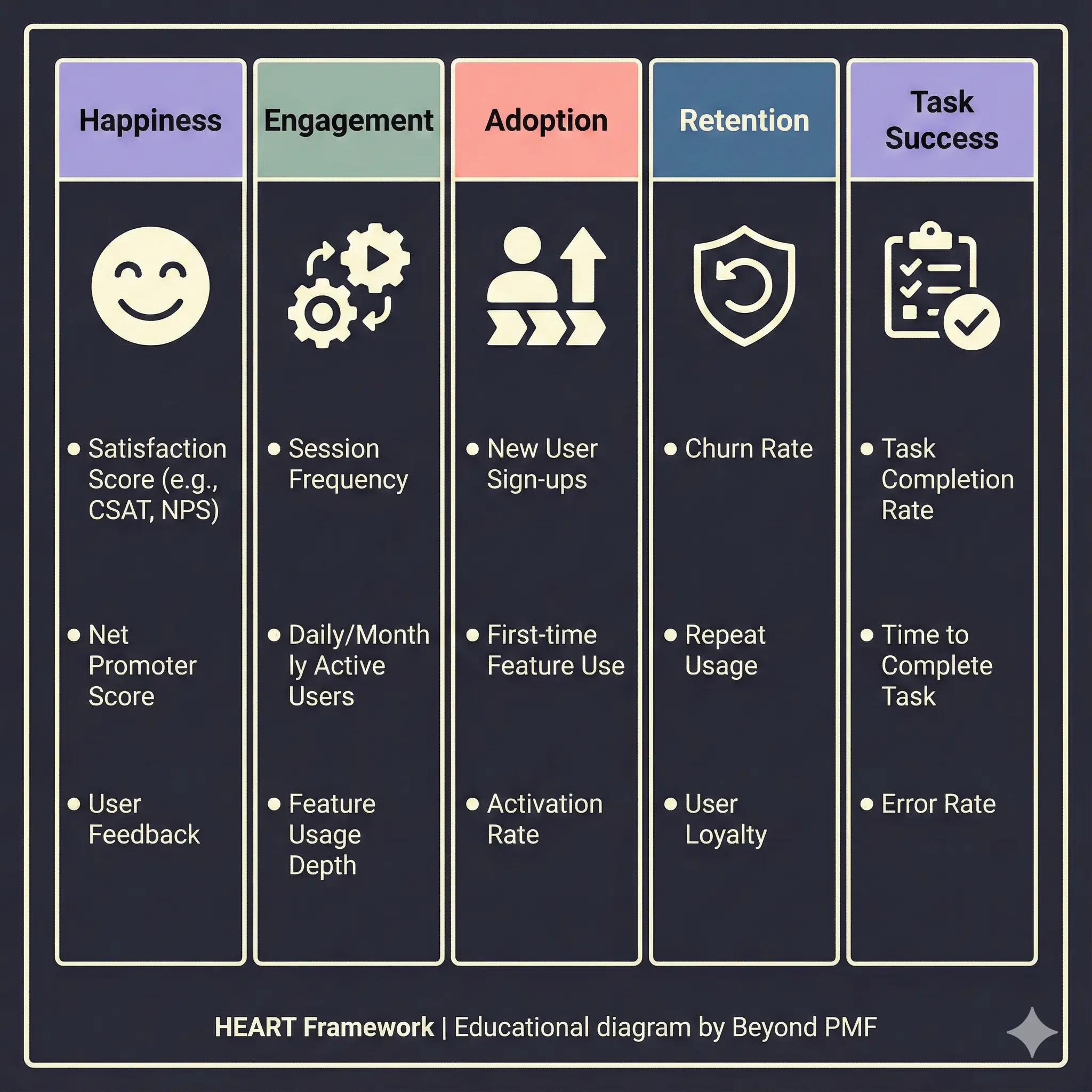
Diagram of the HEART Framework showing five UX metrics categories: Happiness, Engagement, Adoption, Retention, and Task Success. Each column lists example measures such as satisfaction score, active users, feature adoption, churn rate, loyalty, task completion rate, and error rate, with icons representing each category.
The HEART framework directly addresses customer experience by providing a structured method for measuring the quality of user experience. This helps identify and improve areas of the product or service that cause friction for the end-user during interaction.

The HEART Framework, developed by Google, helps organizations measure and optimize user experience across five key dimensions: Happiness, Engagement, Adoption, Retention, and Task Success. It is used to align user experience outcomes with business goals, providing a clear and structured approach to understanding user interactions. The framework is beneficial for its ability to focus on user satisfaction and performance, making it ideal for improving product interfaces and services.

Steps / Detailed Description

Define Goals: Identify specific goals for each of the HEART dimensions. | Signal Identification: Determine which user actions serve as signals indicating success for each goal. | Metrics Selection: Choose metrics that effectively measure these signals. | Data Collection: Implement tools and processes to collect data on the identified metrics. | Analysis and Reporting: Analyze the collected data to assess performance against goals and report findings.

Best Practices

Clearly define measurable goals for each dimension | Regularly review and update metrics as needed | Ensure comprehensive data collection for accuracy

Pros

Focuses on key user experience aspects | Aligns UX outcomes with business objectives | Facilitates targeted improvements

Cons

Requires access to detailed user data | Can be complex to implement and interpret | May not cover all aspects of user experience

When to Use

When refining user interface design | When assessing new feature adoption

When Not to Use

In early-stage product development | When insufficient user data is available

Related Frameworks

Categories

Lifecycle

Not tied to a specific lifecycle stage

Scope

Scope not defined

Maturity Level

Maturity level not specified

Time to Implement

2–4 Weeks
3–6 Months
1–2 Weeks
3–6 Months
1–2 Months
3–6 Months
1–2 Weeks
Less Than 1 Day
1–2 Weeks
Longer Than 6 Months
1–2 Weeks
Longer Than 6 Months
1–2 Weeks
3–6 Months
1–2 Weeks
1–2 Weeks
1–2 Weeks
1–2 Weeks
1–2 Days
1–2 Weeks
1–2 Weeks
1–2 Weeks
1–2 Weeks
1–2 Weeks
1–2 Weeks
3–6 Months
1–2 Weeks
1–2 Weeks
1–2 Weeks
3–6 Months
1–2 Weeks
1–2 Weeks
2–4 Weeks
1–2 Weeks
1–2 Days
1–2 Weeks
Longer Than 6 Months
3–6 Months
Longer Than 6 Months
1–2 Weeks
Longer Than 6 Months
3–6 Months
Less Than 1 Day
3–6 Months
1–2 Months
3–6 Months
Longer Than 6 Months
3–6 Months
Less Than 1 Day
1–2 Weeks
3–6 Months
3–6 Months
1–2 Weeks
3–6 Months
1–2 Weeks
1–2 Weeks
1–2 Days
1–2 Weeks
1–2 Months
Longer Than 6 Months
1–2 Weeks
Longer Than 6 Months
1–2 Weeks
3–6 Months
1–2 Weeks
Less Than 1 Day
1–2 Weeks
3–6 Months
1–2 Weeks
3–6 Months
1–2 Weeks
1–2 Weeks
Longer Than 6 Months
Less Than 1 Day
3–6 Months
Longer Than 6 Months
1–2 Months
1–2 Weeks
Longer Than 6 Months
1–2 Weeks
3–6 Months
1–2 Weeks
1–2 Weeks
3–6 Months
Less Than 1 Day
1–2 Weeks
1–2 Weeks
3–6 Months
3–6 Months
Less Than 1 Day
1–2 Weeks
Longer Than 6 Months
1–2 Months
1–2 Weeks
1–2 Weeks
1–2 Weeks
Longer Than 6 Months

Copyright Information

Autor:
Kerry Rodden, Hilary Hutchinson, Xin Fu
2010
Publication:
Google