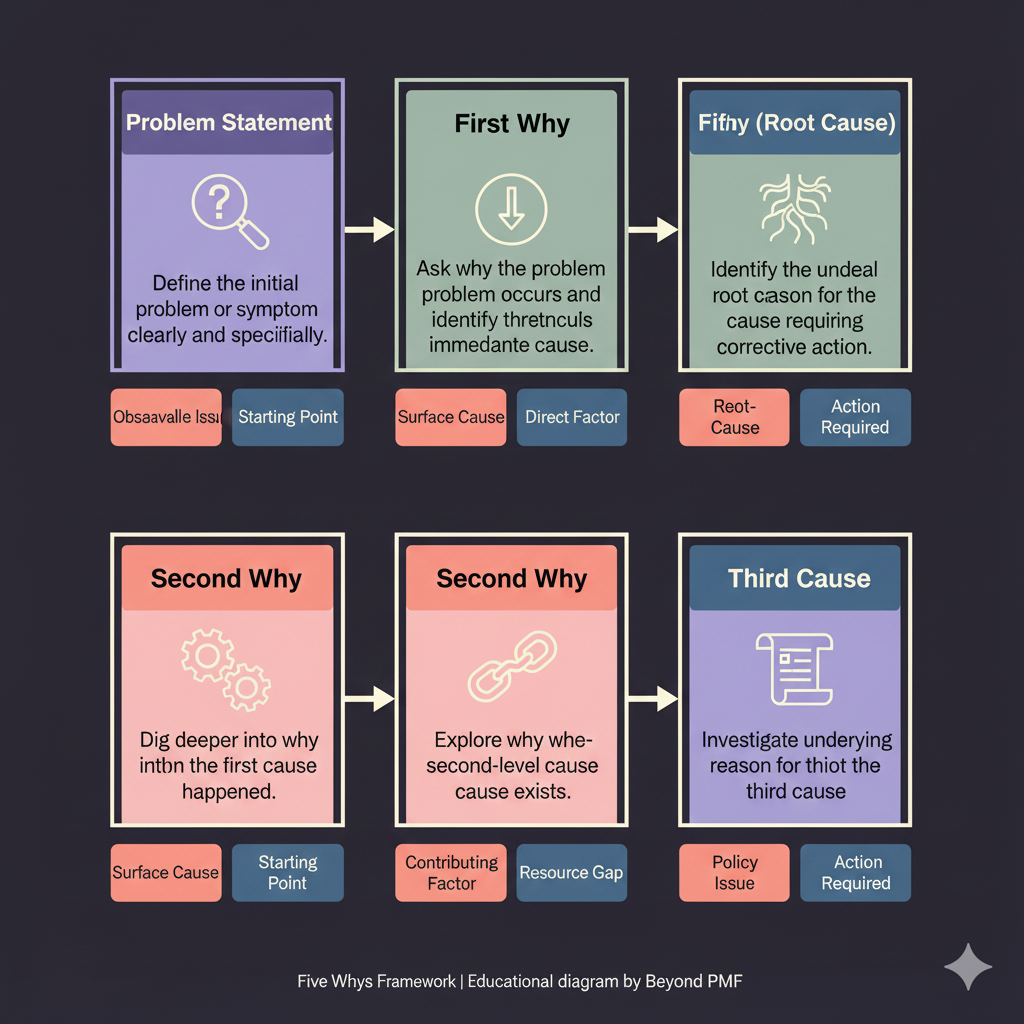
The Five Whys framework is a simple but powerful tool used primarily for root cause analysis. It involves asking the question 'Why?' successively five times or more until the fundamental cause of a problem is identified. This iterative interrogative technique helps peel away the layers of symptoms to reach the core of an issue. It is widely used because it is easy to understand and implement, and it helps teams quickly get to the root of a problem.
Identify the problem and clearly define it. | Ask 'Why?' to determine the first layer of cause. | Based on the answer, ask 'Why?' again to delve deeper into the preceding cause. | Repeat the process until the root cause is identified, typically by the fifth 'Why?' | Once the root cause is identified, develop countermeasures to prevent recurrence.
Clearly define the problem before starting the Five Whys process. | Ensure a diverse group participates to provide multiple perspectives. | Document each step of the process for future reference and accountability.
Simple and easy to use | Promotes deeper understanding of problems | Helps identify the root cause of an issue quickly
Can lead to oversimplification of complex issues | Relies heavily on the knowledge and perspective of participants | May not be effective if initial problem statement is inaccurately defined
Troubleshooting and resolving simple or moderately complex problems | Continuous improvement activities
Highly complex or technical issues requiring expert analysis | Situations where the root cause is already known