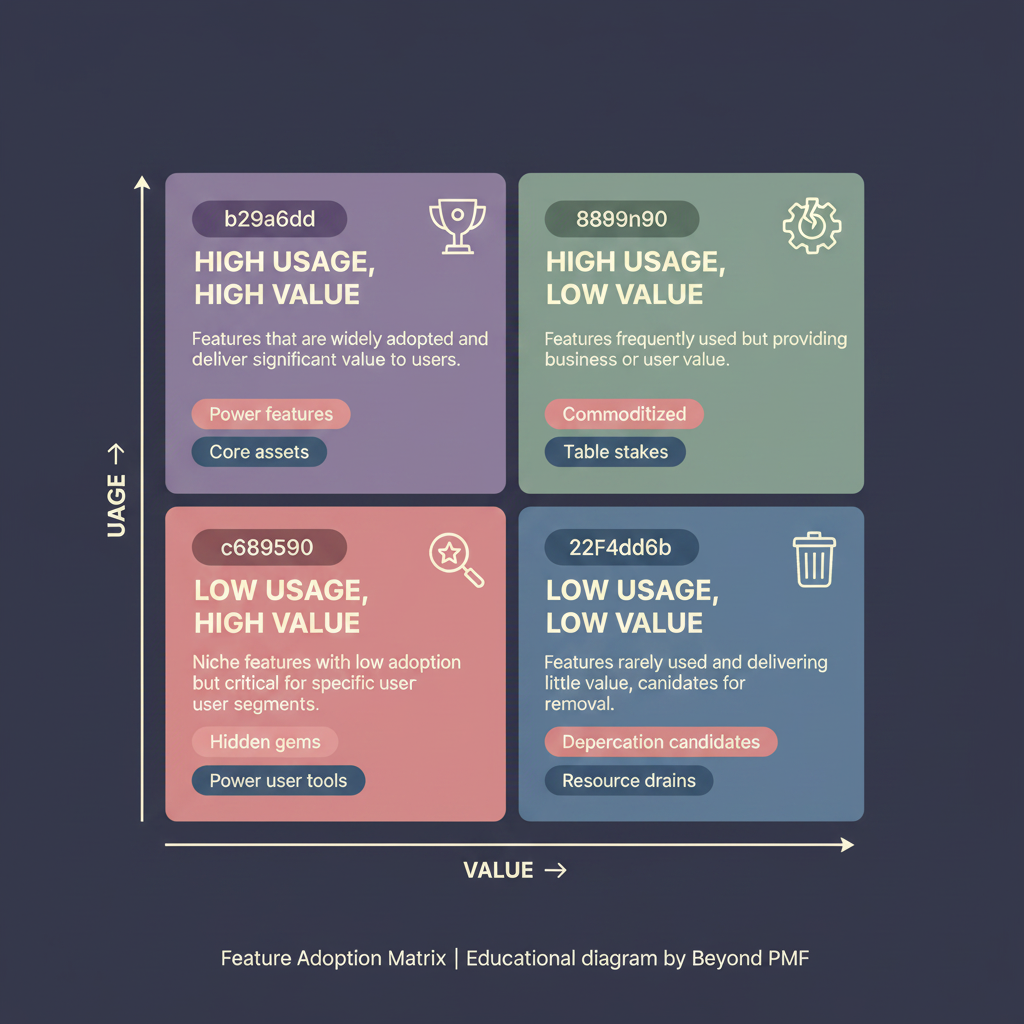
The Feature Adoption Matrix is a strategic framework that helps organizations evaluate which new features should be implemented to maximize user engagement and business value. It categorizes features based on their adoption rates and perceived value, allowing decision-makers to prioritize development and marketing efforts effectively. This framework is particularly useful in product development and project management to ensure that resources are allocated to features that will drive the most impact.
Identify all potential new features to be evaluated. | Measure or estimate the current adoption rate for each feature. | Assess the potential value each feature brings to users and the business. | Plot the features on a matrix with axes representing adoption rate and value. | Prioritize features based on their position in the matrix, focusing on high-value, high-adoption features first. | Develop strategies for increasing adoption of high-value, low-adoption features.
Regularly update the matrix with new data to reflect changes in user behavior and market conditions. | Combine qualitative insights with quantitative data for a balanced evaluation of features. | Use the matrix as a discussion tool in cross-functional teams to ensure diverse perspectives are considered.
Helps prioritize features that offer the highest value and adoption potential. | Facilitates strategic allocation of resources in development and marketing. | Enhances decision-making by visualizing feature impact and user engagement.
Estimating potential value and adoption can be subjective and prone to biases. | May overlook the potential long-term benefits of features with initially low adoption. | Requires accurate and comprehensive data collection, which can be resource-intensive.
When launching a new product or feature set. | During periodic product reviews to reassess feature sets.
For products in early development stages with insufficient user data. | When rapid decision-making is required without the time for detailed analysis.