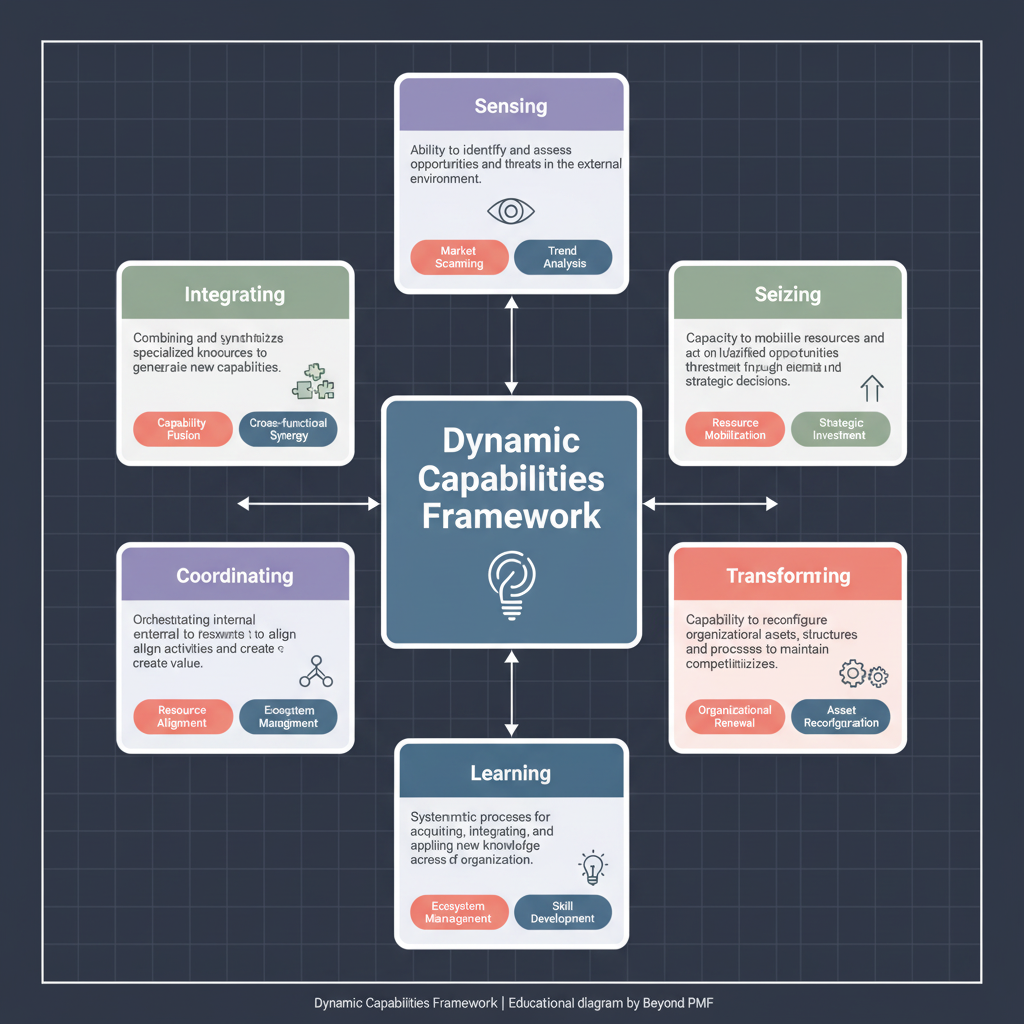
Dynamic Capabilities Framework

https://ik.imagekit.io/beyondpmf/frameworks/dynamic-capabilities-framework.png
The Dynamic Capabilities Framework primarily addresses strategic friction by focusing on a business's capacity to adapt to rapid environmental changes. It helps companies develop the strategic agility needed to redefine their business model and market alignment amidst evolving competitive landscapes.

The Dynamic Capabilities Framework is a strategic management approach that emphasizes the role of managerial and organizational processes in leveraging a firm's capabilities to match and even create market change. It is used to understand how companies can sustain competitive advantage in markets characterized by rapid technological change and intense competition. The framework helps firms to innovate, adapt, and capture new opportunities, thereby achieving and sustaining competitive advantage.

Steps / Detailed Description

Identify and assess the firm's current resource base and capabilities. | Determine the external market opportunities and threats. | Develop and adapt capabilities to match market changes. | Integrate new functional competencies into the organization. | Reconfigure existing assets and resources to better align with strategic goals.

Best Practices

Continuously evaluate and respond to market trends | Invest in technology and human resources to support capability development | Encourage a culture of innovation and flexibility

Pros

Enhances adaptability to changing environments | Supports sustainable competitive advantage | Facilitates strategic alignment with market conditions

Cons

Can be complex to implement | Requires continuous investment in capability development | Dependent on high-quality and timely information

When to Use

In industries experiencing rapid technological changes | When entering new markets or launching new products

When Not to Use

In stable, unchanging market conditions | When the organization lacks resources to invest in capability development

Related Frameworks

Categories

Lifecycle

Not tied to a specific lifecycle stage

Scope

Scope not defined

Maturity Level

Maturity level not specified

Time to Implement

2–4 Weeks
3–6 Months
1–2 Weeks
3–6 Months
1–2 Months
3–6 Months
1–2 Weeks
Less Than 1 Day
1–2 Weeks
Longer Than 6 Months
1–2 Weeks
Longer Than 6 Months
1–2 Weeks
3–6 Months
1–2 Weeks
1–2 Weeks
1–2 Weeks
1–2 Weeks
1–2 Days
1–2 Weeks
1–2 Weeks
1–2 Weeks
1–2 Weeks
1–2 Weeks
1–2 Weeks
3–6 Months
1–2 Weeks
1–2 Weeks
1–2 Weeks
3–6 Months
1–2 Weeks
1–2 Weeks
2–4 Weeks
1–2 Weeks
1–2 Days
1–2 Weeks
Longer Than 6 Months
3–6 Months
Longer Than 6 Months
1–2 Weeks
Longer Than 6 Months
3–6 Months
Less Than 1 Day
3–6 Months
1–2 Months
3–6 Months
Longer Than 6 Months
3–6 Months
Less Than 1 Day
1–2 Weeks
3–6 Months
3–6 Months
1–2 Weeks
3–6 Months
1–2 Weeks
1–2 Weeks
1–2 Days
1–2 Weeks
1–2 Months
Longer Than 6 Months
1–2 Weeks
Longer Than 6 Months
1–2 Weeks
3–6 Months
1–2 Weeks
Less Than 1 Day
1–2 Weeks
3–6 Months
1–2 Weeks
3–6 Months
1–2 Weeks
1–2 Weeks
Longer Than 6 Months
Less Than 1 Day
3–6 Months
Longer Than 6 Months
1–2 Months
1–2 Weeks
Longer Than 6 Months
1–2 Weeks
3–6 Months
1–2 Weeks
1–2 Weeks
3–6 Months
Less Than 1 Day
1–2 Weeks
1–2 Weeks
3–6 Months
3–6 Months
Less Than 1 Day
1–2 Weeks
Longer Than 6 Months
1–2 Months
1–2 Weeks
1–2 Weeks
1–2 Weeks
Longer Than 6 Months

Copyright Information

Autor:
David Teece, Gary Pisano, Amy Shuen
1997
Publication:
Strategic Management Journal