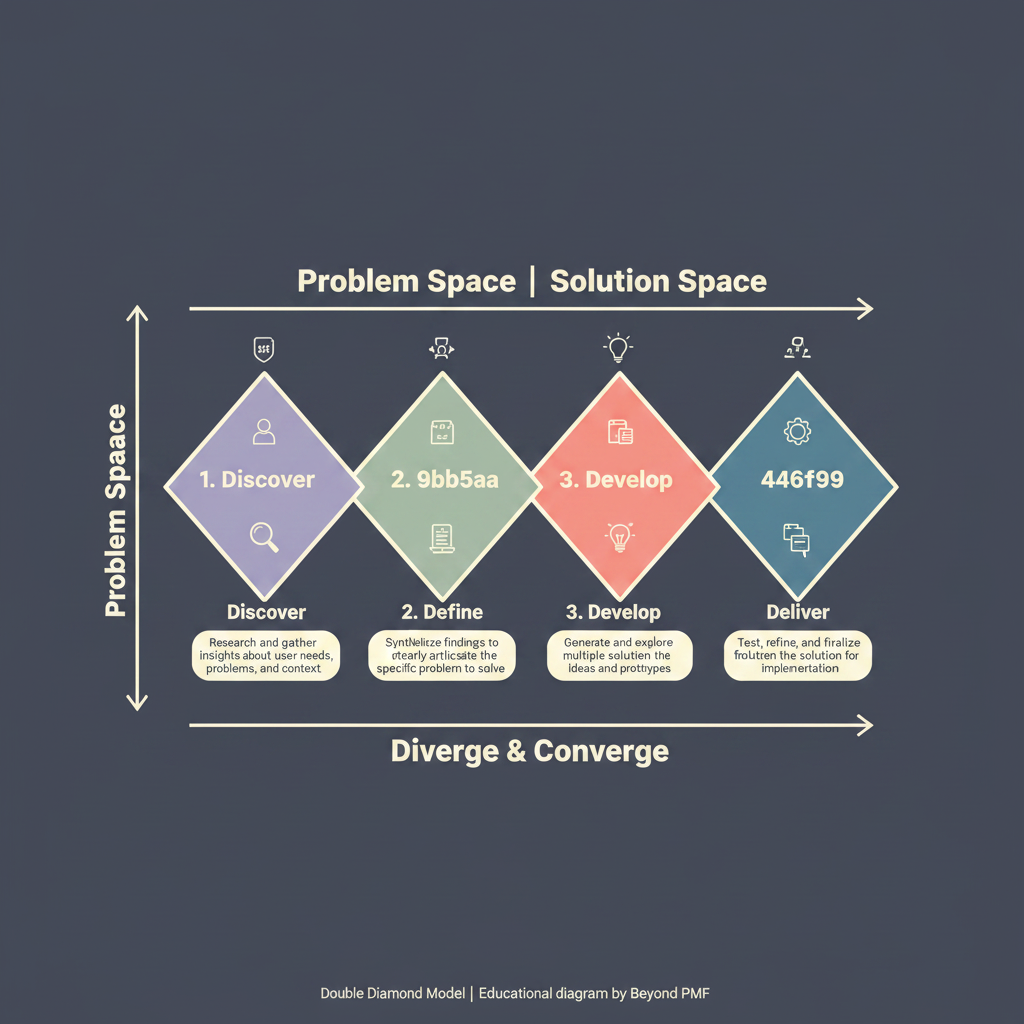
Double Diamond Model

https://ik.imagekit.io/beyondpmf/frameworks/double-diamond-model.png
The Double Diamond Model primarily addresses friction in the execution phase by providing a structured process for design and innovation. It helps to improve the quality of solutions and customer experience through structured exploration and refinement, guiding the delivery of products or services.

The Double Diamond Model is a design process framework that guides teams through four main phases of product or service development: Discover, Define, Develop, and Deliver. This model helps teams explore a wide range of possibilities (divergent thinking) and then refine and narrow down these possibilities to the best solution (convergent thinking). It is used to manage design processes effectively, ensuring that the end product is both innovative and user-centered. The framework is beneficial for fostering creativity, ensuring thorough exploration of ideas, and aligning the team towards a common goal.

Steps / Detailed Description

Discover: Identify the problem and gather insights through research to understand user needs and market conditions. | Define: Synthesize the gathered information to define the main challenges and the project scope. | Develop: Generate a range of ideas and prototypes that address the defined challenges. | Deliver: Finalize and launch the solution that best meets the needs identified in the Discover phase.

Best Practices

Engage a diverse team for varied perspectives | Iterate based on feedback at each phase | Maintain flexibility to adapt the process as needed

Pros

Promotes thorough understanding of the problem space | Encourages creativity and innovation | Aligns team efforts through a structured process

Cons

Can be time-consuming | May require substantial resources | Risk of overemphasis on process over product

When to Use

When developing new products or services | When redesigning or improving existing products

When Not to Use

For quick, tactical decisions | When the problem is already well-defined and straightforward

Related Frameworks

Categories

Lifecycle

Scope

Scope not defined

Maturity Level

Maturity level not specified

Time to Implement

2–4 Weeks
3–6 Months
1–2 Weeks
3–6 Months
1–2 Months
3–6 Months
1–2 Weeks
Less Than 1 Day
1–2 Weeks
Longer Than 6 Months
1–2 Weeks
Longer Than 6 Months
1–2 Weeks
3–6 Months
1–2 Weeks
1–2 Weeks
1–2 Weeks
1–2 Weeks
1–2 Days
1–2 Weeks
1–2 Weeks
1–2 Weeks
1–2 Weeks
1–2 Weeks
1–2 Weeks
3–6 Months
1–2 Weeks
1–2 Weeks
1–2 Weeks
3–6 Months
1–2 Weeks
1–2 Weeks
2–4 Weeks
1–2 Weeks
1–2 Days
1–2 Weeks
Longer Than 6 Months
3–6 Months
Longer Than 6 Months
1–2 Weeks
Longer Than 6 Months
3–6 Months
Less Than 1 Day
3–6 Months
1–2 Months
3–6 Months
Longer Than 6 Months
3–6 Months
Less Than 1 Day
1–2 Weeks
3–6 Months
3–6 Months
1–2 Weeks
3–6 Months
1–2 Weeks
1–2 Weeks
1–2 Days
1–2 Weeks
1–2 Months
Longer Than 6 Months
1–2 Weeks
Longer Than 6 Months
1–2 Weeks
3–6 Months
1–2 Weeks
Less Than 1 Day
1–2 Weeks
3–6 Months
1–2 Weeks
3–6 Months
1–2 Weeks
1–2 Weeks
Longer Than 6 Months
Less Than 1 Day
3–6 Months
Longer Than 6 Months
1–2 Months
1–2 Weeks
Longer Than 6 Months
1–2 Weeks
3–6 Months
1–2 Weeks
1–2 Weeks
3–6 Months
Less Than 1 Day
1–2 Weeks
1–2 Weeks
3–6 Months
3–6 Months
Less Than 1 Day
1–2 Weeks
Longer Than 6 Months
1–2 Months
1–2 Weeks
1–2 Weeks
1–2 Weeks
Longer Than 6 Months

Copyright Information

Autor:
Design Council
2005
Publication:
Design Council