
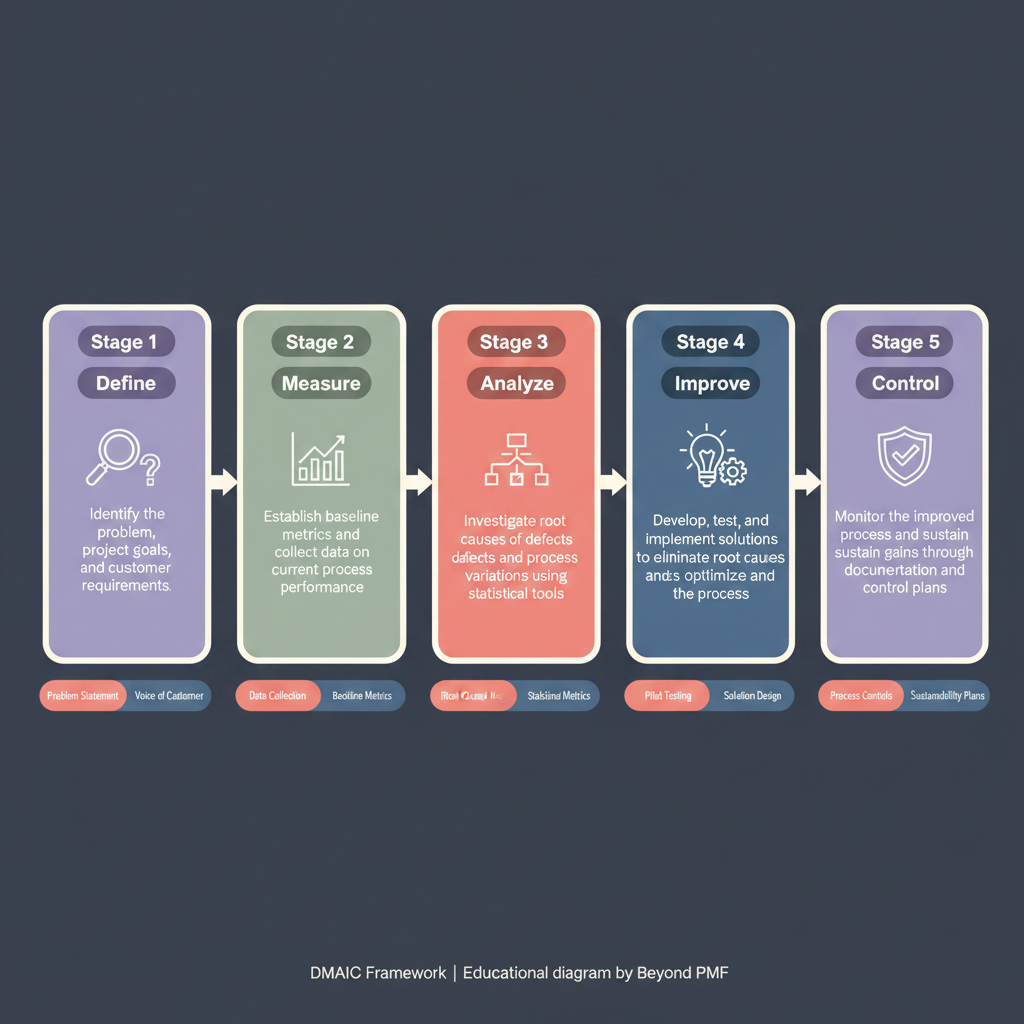
DMAIC stands for Define, Measure, Analyze, Improve, and Control. This framework is used primarily to improve, optimize, and stabilize business processes and designs. The DMAIC framework is effective in identifying root causes of inefficiencies, enabling businesses to develop solutions to mitigate these issues. By using a structured approach, it ensures that the improvements are statistically significant and that they can be sustained over time. This methodology is widely appreciated for its systematic approach to problem-solving and continuous improvement.
Define: Identify the project goals and customer (internal and external) requirements. | Measure: Collect data to establish baselines, identify potential capability gaps. | Analyze: Analyze the data to investigate and verify cause-and-effect relationships. Determine what the relationships are, and attempt to ensure that all factors have been considered. | Improve: Develop and deploy solutions aimed at eliminating defects and reducing variability in the process. | Control: Implement controls to sustain the gains achieved through the improve phase. Monitor the process to ensure that high performance levels are maintained.
Ensure clear definition of project scope and goals in the Define phase to guide the entire process. | Utilize robust statistical tools in the Measure and Analyze phases to ensure data accuracy and relevance. | Maintain ongoing training and engagement for team members to foster continuous improvement culture.
Provides a structured problem-solving methodology that can lead to significant cost savings and quality improvements. | Enhances understanding of processes by using data-driven analysis which helps in making informed decisions. | Facilitates sustainable improvements by implementing control mechanisms to monitor ongoing process performance.
Can be time-consuming and resource-intensive, particularly in the measure and analyze phases. | Requires a high level of statistical and analytical skills, which may necessitate training or hiring specialized personnel. | May focus too heavily on existing processes and incremental improvements, potentially overlooking radical innovation or transformation opportunities.
When looking to improve the efficiency and quality of a well-defined business process. | When there is a need to solve complex issues that require detailed data analysis.
When the project scope or problem is not clearly defined or is too broad. | When immediate or radical changes are required, bypassing detailed analysis and gradual improvement.