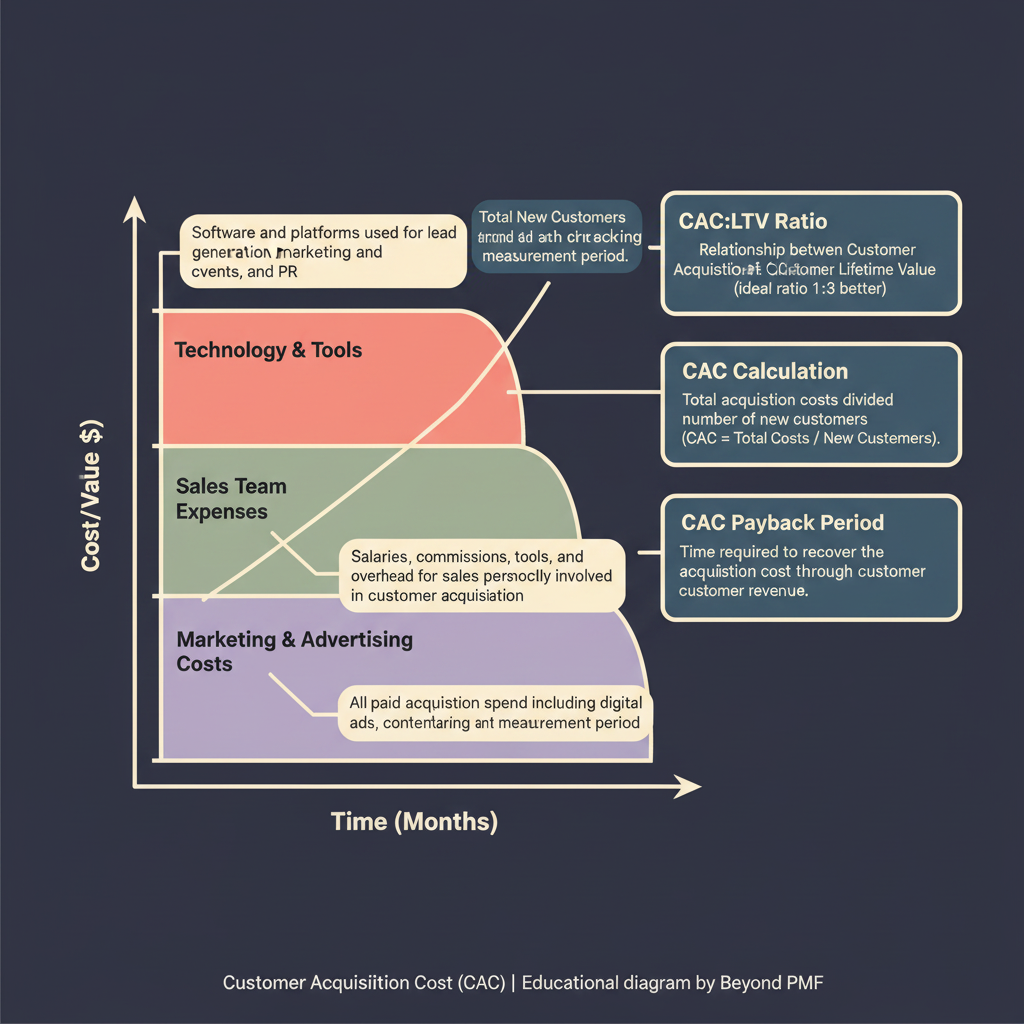
The Customer Acquisition Cost (CAC) Framework is a financial metric used by businesses to evaluate the total cost of acquiring a new customer. This includes all marketing and sales expenses divided by the number of new customers acquired over a specific period. It is essential for determining the profitability of different marketing strategies, optimizing marketing spend, and ensuring sustainable business growth. Understanding CAC helps companies make informed decisions about how much they are willing to spend to gain a new customer.
Identify all costs associated with acquiring customers, including marketing, advertising, and sales team expenses. | Determine the time frame for the analysis (e.g., quarterly, annually). | Calculate the total number of new customers acquired during the specified period. | Divide the total acquisition costs by the number of new customers to find the CAC.
Regularly update cost inputs to reflect current spending. | Segment CAC by marketing channel to identify the most efficient strategies. | Incorporate customer lifetime value (CLV) for a more comprehensive analysis.
Provides insight into the effectiveness of marketing strategies. | Helps in budget allocation and financial forecasting. | Facilitates better resource allocation by identifying cost-efficient channels.
Can be misleading if not all relevant costs are included. | Does not account for the lifetime value of customers. | May encourage short-term thinking over long-term customer value.
When planning or evaluating marketing strategies. | During budget reviews to optimize marketing spend.
When immediate financial data is unavailable. | For assessing non-financial customer engagement metrics.