CRISP-DM

https://ik.imagekit.io/beyondpmf/frameworks/crisp-dm.png
CRISP-DM addresses the friction of poorly defined and executed data mining projects. It provides a structured process for handling complex workflows, handoffs between stages, and overall coordination of data mining activities. This helps to ensure consistent and effective project delivery.

CRISP-DM is a structured approach to planning and executing data mining projects. It provides a comprehensive framework that outlines the key phases of any data mining project, from understanding the business problem to deploying the solution. This methodology is favored for its flexibility, industry-agnostic design, and emphasis on understanding both business and data requirements, making it suitable for a wide range of industries and data-intensive applications.

Steps / Detailed Description

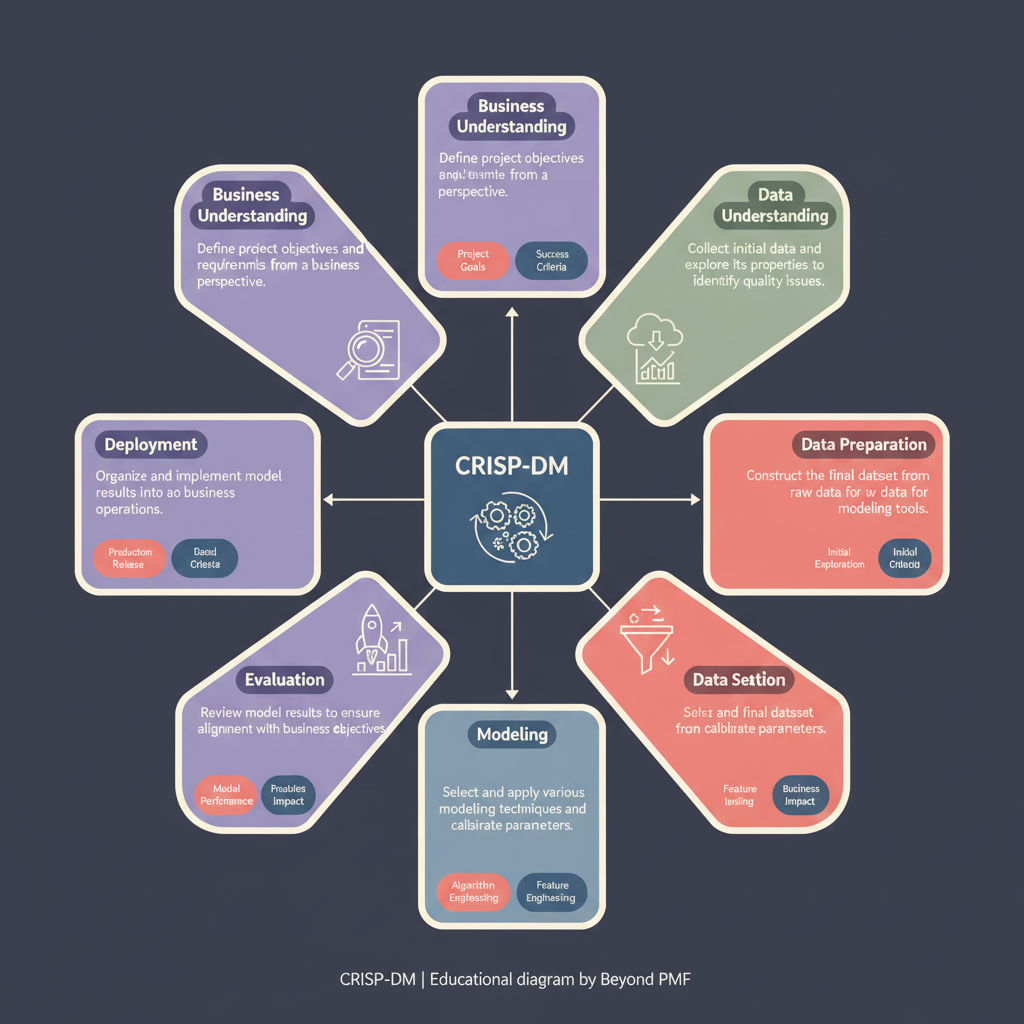
Business Understanding: Define the project objectives and requirements from a business perspective. | Data Understanding: Start collecting data and proceed with activities to get familiar with the data, to identify data quality issues, to discover first insights into the data, or to detect interesting subsets to form hypotheses for hidden information. | Data Preparation: Select, clean, construct, and format data to be suitable for analysis. | Modeling: Select and apply various modeling techniques and calibrate the parameters to optimal values. | Evaluation: Evaluate the model to ensure it meets the business objectives set in the first phase. | Deployment: Implement the model into the business process, which may involve scaling up, making the model operational, and monitoring its performance.

Best Practices

Ensure clear communication and understanding between business and data teams. | Iteratively refine models and strategies based on feedback and results. | Maintain thorough documentation throughout all phases.

Pros

Industry-agnostic applicability | Emphasizes thorough understanding of both business and data | Flexible and iterative, allowing for continuous improvement

Cons

Can be time-consuming due to its comprehensive nature | Requires significant domain knowledge | Lacks guidance on newer technologies like big data and real-time analytics

When to Use

When starting a new data mining project with clear business objectives | When dealing with complex data from various sources

When Not to Use

For projects requiring rapid, real-time analytics | When the project scope or data is too limited to justify the comprehensive approach

Related Frameworks

Categories

Lifecycle

Scope

Scope not defined

Maturity Level

Maturity level not specified

Time to Implement

2–4 Weeks
3–6 Months
1–2 Weeks
3–6 Months
1–2 Months
3–6 Months
1–2 Weeks
Less Than 1 Day
1–2 Weeks
Longer Than 6 Months
1–2 Weeks
Longer Than 6 Months
1–2 Weeks
3–6 Months
1–2 Weeks
1–2 Weeks
1–2 Weeks
1–2 Weeks
1–2 Days
1–2 Weeks
1–2 Weeks
1–2 Weeks
1–2 Weeks
1–2 Weeks
1–2 Weeks
3–6 Months
1–2 Weeks
1–2 Weeks
1–2 Weeks
3–6 Months
1–2 Weeks
1–2 Weeks
2–4 Weeks
1–2 Weeks
1–2 Days
1–2 Weeks
Longer Than 6 Months
3–6 Months
Longer Than 6 Months
1–2 Weeks
Longer Than 6 Months
3–6 Months
Less Than 1 Day
3–6 Months
1–2 Months
3–6 Months
Longer Than 6 Months
3–6 Months
Less Than 1 Day
1–2 Weeks
3–6 Months
3–6 Months
1–2 Weeks
3–6 Months
1–2 Weeks
1–2 Weeks
1–2 Days
1–2 Weeks
1–2 Months
Longer Than 6 Months
1–2 Weeks
Longer Than 6 Months
1–2 Weeks
3–6 Months
1–2 Weeks
Less Than 1 Day
1–2 Weeks
3–6 Months
1–2 Weeks
3–6 Months
1–2 Weeks
1–2 Weeks
Longer Than 6 Months
Less Than 1 Day
3–6 Months
Longer Than 6 Months
1–2 Months
1–2 Weeks
Longer Than 6 Months
1–2 Weeks
3–6 Months
1–2 Weeks
1–2 Weeks
3–6 Months
Less Than 1 Day
1–2 Weeks
1–2 Weeks
3–6 Months
3–6 Months
Less Than 1 Day
1–2 Weeks
Longer Than 6 Months
1–2 Months
1–2 Weeks
1–2 Weeks
1–2 Weeks
Longer Than 6 Months

Copyright Information

Autor:
Public Domain
N/A
Publication:
Generic Business Tool