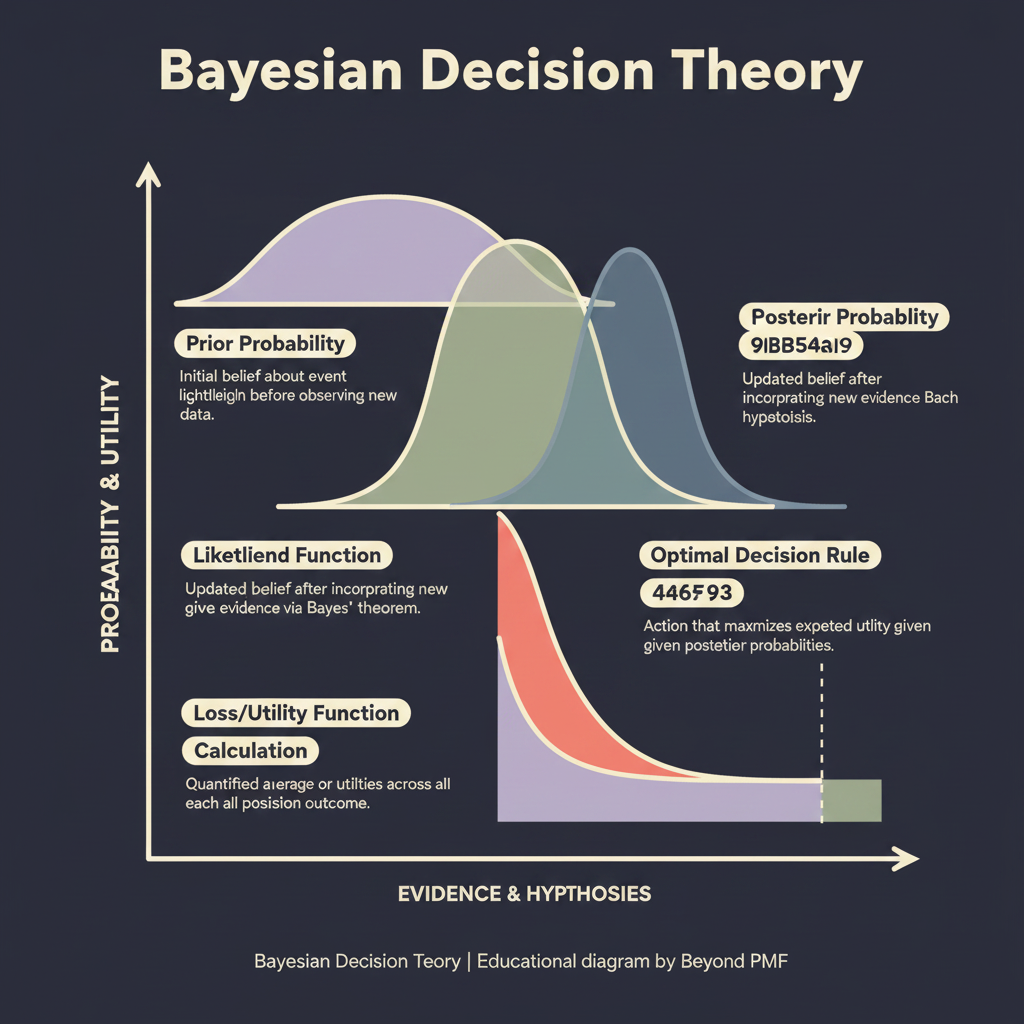
Bayesian Decision Theory is a framework that combines Bayesian inference and decision theory. It is used to make optimal decisions by updating beliefs based on new evidence and calculating the expected utility of different actions. This approach is particularly beneficial in complex decision-making environments where the probabilities of outcomes are uncertain and continuously updated as new data becomes available.
Define the decision problem and the possible actions. | Specify the prior probability distribution over the uncertain parameters. | Determine the likelihood of observing the data given each possible action. | Use Bayes' theorem to update the prior distribution with the observed data, resulting in a posterior distribution. | Calculate the expected utility for each action based on the posterior distribution. | Select the action with the highest expected utility.
Carefully choose and justify the prior distributions. | Regularly update the model as new data becomes available. | Validate the model assumptions and outcomes through sensitivity analysis.
Incorporates uncertainty and new evidence into decision making. | Provides a systematic approach to updating beliefs and making decisions. | Optimizes decisions based on expected outcomes.
Requires precise prior knowledge, which can be subjective. | Computationally intensive, especially with complex models. | Can be sensitive to the choice of prior distribution.
In situations where decisions must be made with incomplete information. | When historical data or expert knowledge is available to inform prior distributions.
When there is no reliable prior information available. | In simple decision-making scenarios where the cost of complex modeling outweighs the benefits.