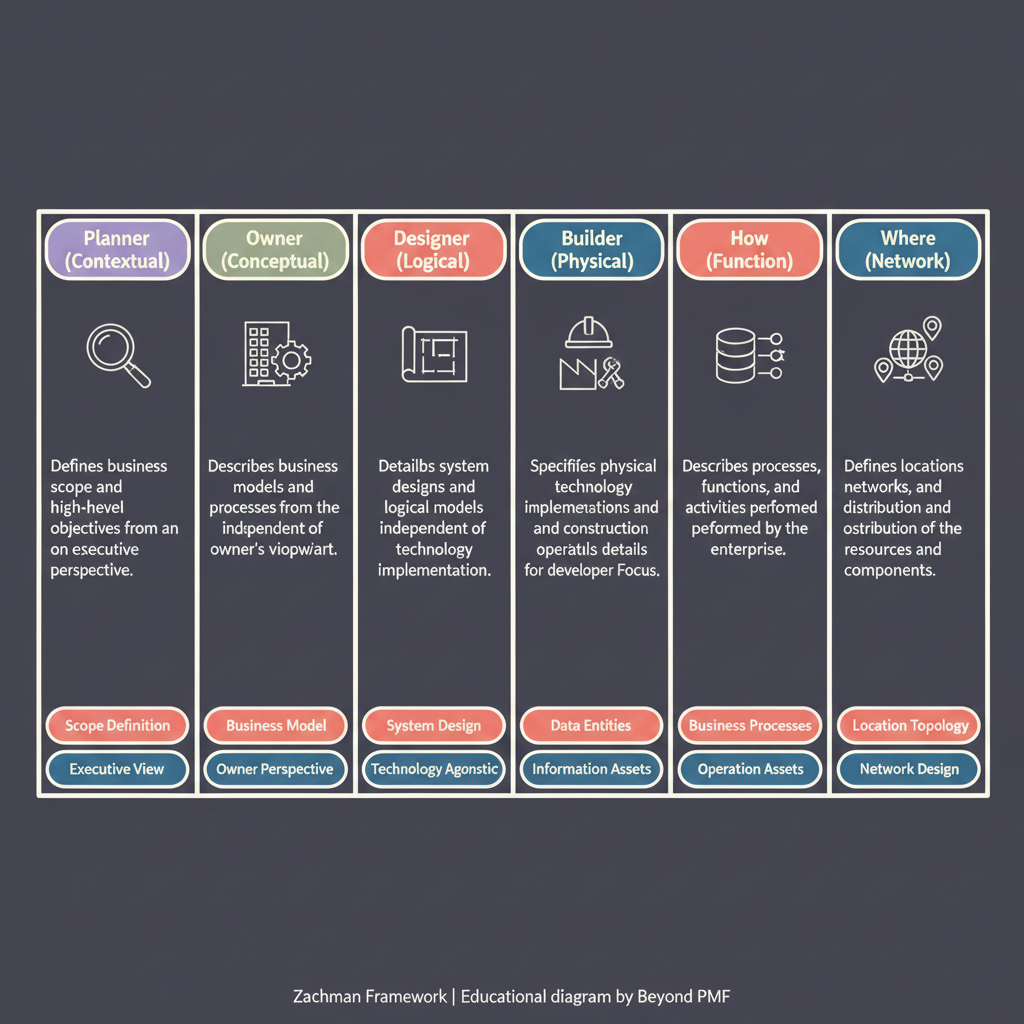
Zachman Framework

https://ik.imagekit.io/beyondpmf/frameworks/zachman-framework.png
The Zachman Framework primarily addresses structural friction by providing a structured way to define and view an enterprise. It focuses on different perspectives of the enterprise, thereby helping to clarify ownership and facilitate cross-functional alignment. This promotes a clearer understanding of the business and its components.

The Zachman Framework, developed by John Zachman, is a schema for organizing architectural artifacts (i.e., design documents, specifications, and models) that takes into account both who the artifact targets (e.g., business owner, developer) and what particular issue (e.g., data, functionality) is being addressed. The framework aims to provide a comprehensive view of the interrelationships among all elements of enterprise architecture, helping organizations to better understand the impact of changes and decisions. Its matrix structure allows for efficient analysis and adaptation, making it a valuable tool for businesses undergoing digital transformation or needing to align IT strategy with business goals.

Steps / Detailed Description

Identify the stakeholders involved across different perspectives such as business owners, architects, and developers. | Define and categorize the fundamental questions: What, How, Where, Who, When, and Why. | Create and populate the framework matrix by addressing each cell with specific artifacts or models relevant to the intersection of stakeholder perspective and the fundamental question. | Analyze the relationships and dependencies across all dimensions of the framework to ensure alignment and coherence. | Use the framework to guide decision-making processes, ensuring that all aspects of the enterprise architecture are considered.

Best Practices

Start small by focusing on specific areas of the architecture before expanding | Ensure continuous training and involvement of all stakeholders to maximize understanding and use of the framework | Regularly update the framework artifacts to reflect changes in the enterprise environment

Pros

Provides a comprehensive view of the enterprise architecture | Facilitates better communication and understanding among different stakeholders | Supports effective decision-making by providing a structured analysis of business and IT artifacts

Cons

Can be complex and time-consuming to implement fully | May require significant training and expertise to utilize effectively | Potentially overwhelming due to its detailed and exhaustive nature

When to Use

When undertaking comprehensive enterprise architecture initiatives | When aligning IT strategy with business objectives

When Not to Use

For small-scale projects where the framework's complexity may not be justified | When quick decision-making is required without the need for detailed architectural analysis

Related Frameworks

Lifecycle

Not tied to a specific lifecycle stage

Scope

Scope not defined

Maturity Level

Maturity level not specified

Time to Implement

2–4 Weeks
3–6 Months
1–2 Weeks
3–6 Months
1–2 Months
3–6 Months
1–2 Weeks
Less Than 1 Day
1–2 Weeks
Longer Than 6 Months
1–2 Weeks
Longer Than 6 Months
1–2 Weeks
3–6 Months
1–2 Weeks
1–2 Weeks
1–2 Weeks
1–2 Weeks
1–2 Days
1–2 Weeks
1–2 Weeks
1–2 Weeks
1–2 Weeks
1–2 Weeks
1–2 Weeks
3–6 Months
1–2 Weeks
1–2 Weeks
1–2 Weeks
3–6 Months
1–2 Weeks
1–2 Weeks
2–4 Weeks
1–2 Weeks
1–2 Days
1–2 Weeks
Longer Than 6 Months
3–6 Months
Longer Than 6 Months
1–2 Weeks
Longer Than 6 Months
3–6 Months
Less Than 1 Day
3–6 Months
1–2 Months
3–6 Months
Longer Than 6 Months
3–6 Months
Less Than 1 Day
1–2 Weeks
3–6 Months
3–6 Months
1–2 Weeks
3–6 Months
1–2 Weeks
1–2 Weeks
1–2 Days
1–2 Weeks
1–2 Months
Longer Than 6 Months
1–2 Weeks
Longer Than 6 Months
1–2 Weeks
3–6 Months
1–2 Weeks
Less Than 1 Day
1–2 Weeks
3–6 Months
1–2 Weeks
3–6 Months
1–2 Weeks
1–2 Weeks
Longer Than 6 Months
Less Than 1 Day
3–6 Months
Longer Than 6 Months
1–2 Months
1–2 Weeks
Longer Than 6 Months
1–2 Weeks
3–6 Months
1–2 Weeks
1–2 Weeks
3–6 Months
Less Than 1 Day
1–2 Weeks
1–2 Weeks
3–6 Months
3–6 Months
Less Than 1 Day
1–2 Weeks
Longer Than 6 Months
1–2 Months
1–2 Weeks
1–2 Weeks
1–2 Weeks
Longer Than 6 Months

Copyright Information

Autor:
John Zachman
1987
Publication:
IBM Systems Journal