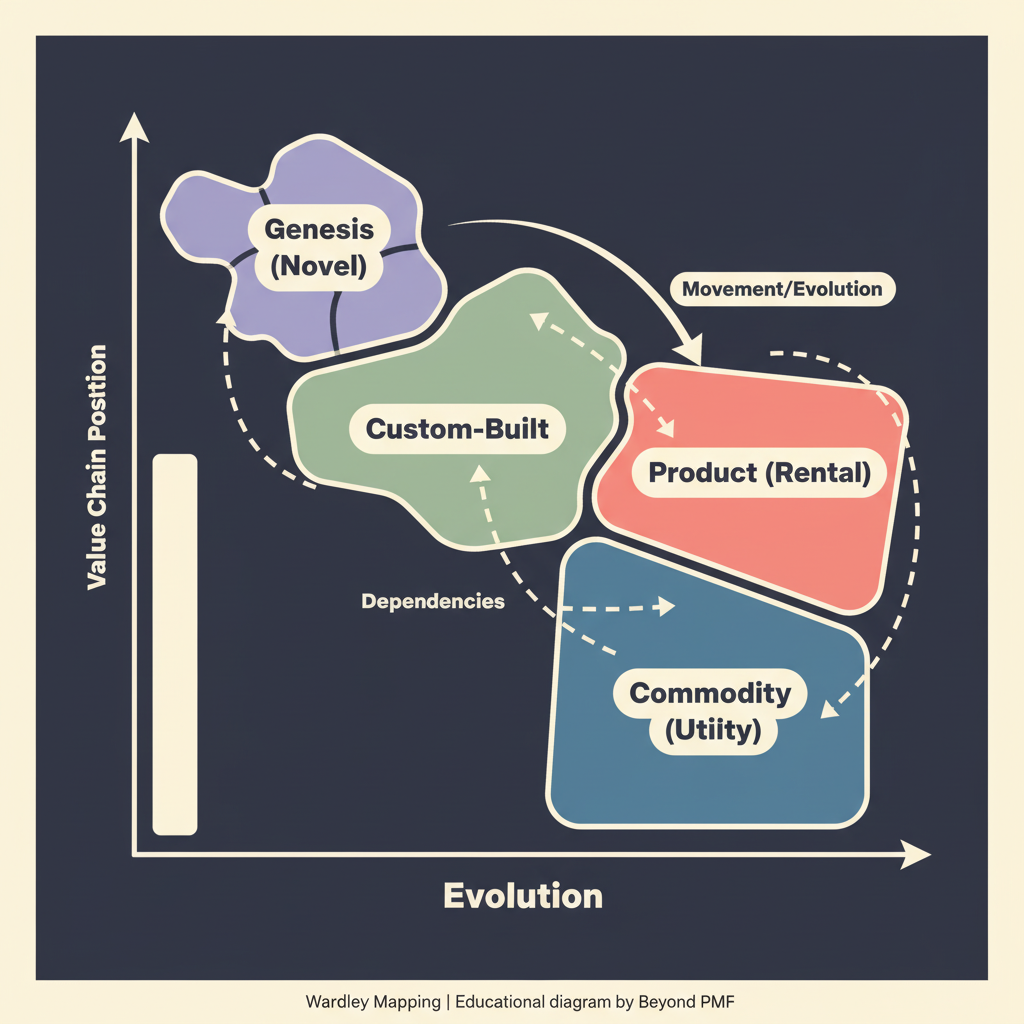
Wardley Mapping is a framework designed to assist businesses in understanding their environment and evolving landscape through visual mapping of their value chain. It focuses on the context of various elements within a business ecosystem, identifying their maturity and value. By mapping these elements, organizations can anticipate market trends, make informed strategic decisions, and optimize resource allocation. The framework is particularly beneficial for strategic planning, competitive analysis, and driving innovation.
Identify the purpose or the user needs. | List the components needed to fulfill the user needs. | Map these components on a value chain, categorizing them by their stage of evolution (Genesis, Custom built, Product, and Commodity). | Assess the visibility and value of each component to the user. | Determine the landscape by positioning components based on their evolution stage and their connection to user needs. | Apply climatic patterns to anticipate how components might evolve. | Use gameplay to strategize based on the current landscape.
Regularly update the map to reflect changes in the business environment. | Engage cross-functional teams to provide diverse insights and enhance accuracy. | Use the map to communicate and align strategy across the organization.
Provides a clear visualization of the business ecosystem. | Facilitates strategic decision-making by identifying dependencies and evolution stages. | Enhances adaptability to changes in the market environment.
Can be complex and time-consuming to create detailed maps. | Requires ongoing updates as market and internal conditions change. | May be challenging for those unfamiliar with strategic mapping techniques.
When entering new markets or launching new products. | For strategic planning and competitive analysis.
In highly stable, unchanging market conditions. | When quick, tactical decisions are required without the need for detailed analysis.