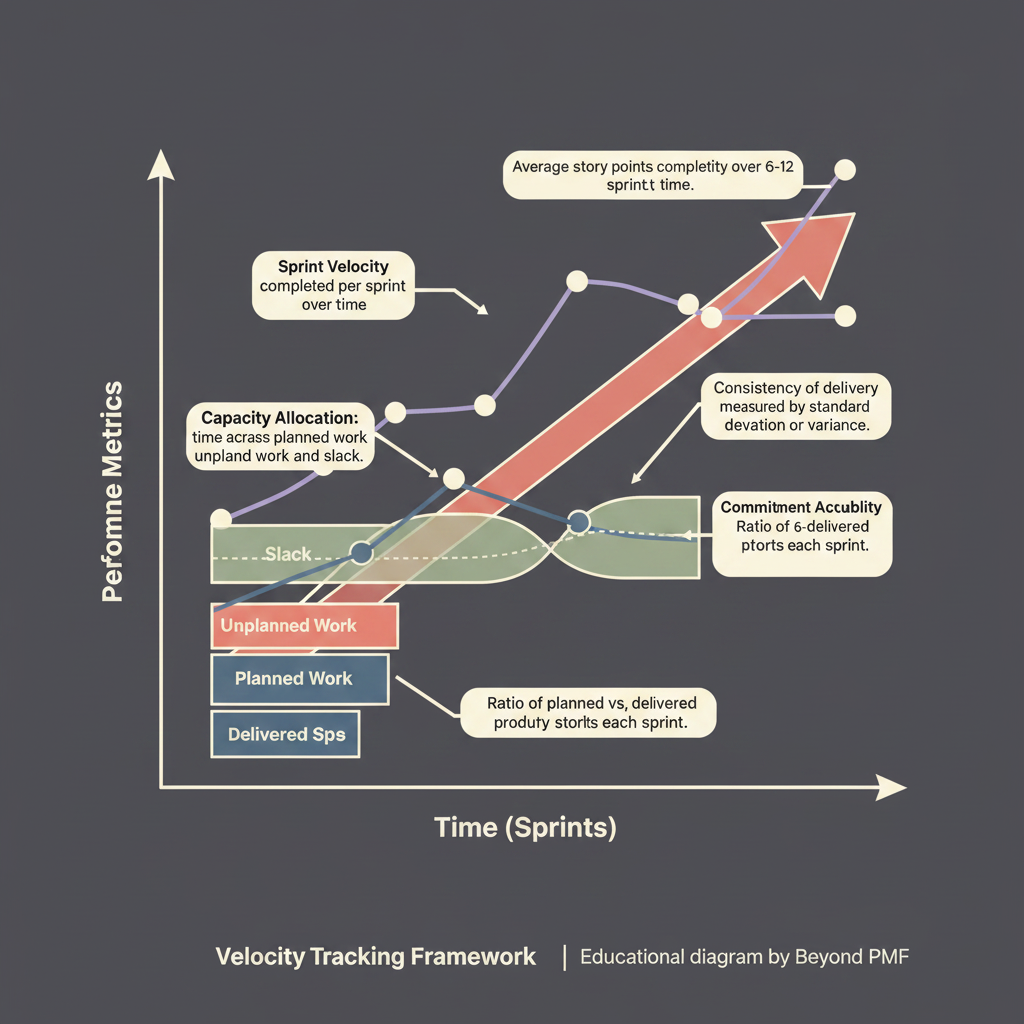
Velocity Tracking Framework

https://ik.imagekit.io/beyondpmf/frameworks/velocity-tracking-framework.png
The Velocity Tracking Framework primarily addresses the friction of slow delivery speed and the difficulty in measuring progress in project implementation, especially within agile software development environments. It helps teams track and improve their execution capabilities.

The Velocity Tracking Framework is a tool used primarily in agile project management to quantify the amount of work a team can handle during a single sprint or iteration. It helps in planning and efficiency by providing a clear measure of the team's productivity over time. This framework is crucial for optimizing processes, forecasting future sprints, and managing stakeholder expectations effectively. By tracking velocity, teams can adjust their workflows to maximize throughput and improve delivery timelines.

Steps / Detailed Description

Define the units of work (e.g., story points, hours, etc.). | Record the amount of work completed in each sprint. | Calculate the average velocity over several sprints. | Use this average to plan future project capacities and timelines. | Adjust for any variations in team size, sprint duration, or complexity.

Best Practices

Regularly review and adjust estimation techniques. | Ensure all team members understand and agree on the definition of 'done'. | Use velocity as a guide, not a strict target.

Pros

Provides a clear measure of team productivity. | Helps in accurate sprint planning and forecasting. | Facilitates continuous improvement through data-driven insights.

Cons

Can be misleading if not all factors (like complexity) are accurately accounted for. | Relies heavily on consistent team composition and sprint lengths. | May encourage teams to focus on velocity over quality.

When to Use

In agile software development projects. | When needing to improve or assess team productivity over time.

When Not to Use

In projects where work items greatly vary in complexity and size. | When team composition changes frequently.

Related Frameworks

Categories

Lifecycle

Scope

Scope not defined

Maturity Level

Maturity level not specified

Time to Implement

2–4 Weeks
3–6 Months
1–2 Weeks
3–6 Months
1–2 Months
3–6 Months
1–2 Weeks
Less Than 1 Day
1–2 Weeks
Longer Than 6 Months
1–2 Weeks
Longer Than 6 Months
1–2 Weeks
3–6 Months
1–2 Weeks
1–2 Weeks
1–2 Weeks
1–2 Weeks
1–2 Days
1–2 Weeks
1–2 Weeks
1–2 Weeks
1–2 Weeks
1–2 Weeks
1–2 Weeks
3–6 Months
1–2 Weeks
1–2 Weeks
1–2 Weeks
3–6 Months
1–2 Weeks
1–2 Weeks
2–4 Weeks
1–2 Weeks
1–2 Days
1–2 Weeks
Longer Than 6 Months
3–6 Months
Longer Than 6 Months
1–2 Weeks
Longer Than 6 Months
3–6 Months
Less Than 1 Day
3–6 Months
1–2 Months
3–6 Months
Longer Than 6 Months
3–6 Months
Less Than 1 Day
1–2 Weeks
3–6 Months
3–6 Months
1–2 Weeks
3–6 Months
1–2 Weeks
1–2 Weeks
1–2 Days
1–2 Weeks
1–2 Months
Longer Than 6 Months
1–2 Weeks
Longer Than 6 Months
1–2 Weeks
3–6 Months
1–2 Weeks
Less Than 1 Day
1–2 Weeks
3–6 Months
1–2 Weeks
3–6 Months
1–2 Weeks
1–2 Weeks
Longer Than 6 Months
Less Than 1 Day
3–6 Months
Longer Than 6 Months
1–2 Months
1–2 Weeks
Longer Than 6 Months
1–2 Weeks
3–6 Months
1–2 Weeks
1–2 Weeks
3–6 Months
Less Than 1 Day
1–2 Weeks
1–2 Weeks
3–6 Months
3–6 Months
Less Than 1 Day
1–2 Weeks
Longer Than 6 Months
1–2 Months
1–2 Weeks
1–2 Weeks
1–2 Weeks
Longer Than 6 Months

Copyright Information

Autor:
Unknown
N/A
Publication:
Generic Business Tool