
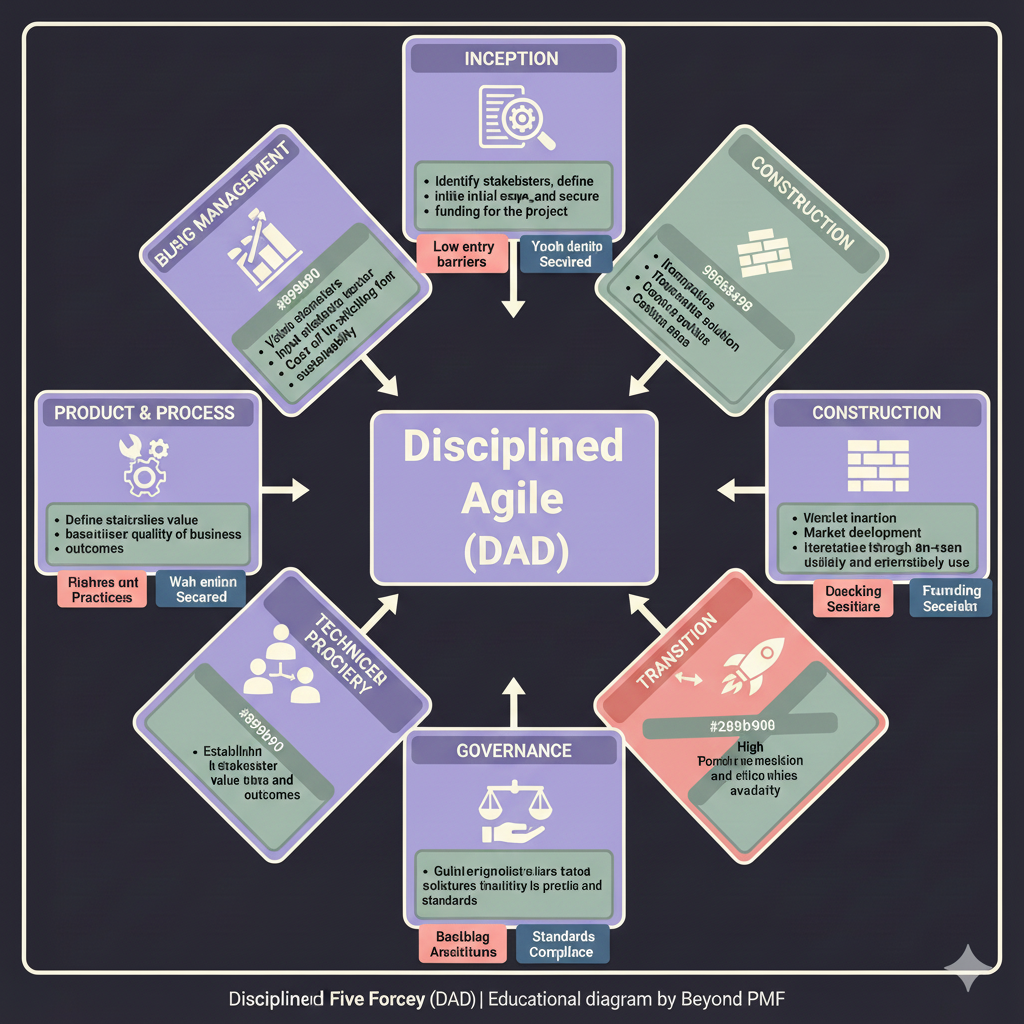
Disciplined Agile Delivery (DAD) is a hybrid agile approach to IT solution delivery that provides a solid foundation for business agility. It combines leading agile and lean approaches such as Scrum, Kanban, and SAFe, providing a decision framework that guides teams in making informed process decisions based on the specifics of their organizational and project context. DAD promotes a more disciplined approach to agile by addressing gaps left by other methodologies, particularly in the areas of architecture and design, as well as in governance.
Initiate a project by establishing team environments and capturing stakeholder needs. | Construct a consumable solution in increments, ensuring stakeholder satisfaction and proper integration. | Deploy the solution incrementally to the appropriate environments, ensuring it meets relevant criteria and stakeholder expectations. | Ensure the solution is sustainably consumable while addressing ongoing stakeholder needs and operational viability.
Start with a full understanding of DAD’s fundamentals before implementation. | Customize DAD to fit the specific needs and context of your organization. | Regularly review and adapt processes to ensure continuous improvement.
Provides a comprehensive lifecycle approach that incorporates architecture and design. | Flexible and scalable to adapt to various types of projects and organizational sizes. | Promotes continuous improvement and learning within teams.
Can be complex to implement due to its comprehensive and detailed nature. | Requires significant training and experience to apply effectively. | May be perceived as too prescriptive compared to more lightweight agile methods.
In complex projects requiring robust governance and architectural oversight. | When transitioning from traditional to agile methodologies in large organizations.
In very small projects where simpler agile methods suffice. | Where the organization is not ready to invest in comprehensive training and change management.