
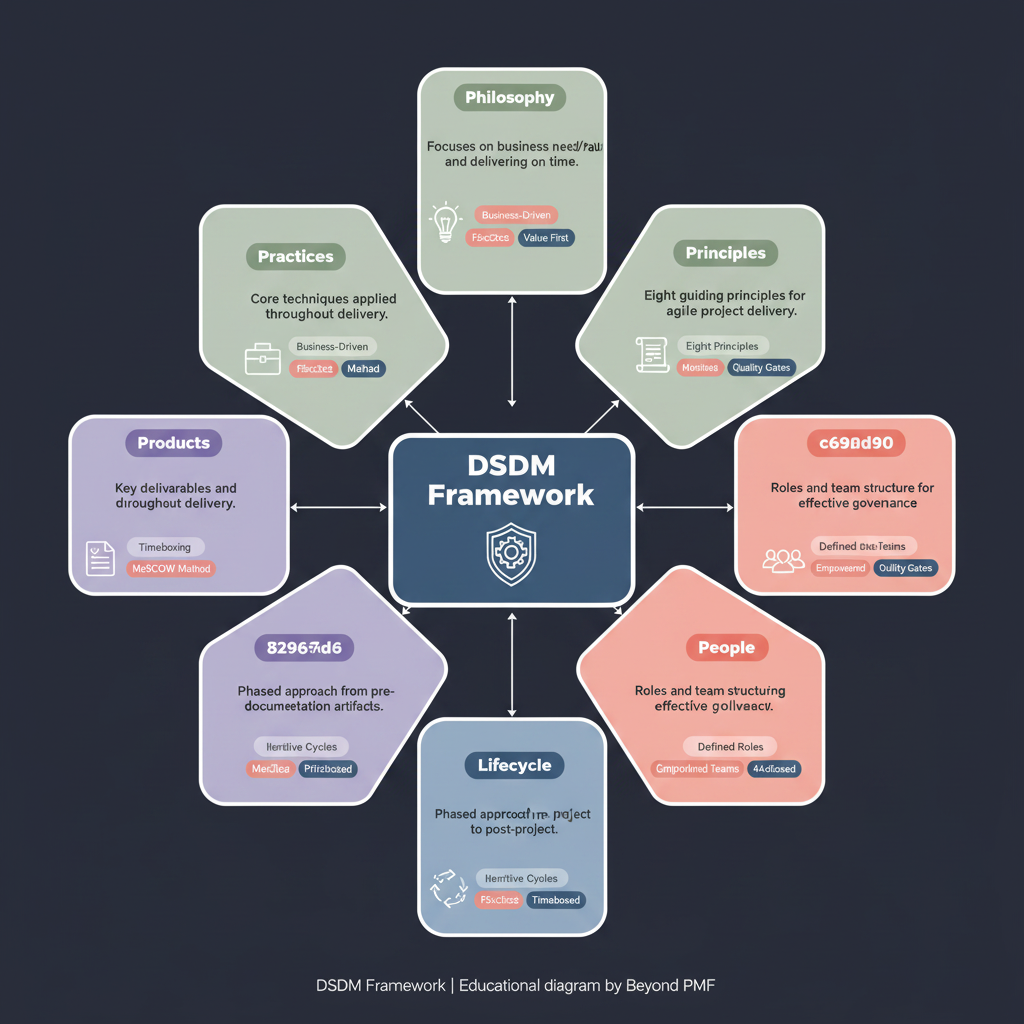
The Dynamic Systems Development Method (DSDM) Framework is a comprehensive agile project management and delivery framework that focuses on timely delivery of business solutions. The framework is built on collaboration and iterative progress through controlled project environments. It ensures that strategic goals are met within budget, on schedule, and with rigorous quality standards. DSDM is particularly effective in environments where requirements are likely to change, allowing for rapid adjustments without significant rework.
Feasibility Study: Assess the project's viability and define the scope. | Business Study: Analyze business processes and user needs to develop a business model. | Functional Model Iteration: Create prototypes and designs to refine the system's functionality. | Design and Build Iteration: Develop and test the system iteratively, incorporating user feedback. | Implementation: Deploy the system in a live environment, with user training and support. | Post-Project: Review project outcomes and identify lessons learned for future projects.
Ensure active and continuous user involvement. | Maintain clear communication and frequent updates among all stakeholders. | Use modular development to manage complexity and facilitate changes.
High user involvement leads to more user-focused solutions. | Flexible and adaptable to changing requirements. | Emphasizes frequent delivery of products.
Requires a significant time commitment from user representatives. | Can be complex to manage if team members are not well-versed in the framework. | Potentially high overhead costs due to the iterative nature and frequent reviews.
When rapid response to changing requirements is needed. | In projects where user involvement is critical for success.
In projects with fixed requirements and scope. | Where there is limited availability of key stakeholders.