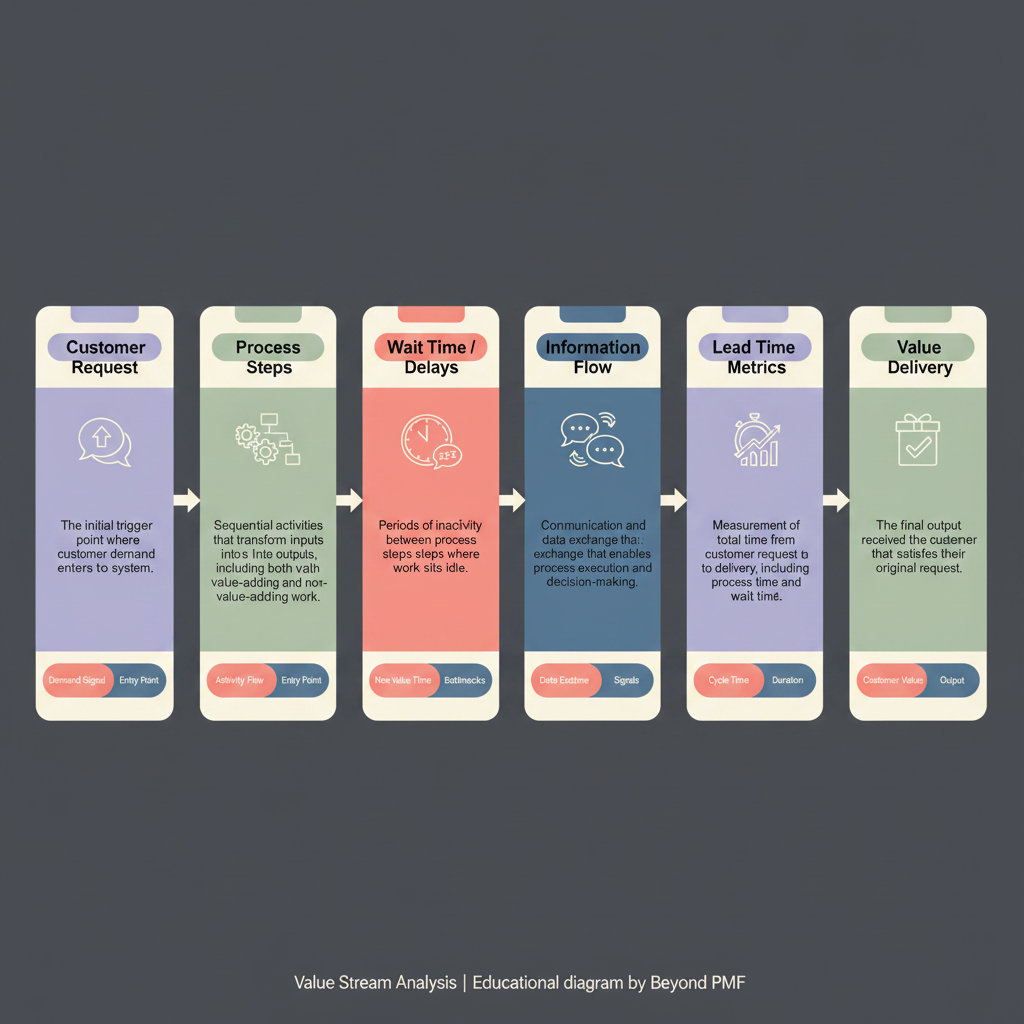
Value Stream Analysis (VSA) is a strategic tool used in lean manufacturing to analyze and design the flow of materials and information required to bring a product or service to a consumer. VSA helps organizations identify waste, reduce process cycle times, and implement process improvement. This analysis not only helps in identifying the inefficiencies but also provides a roadmap for eliminating these inefficiencies and improving the overall performance.
Identify the product or service: Determine the product or service to be analyzed. | Map the current state: Document all the actions, materials, and information flows required to deliver the product or service. | Identify wastes: Analyze the current state map to identify non-value-added activities or wastes. | Design the future state: Create a streamlined version of the value stream without the wastes. | Develop an implementation plan: Outline the steps necessary to transition from the current state to the future state.
Involve a cross-functional team for diverse perspectives | Regularly update the value stream maps as processes evolve | Focus on continuous improvement, not just one-time changes
Increases efficiency by identifying and eliminating waste | Improves product delivery by streamlining processes | Enhances understanding of the overall process flow and dependencies
Can be time-consuming and resource-intensive | Requires detailed and accurate data collection | May lead to resistance from employees due to change
When looking to improve process efficiencies | When planning to reduce cycle times and costs
In very small or simple operations where the benefits do not justify the effort | When the organization is not ready to implement changes