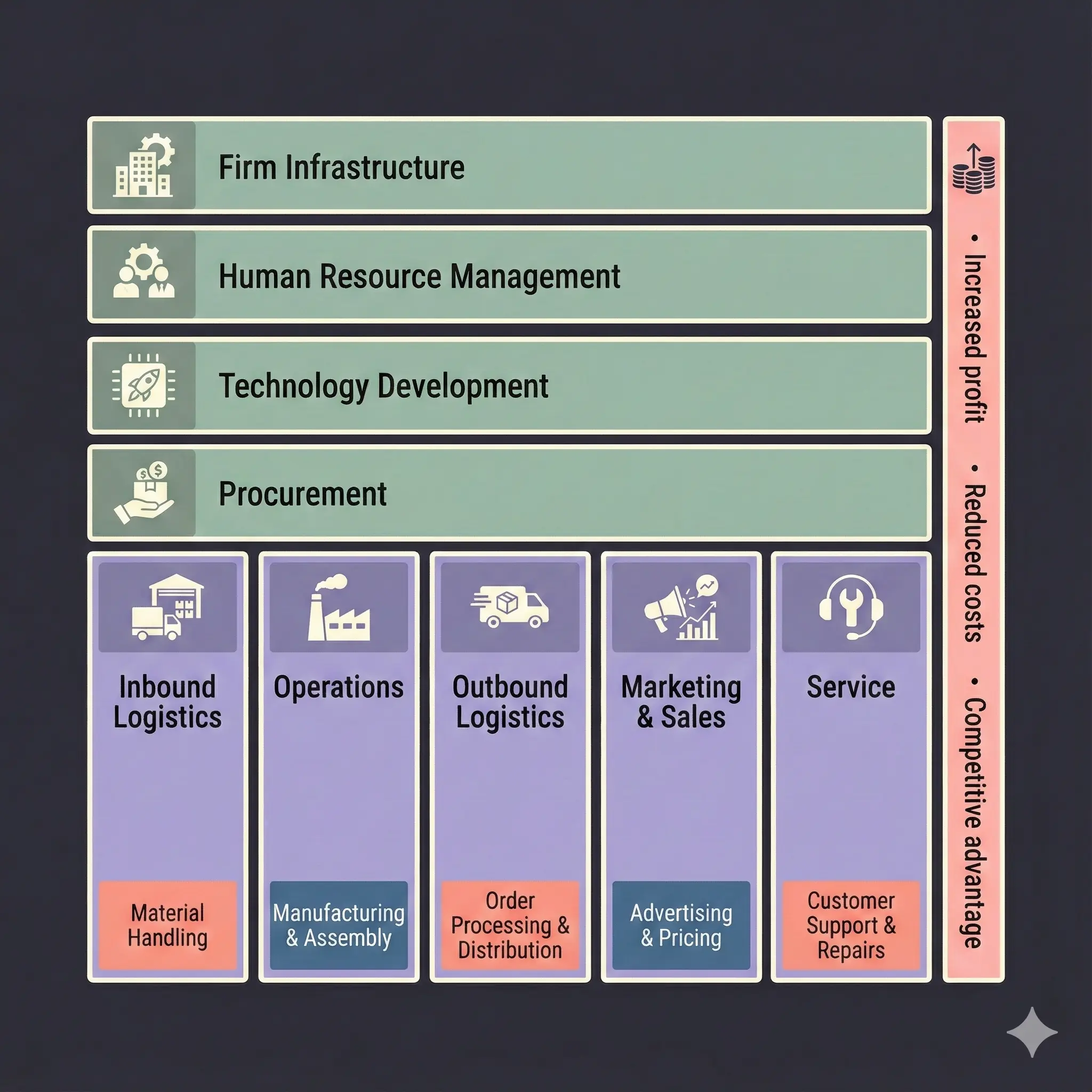
Value Chain Analysis is a business management framework developed by Michael Porter, used to identify specific activities within a business which create value and competitive advantage. Businesses use the framework to focus on those activities that enable them to increase margins, optimize and improve efficiency. It helps in identifying processes where the company can reduce cost, optimize effort, or add value, thereby giving the company a competitive edge in the market.
Identify primary and support activities: Break down the company's operations into primary (e.g., production, marketing, sales) and support activities (e.g., human resources, technology development). | Analyze the value created and cost incurred at each step: Evaluate how each activity contributes to the companyβs profitability and competitive positioning. | Identify opportunities for competitive advantage: Look for activities that can be optimized to create differentiation or lower costs. | Implement improvements: Apply strategies to enhance value creation or reduce costs in identified areas. | Monitor and refine: Continuously assess changes and refine activities to maintain competitive advantage.
Regularly update the analysis to reflect changes in the business environment | Involve stakeholders from different departments for comprehensive insights | Use quantitative data to support decision-making
Enhances understanding of business operations | Facilitates cost reduction and differentiation | Improves competitive advantage
Can be time-consuming | May require significant resources | Focuses mainly on internal factors, ignoring external influences
When seeking areas for cost reduction | When looking to enhance competitive advantage
In rapidly changing industries where internal focus may miss external shifts | When a quick decision is needed, as the analysis can be time-consuming