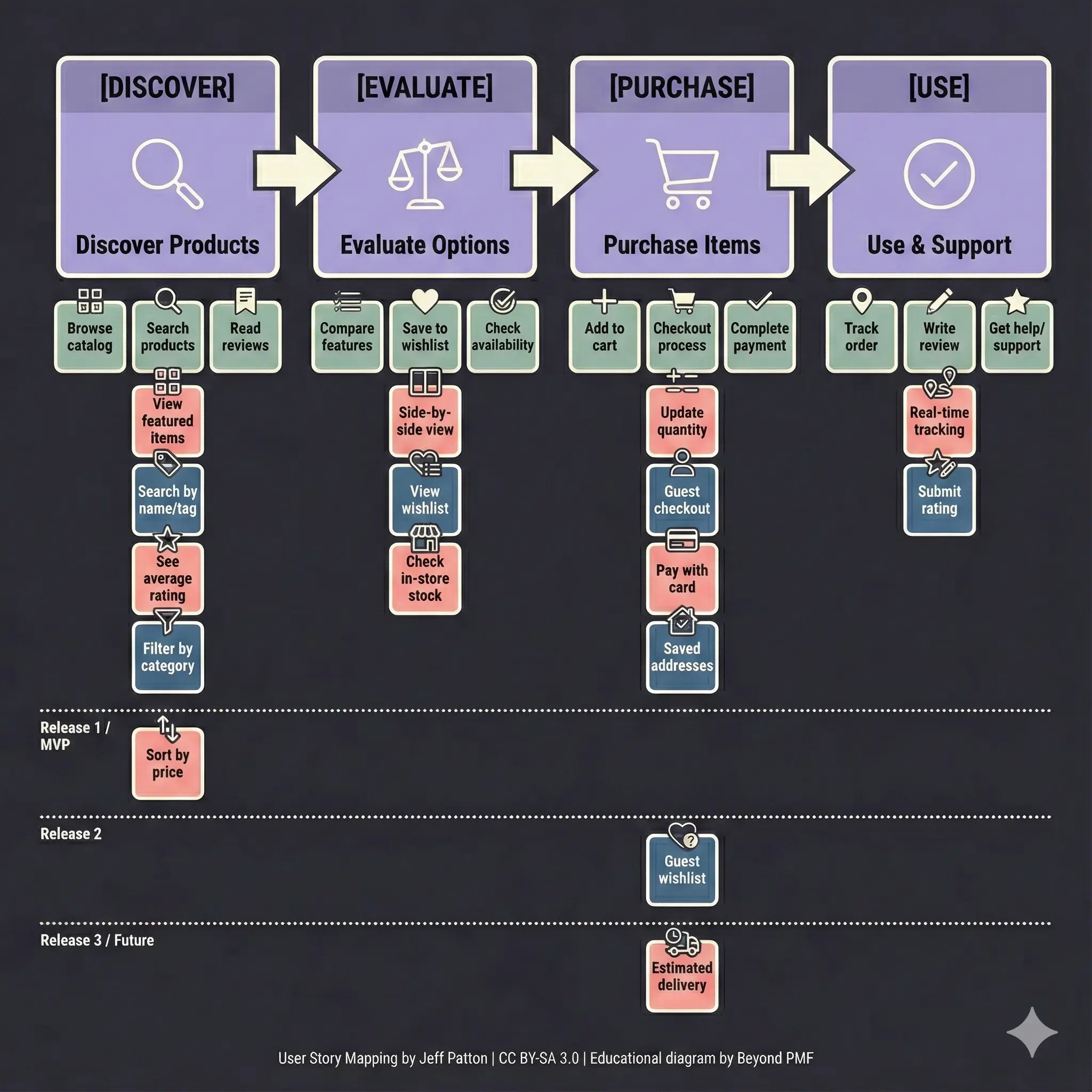
User Story Mapping is a collaborative framework used to manage and prioritize software development tasks. It involves creating a visual mapping of user stories to understand product functionalities, user needs, and the journey over time. This framework helps teams focus on building products that deliver value to users by identifying critical user interactions and ensuring that the most valuable features are developed first.
Define the goal: Identify the main objective of the product or feature. | Create a backbone: List the main tasks or activities users will perform. | Map user stories: Break down the main tasks into smaller, actionable user stories. | Prioritize stories: Arrange user stories by their importance and dependencies. | Slice out releases: Organize stories into releases based on priority and logical grouping.
Involve all stakeholders in the mapping process | Regularly update the map as the project evolves | Use a digital tool for easier collaboration and adjustments
Enhances understanding of the user's needs and journey | Facilitates prioritization of work based on value | Promotes collaboration across different team roles
Can be time-consuming to create and maintain | May become complex with larger projects | Requires active participation from all team members
When starting a new project to define scope and priorities | When refining or updating a product with complex user interactions
For very small or simple projects where a full map is overkill | When project requirements are rigid and predefined