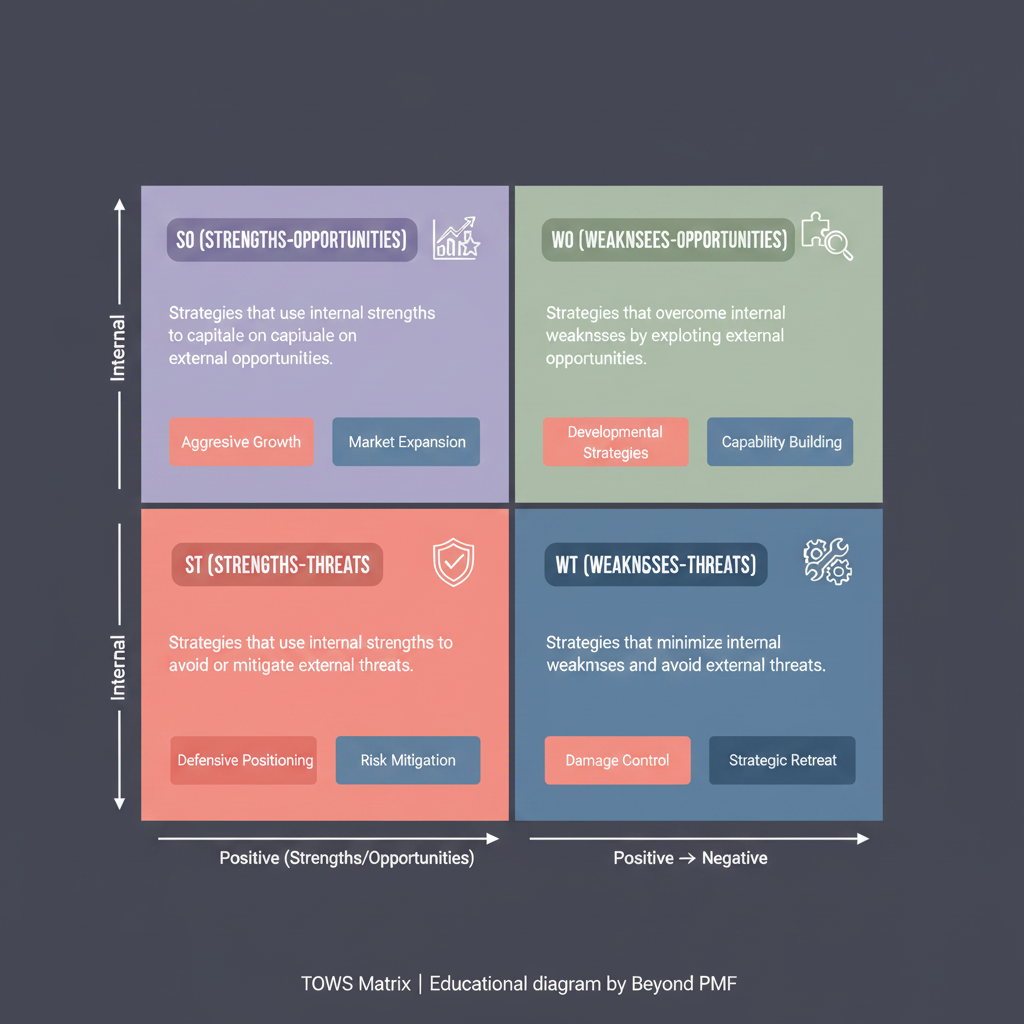
TOWS Matrix

https://ik.imagekit.io/beyondpmf/frameworks/tows-matrix.png
The TOWS Matrix helps organizations formulate strategies by analyzing external opportunities and threats in relation to internal strengths and weaknesses. It directly addresses the strategic friction of unclear direction by providing a structured approach to market alignment, vision, and strategic positioning.

The TOWS Matrix is an advanced form of SWOT analysis, emphasizing strategic planning by examining external opportunities (O) and threats (T) and aligning them with internal strengths (S) and weaknesses (W). This framework helps organizations identify strategic options that leverage strengths to capitalize on opportunities, minimize weaknesses, and mitigate threats. It is used to generate various strategic alternatives and guide decision-making, making it a valuable tool for strategic planning.

Steps / Detailed Description

Identify internal strengths and weaknesses of the organization. | Analyze external opportunities and threats in the market. | Construct the TOWS Matrix with strengths, weaknesses, opportunities, and threats. | Develop strategies that use strengths to take advantage of opportunities (SO strategies). | Formulate strategies to use strengths to overcome threats (ST strategies). | Create strategies to minimize weaknesses by taking advantage of opportunities (WO strategies). | Develop strategies to minimize weaknesses and avoid threats (WT strategies).

Best Practices

Regularly update the data used in the analysis to maintain relevance. | Involve stakeholders from various departments to gain diverse insights. | Focus on prioritizing and implementing the most impactful strategies.

Pros

Provides a comprehensive overview of the strategic landscape. | Facilitates the development of tailored strategies based on internal and external factors. | Enhances decision-making by clearly identifying how internal capabilities align with external possibilities.

Cons

Can be overly complex when dealing with multiple factors. | Requires accurate and up-to-date information for effective analysis. | May lead to a large number of strategies, complicating prioritization.

When to Use

When defining strategic directions in a dynamic market environment. | During the strategic planning phase to align internal capabilities with market conditions.

When Not to Use

In situations where quick, tactical decisions are required. | When there is insufficient data about internal capabilities or external environments.

Related Frameworks

Scope

Scope not defined

Maturity Level

Maturity level not specified

Time to Implement

2–4 Weeks
3–6 Months
1–2 Weeks
3–6 Months
1–2 Months
3–6 Months
1–2 Weeks
Less Than 1 Day
1–2 Weeks
Longer Than 6 Months
1–2 Weeks
Longer Than 6 Months
1–2 Weeks
3–6 Months
1–2 Weeks
1–2 Weeks
1–2 Weeks
1–2 Weeks
1–2 Days
1–2 Weeks
1–2 Weeks
1–2 Weeks
1–2 Weeks
1–2 Weeks
1–2 Weeks
3–6 Months
1–2 Weeks
1–2 Weeks
1–2 Weeks
3–6 Months
1–2 Weeks
1–2 Weeks
2–4 Weeks
1–2 Weeks
1–2 Days
1–2 Weeks
Longer Than 6 Months
3–6 Months
Longer Than 6 Months
1–2 Weeks
Longer Than 6 Months
3–6 Months
Less Than 1 Day
3–6 Months
1–2 Months
3–6 Months
Longer Than 6 Months
3–6 Months
Less Than 1 Day
1–2 Weeks
3–6 Months
3–6 Months
1–2 Weeks
3–6 Months
1–2 Weeks
1–2 Weeks
1–2 Days
1–2 Weeks
1–2 Months
Longer Than 6 Months
1–2 Weeks
Longer Than 6 Months
1–2 Weeks
3–6 Months
1–2 Weeks
Less Than 1 Day
1–2 Weeks
3–6 Months
1–2 Weeks
3–6 Months
1–2 Weeks
1–2 Weeks
Longer Than 6 Months
Less Than 1 Day
3–6 Months
Longer Than 6 Months
1–2 Months
1–2 Weeks
Longer Than 6 Months
1–2 Weeks
3–6 Months
1–2 Weeks
1–2 Weeks
3–6 Months
Less Than 1 Day
1–2 Weeks
1–2 Weeks
3–6 Months
3–6 Months
Less Than 1 Day
1–2 Weeks
Longer Than 6 Months
1–2 Months
1–2 Weeks
1–2 Weeks
1–2 Weeks
Longer Than 6 Months

Copyright Information

Autor:
Unknown
N/A
Publication:
Generic Business Tool