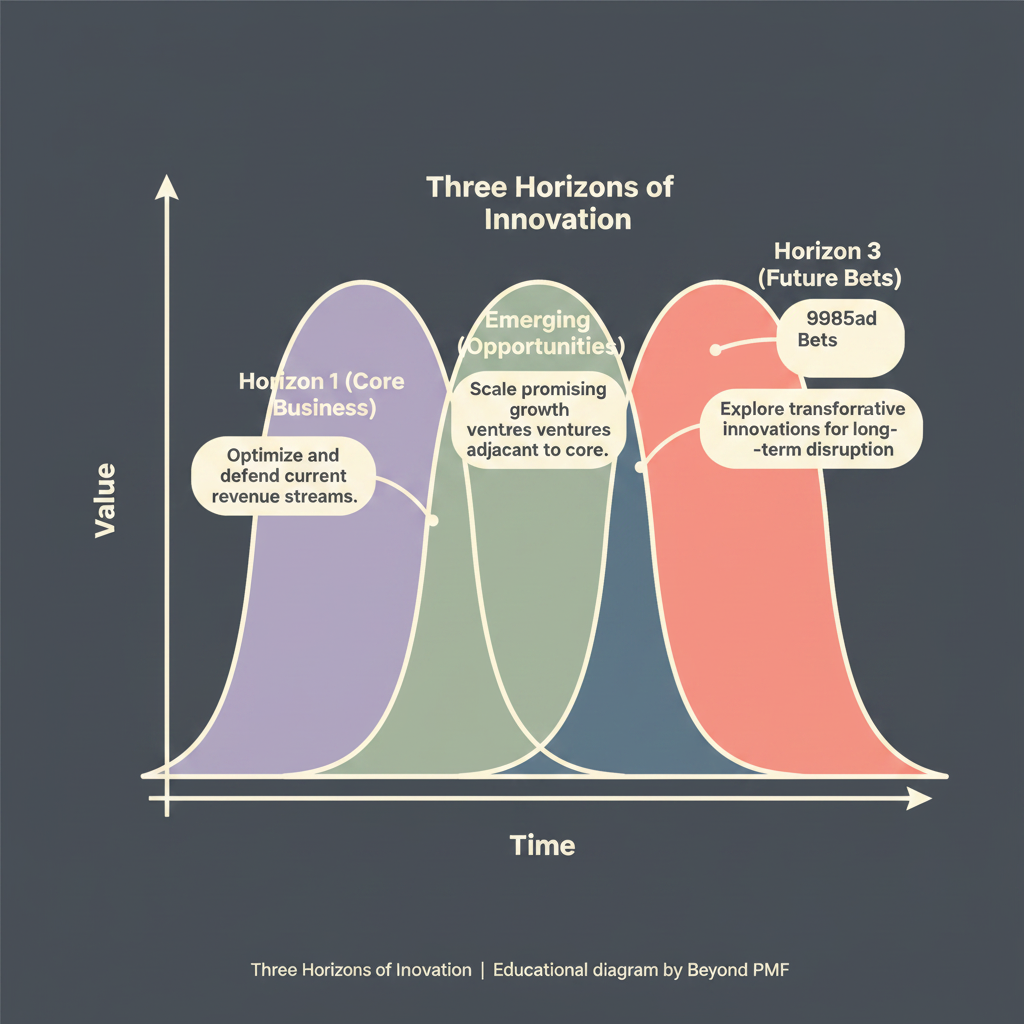
Three Horizons of Innovation

https://ik.imagekit.io/beyondpmf/frameworks/three-horizons-of-innovation.png
The Three Horizons framework primarily addresses the strategic friction of balancing short-term operational needs with long-term innovation and future opportunities. It helps organizations clarify their direction and priorities by providing a framework to manage different time horizons.

The Three Horizons of Innovation framework is a strategic tool used by businesses to ensure continuous growth by managing innovations across three different horizons: maintaining and improving core business (Horizon 1), developing emerging opportunities (Horizon 2), and creating completely new business models or technologies (Horizon 3). This approach helps companies allocate resources effectively, prioritize projects, and prepare for future challenges while sustaining current operations.

Steps / Detailed Description

Identify and continue optimizing core business operations that ensure current profitability (Horizon 1). | Focus on emerging technologies and markets that promise future growth but require substantial investment (Horizon 2). | Invest in radical innovation to create new markets or disrupt existing ones (Horizon 3). | Allocate resources and assign leadership according to the specific needs and timelines of each horizon. | Regularly review and adjust strategies for each horizon based on market feedback and technological advancements.

Best Practices

Clearly define the goals and expectations for each horizon. | Ensure strong leadership and dedicated teams for each horizon. | Regularly review and recalibrate the strategy as necessary.

Pros

Encourages long-term thinking while maintaining short-term performance | Helps in balancing resource allocation between current and future projects | Fosters innovation by systematically exploring new opportunities

Cons

Can be complex to implement and manage across different business units | Risk of neglecting Horizon 1 in the pursuit of more exciting future opportunities | Requires significant investment in terms of time and capital

When to Use

When planning long-term business strategy | During periods of business transformation or market disruption

When Not to Use

In very small or resource-constrained startups | When immediate survival is more critical than long-term planning

Related Frameworks

Lifecycle

Not tied to a specific lifecycle stage

Scope

Scope not defined

Maturity Level

Maturity level not specified

Time to Implement

2–4 Weeks
3–6 Months
1–2 Weeks
3–6 Months
1–2 Months
3–6 Months
1–2 Weeks
Less Than 1 Day
1–2 Weeks
Longer Than 6 Months
1–2 Weeks
Longer Than 6 Months
1–2 Weeks
3–6 Months
1–2 Weeks
1–2 Weeks
1–2 Weeks
1–2 Weeks
1–2 Days
1–2 Weeks
1–2 Weeks
1–2 Weeks
1–2 Weeks
1–2 Weeks
1–2 Weeks
3–6 Months
1–2 Weeks
1–2 Weeks
1–2 Weeks
3–6 Months
1–2 Weeks
1–2 Weeks
2–4 Weeks
1–2 Weeks
1–2 Days
1–2 Weeks
Longer Than 6 Months
3–6 Months
Longer Than 6 Months
1–2 Weeks
Longer Than 6 Months
3–6 Months
Less Than 1 Day
3–6 Months
1–2 Months
3–6 Months
Longer Than 6 Months
3–6 Months
Less Than 1 Day
1–2 Weeks
3–6 Months
3–6 Months
1–2 Weeks
3–6 Months
1–2 Weeks
1–2 Weeks
1–2 Days
1–2 Weeks
1–2 Months
Longer Than 6 Months
1–2 Weeks
Longer Than 6 Months
1–2 Weeks
3–6 Months
1–2 Weeks
Less Than 1 Day
1–2 Weeks
3–6 Months
1–2 Weeks
3–6 Months
1–2 Weeks
1–2 Weeks
Longer Than 6 Months
Less Than 1 Day
3–6 Months
Longer Than 6 Months
1–2 Months
1–2 Weeks
Longer Than 6 Months
1–2 Weeks
3–6 Months
1–2 Weeks
1–2 Weeks
3–6 Months
Less Than 1 Day
1–2 Weeks
1–2 Weeks
3–6 Months
3–6 Months
Less Than 1 Day
1–2 Weeks
Longer Than 6 Months
1–2 Months
1–2 Weeks
1–2 Weeks
1–2 Weeks
Longer Than 6 Months

Copyright Information

Autor:
McKinsey & Company
Unknown
Publication:
McKinsey & Company