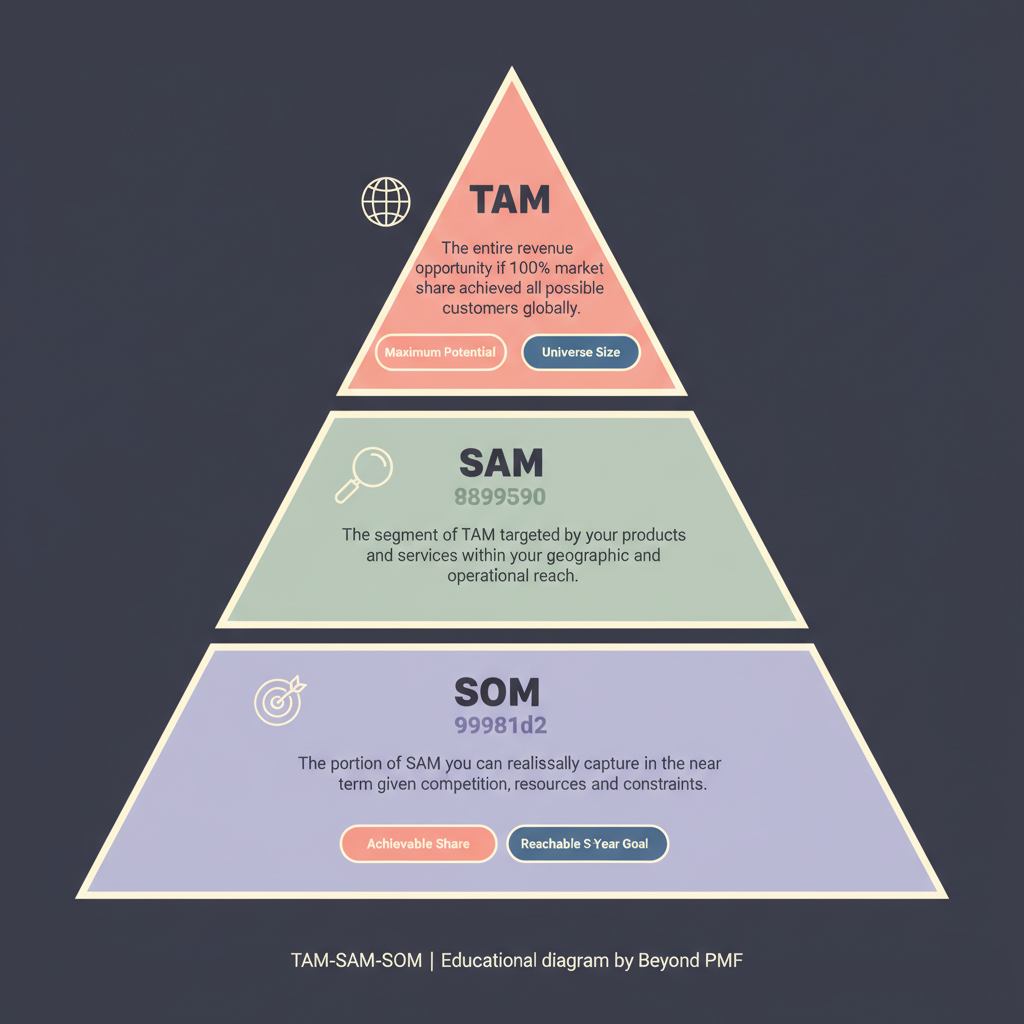
TAM-SAM-SOM

https://ik.imagekit.io/beyondpmf/frameworks/tam-sam-som.png
The TAM-SAM-SOM framework directly addresses strategic friction by helping businesses define and quantify their target markets. This provides a clearer direction and market alignment for the business.

TAM-SAM-SOM stands for Total Addressable Market, Serviceable Available Market, and Serviceable Obtainable Market, respectively. This framework is used to assess the potential market size at three different levels, helping businesses to strategically plan their product development, marketing, and sales efforts. It provides a clear view of the market from the broadest to the most directly reachable customers, thus aiding in resource allocation and strategy formulation.

Steps / Detailed Description

Identify the Total Addressable Market (TAM): Estimate the total market demand for a product or service. | Define the Serviceable Available Market (SAM): Focus on the segment of TAM that is within your geographical reach and can be served by your products or services. | Determine the Serviceable Obtainable Market (SOM): Identify the portion of SAM that you can capture in the short to medium term, considering competition and other limiting factors.

Best Practices

Use reliable and updated market data for analysis | Regularly update the TAM-SAM-SOM analysis to reflect market changes | Align the framework with specific business goals and strategies

Pros

Provides a structured approach to market analysis | Helps in strategic planning by identifying market potential at different levels | Aids in setting realistic sales and growth targets

Cons

Estimating market sizes accurately can be challenging | May not account for rapid changes in the market | Relies on the availability of accurate and current data

When to Use

When entering a new market | When launching a new product or service

When Not to Use

In highly volatile markets where data changes frequently | When detailed market data is not available

Related Frameworks

Categories

Lifecycle

Scope

Scope not defined

Maturity Level

Maturity level not specified

Time to Implement

2–4 Weeks
3–6 Months
1–2 Weeks
3–6 Months
1–2 Months
3–6 Months
1–2 Weeks
Less Than 1 Day
1–2 Weeks
Longer Than 6 Months
1–2 Weeks
Longer Than 6 Months
1–2 Weeks
3–6 Months
1–2 Weeks
1–2 Weeks
1–2 Weeks
1–2 Weeks
1–2 Days
1–2 Weeks
1–2 Weeks
1–2 Weeks
1–2 Weeks
1–2 Weeks
1–2 Weeks
3–6 Months
1–2 Weeks
1–2 Weeks
1–2 Weeks
3–6 Months
1–2 Weeks
1–2 Weeks
2–4 Weeks
1–2 Weeks
1–2 Days
1–2 Weeks
Longer Than 6 Months
3–6 Months
Longer Than 6 Months
1–2 Weeks
Longer Than 6 Months
3–6 Months
Less Than 1 Day
3–6 Months
1–2 Months
3–6 Months
Longer Than 6 Months
3–6 Months
Less Than 1 Day
1–2 Weeks
3–6 Months
3–6 Months
1–2 Weeks
3–6 Months
1–2 Weeks
1–2 Weeks
1–2 Days
1–2 Weeks
1–2 Months
Longer Than 6 Months
1–2 Weeks
Longer Than 6 Months
1–2 Weeks
3–6 Months
1–2 Weeks
Less Than 1 Day
1–2 Weeks
3–6 Months
1–2 Weeks
3–6 Months
1–2 Weeks
1–2 Weeks
Longer Than 6 Months
Less Than 1 Day
3–6 Months
Longer Than 6 Months
1–2 Months
1–2 Weeks
Longer Than 6 Months
1–2 Weeks
3–6 Months
1–2 Weeks
1–2 Weeks
3–6 Months
Less Than 1 Day
1–2 Weeks
1–2 Weeks
3–6 Months
3–6 Months
Less Than 1 Day
1–2 Weeks
Longer Than 6 Months
1–2 Months
1–2 Weeks
1–2 Weeks
1–2 Weeks
Longer Than 6 Months

Copyright Information

Autor:
Unknown
N/A
Publication:
Generic Business Tool