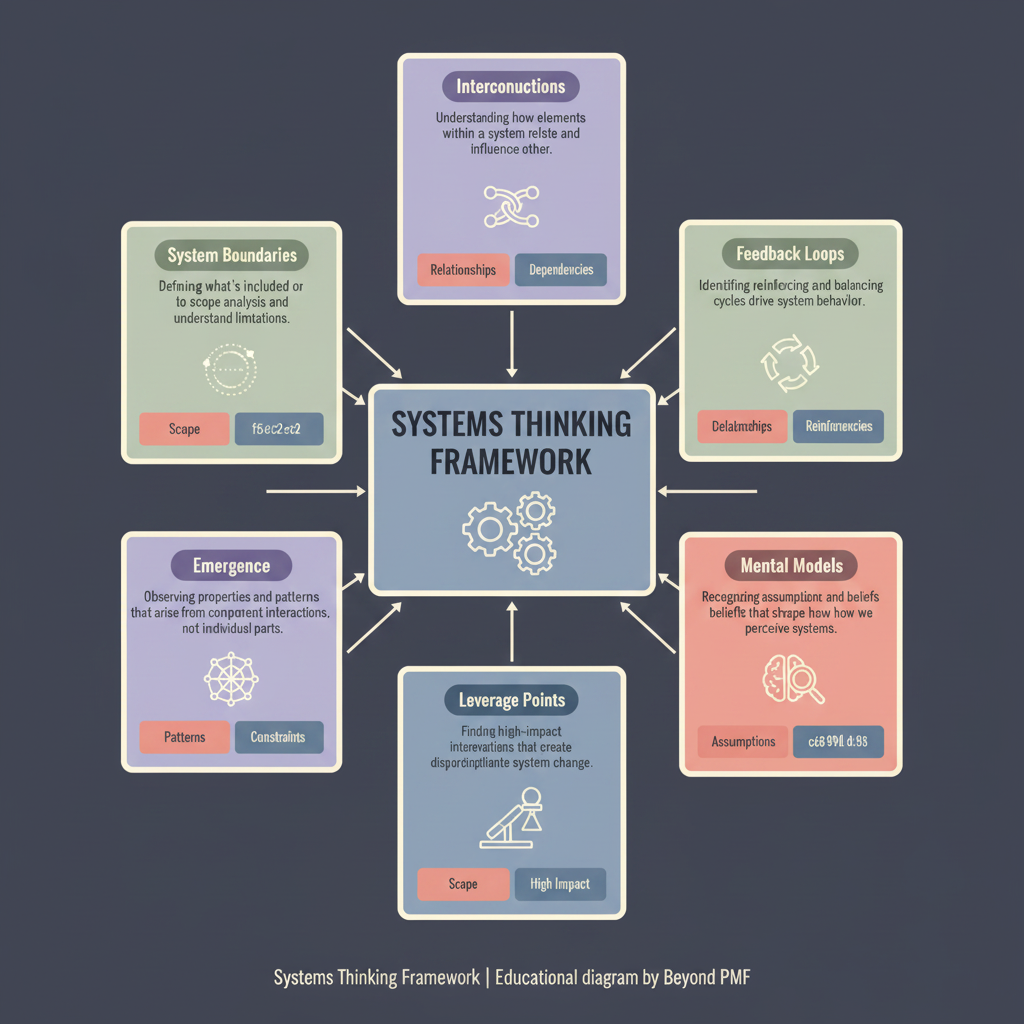
Systems Thinking Framework

https://ik.imagekit.io/beyondpmf/frameworks/systems-thinking-framework.png
Systems Thinking Framework addresses friction related to how the parts of a system interrelate and function over time. This framework improves coordination and understanding of complex processes and workflows.

The Systems Thinking Framework is utilized to understand complex systems by observing the relationships and interactions between the components that comprise the entirety of the defined system. This framework helps in identifying how individual elements influence one another within a whole, in both expected and unexpected ways. It is particularly beneficial for dealing with complex problems that are interconnected and dynamic, providing a way to anticipate the outcomes of changes within the system.

Steps / Detailed Description

Define the system and identify its purpose. | Map out the key elements, connections, and boundaries of the system. | Identify and understand the relationships between the elements. | Use tools like causal loop diagrams to visualize system behavior. | Analyze the system to identify potential leverage points. | Implement interventions based on the analysis. | Monitor the system and adjust interventions as necessary.

Best Practices

Involve stakeholders in defining and mapping the system. | Continuously update and revise system models as new information becomes available. | Focus on high-impact, low-effort leverage points for interventions.

Pros

Promotes understanding of complex and interrelated issues. | Helps predict the effects of changes within a system. | Encourages a long-term perspective over quick fixes.

Cons

Can be time-consuming to implement. | Requires a high level of detail and system knowledge. | May be overwhelming due to complexity of variables.

When to Use

When dealing with complex issues that involve multiple interdependent elements. | When long-term strategic planning is necessary.

When Not to Use

For simple or linear problems with clear cause-and-effect. | When quick decisions or actions are required.

Related Frameworks

Lifecycle

Not tied to a specific lifecycle stage

Scope

Scope not defined

Maturity Level

Maturity level not specified

Time to Implement

2–4 Weeks
3–6 Months
1–2 Weeks
3–6 Months
1–2 Months
3–6 Months
1–2 Weeks
Less Than 1 Day
1–2 Weeks
Longer Than 6 Months
1–2 Weeks
Longer Than 6 Months
1–2 Weeks
3–6 Months
1–2 Weeks
1–2 Weeks
1–2 Weeks
1–2 Weeks
1–2 Days
1–2 Weeks
1–2 Weeks
1–2 Weeks
1–2 Weeks
1–2 Weeks
1–2 Weeks
3–6 Months
1–2 Weeks
1–2 Weeks
1–2 Weeks
3–6 Months
1–2 Weeks
1–2 Weeks
2–4 Weeks
1–2 Weeks
1–2 Days
1–2 Weeks
Longer Than 6 Months
3–6 Months
Longer Than 6 Months
1–2 Weeks
Longer Than 6 Months
3–6 Months
Less Than 1 Day
3–6 Months
1–2 Months
3–6 Months
Longer Than 6 Months
3–6 Months
Less Than 1 Day
1–2 Weeks
3–6 Months
3–6 Months
1–2 Weeks
3–6 Months
1–2 Weeks
1–2 Weeks
1–2 Days
1–2 Weeks
1–2 Months
Longer Than 6 Months
1–2 Weeks
Longer Than 6 Months
1–2 Weeks
3–6 Months
1–2 Weeks
Less Than 1 Day
1–2 Weeks
3–6 Months
1–2 Weeks
3–6 Months
1–2 Weeks
1–2 Weeks
Longer Than 6 Months
Less Than 1 Day
3–6 Months
Longer Than 6 Months
1–2 Months
1–2 Weeks
Longer Than 6 Months
1–2 Weeks
3–6 Months
1–2 Weeks
1–2 Weeks
3–6 Months
Less Than 1 Day
1–2 Weeks
1–2 Weeks
3–6 Months
3–6 Months
Less Than 1 Day
1–2 Weeks
Longer Than 6 Months
1–2 Months
1–2 Weeks
1–2 Weeks
1–2 Weeks
Longer Than 6 Months

Copyright Information

Autor:
Unknown
N/A
Publication:
Generic Business Tool