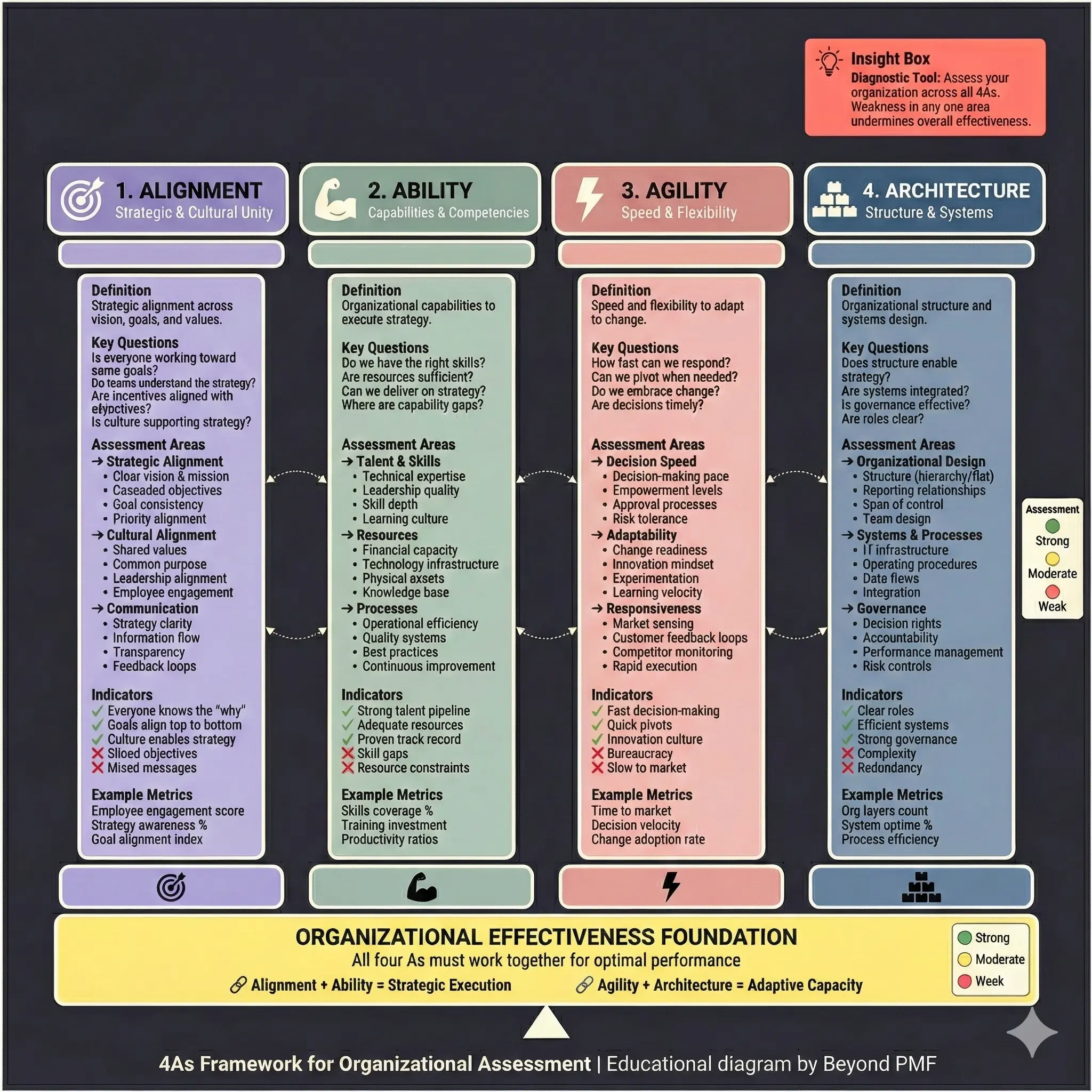
4As Framework

Diagram of the 4As Framework for Organizational Assessment, showing four pillars: Alignment, Ability, Agility, and Architecture. Each pillar includes definitions, key questions, assessment areas, indicators, and example metrics. A foundation bar emphasizes that all four areas must work together for organizational effectiveness, with a color scale indicating strong, moderate, or weak performance.
The 4As Framework assesses an organization's alignment with its strategic goals, its ability to execute those goals, its agility in responding to change, and the underlying architecture supporting these efforts. This framework primarily addresses the friction related to unclear direction, conflicting priorities, and lack of market alignment.

The 4As Framework is designed to help organizations optimize their operations and strategy by focusing on four key areas: Alignment, Ability, Agility, and Architecture. This framework aids in understanding how well these elements are integrated and functioning towards achieving the business goals. It is particularly beneficial for diagnosing organizational issues, enhancing coordination across departments, and improving overall performance.

Steps / Detailed Description

Assess Alignment: Evaluate how well the organization's goals and strategies align with its operations and employee actions. | Analyze Ability: Determine the capabilities of the organization to execute its strategies, including skills and resources. | Evaluate Agility: Measure the organization's flexibility and responsiveness to changes in the market or environment. | Review Architecture: Examine the structural aspects of the organization that support or hinder the implementation of strategies.

Best Practices

Regularly update assessments to reflect changes in the business environment. | Involve stakeholders from various departments for a holistic view. | Use findings to inform strategic decisions and organizational changes.

Pros

Provides a comprehensive overview of organizational effectiveness. | Enhances strategic alignment across different departments. | Improves responsiveness to external changes and challenges.

Cons

Can be time-consuming to implement fully. | Requires substantial data collection and analysis. | May need adaptation to fit specific organizational contexts.

When to Use

During strategic planning sessions. | When diagnosing performance issues or organizational misalignment.

When Not to Use

In very small organizations where formal frameworks may be too cumbersome. | When immediate action is required, as the framework requires time for analysis.

Related Frameworks

Lifecycle

Not tied to a specific lifecycle stage

Scope

Scope not defined

Maturity Level

Maturity level not specified

Time to Implement

2–4 Weeks
3–6 Months
1–2 Weeks
3–6 Months
1–2 Months
3–6 Months
1–2 Weeks
Less Than 1 Day
1–2 Weeks
Longer Than 6 Months
1–2 Weeks
Longer Than 6 Months
1–2 Weeks
3–6 Months
1–2 Weeks
1–2 Weeks
1–2 Weeks
1–2 Weeks
1–2 Days
1–2 Weeks
1–2 Weeks
1–2 Weeks
1–2 Weeks
1–2 Weeks
1–2 Weeks
3–6 Months
1–2 Weeks
1–2 Weeks
1–2 Weeks
3–6 Months
1–2 Weeks
1–2 Weeks
2–4 Weeks
1–2 Weeks
1–2 Days
1–2 Weeks
Longer Than 6 Months
3–6 Months
Longer Than 6 Months
1–2 Weeks
Longer Than 6 Months
3–6 Months
Less Than 1 Day
3–6 Months
1–2 Months
3–6 Months
Longer Than 6 Months
3–6 Months
Less Than 1 Day
1–2 Weeks
3–6 Months
3–6 Months
1–2 Weeks
3–6 Months
1–2 Weeks
1–2 Weeks
1–2 Days
1–2 Weeks
1–2 Months
Longer Than 6 Months
1–2 Weeks
Longer Than 6 Months
1–2 Weeks
3–6 Months
1–2 Weeks
Less Than 1 Day
1–2 Weeks
3–6 Months
1–2 Weeks
3–6 Months
1–2 Weeks
1–2 Weeks
Longer Than 6 Months
Less Than 1 Day
3–6 Months
Longer Than 6 Months
1–2 Months
1–2 Weeks
Longer Than 6 Months
1–2 Weeks
3–6 Months
1–2 Weeks
1–2 Weeks
3–6 Months
Less Than 1 Day
1–2 Weeks
1–2 Weeks
3–6 Months
3–6 Months
Less Than 1 Day
1–2 Weeks
Longer Than 6 Months
1–2 Months
1–2 Weeks
1–2 Weeks
1–2 Weeks
Longer Than 6 Months

Copyright Information

Autor:
Unknown
N/A
Publication:
Unknown