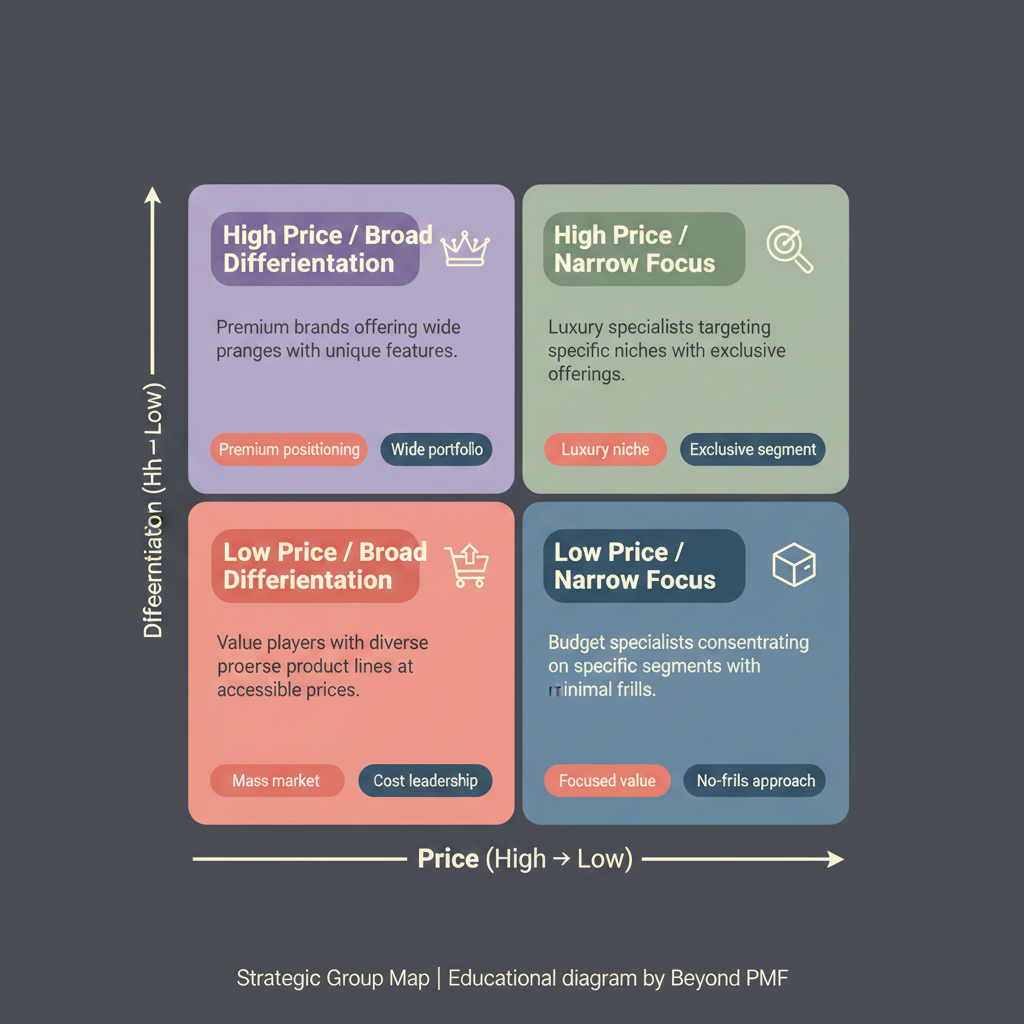
Strategic Group Map

The Strategic Group Map helps to clarify market positioning and competitive advantages within an industry. It addresses the friction that arises from unclear market alignment and a lack of understanding of the competitive landscape, which can impact strategic decisions.

A Strategic Group Map is a graphical representation that showcases different market or competitive positions that rival firms occupy within the industry. By identifying mobility barriers between groups, companies can recognize areas of intense rivalry and opportunities for strategic moves. This framework helps in understanding the landscape of the industry, assessing direct competitors, and strategizing based on the relative strengths and weaknesses of different groups.

Steps / Detailed Description

Identify competitive variables that differentiate firms in the industry. | Select two key dimensions that are the most relevant to customers or critical to success. | Plot firms on a two-dimensional map based on their performance on these dimensions. | Analyze the map to identify strategic groups and understand the competitive dynamics. | Assess the implications for your own strategic positioning and potential moves.

Best Practices

Regularly update the map to reflect current market conditions. | Choose dimensions that are truly significant to the industry. | Combine with other analytical tools for comprehensive insights.

Pros

Provides a clear visualization of the competitive landscape. | Helps in identifying market niches or gaps. | Facilitates strategic planning by highlighting barriers and opportunities.

Cons

Can be overly simplistic, ignoring nuances between companies. | Depends heavily on the selection of appropriate dimensions. | May become outdated quickly in fast-changing industries.

When to Use

When entering a new market to understand the competitive structure. | When considering strategic shifts or new positioning.

When Not to Use

In highly dynamic industries where conditions change rapidly. | When detailed, qualitative insights into competitors are required.

Related Frameworks

Lifecycle

Not tied to a specific lifecycle stage

Scope

Scope not defined

Maturity Level

Maturity level not specified

Time to Implement

2–4 Weeks
3–6 Months
1–2 Weeks
3–6 Months
1–2 Months
3–6 Months
1–2 Weeks
Less Than 1 Day
1–2 Weeks
Longer Than 6 Months
1–2 Weeks
Longer Than 6 Months
1–2 Weeks
3–6 Months
1–2 Weeks
1–2 Weeks
1–2 Weeks
1–2 Weeks
1–2 Days
1–2 Weeks
1–2 Weeks
1–2 Weeks
1–2 Weeks
1–2 Weeks
1–2 Weeks
3–6 Months
1–2 Weeks
1–2 Weeks
1–2 Weeks
3–6 Months
1–2 Weeks
1–2 Weeks
2–4 Weeks
1–2 Weeks
1–2 Days
1–2 Weeks
Longer Than 6 Months
3–6 Months
Longer Than 6 Months
1–2 Weeks
Longer Than 6 Months
3–6 Months
Less Than 1 Day
3–6 Months
1–2 Months
3–6 Months
Longer Than 6 Months
3–6 Months
Less Than 1 Day
1–2 Weeks
3–6 Months
3–6 Months
1–2 Weeks
3–6 Months
1–2 Weeks
1–2 Weeks
1–2 Days
1–2 Weeks
1–2 Months
Longer Than 6 Months
1–2 Weeks
Longer Than 6 Months
1–2 Weeks
3–6 Months
1–2 Weeks
Less Than 1 Day
1–2 Weeks
3–6 Months
1–2 Weeks
3–6 Months
1–2 Weeks
1–2 Weeks
Longer Than 6 Months
Less Than 1 Day
3–6 Months
Longer Than 6 Months
1–2 Months
1–2 Weeks
Longer Than 6 Months
1–2 Weeks
3–6 Months
1–2 Weeks
1–2 Weeks
3–6 Months
Less Than 1 Day
1–2 Weeks
1–2 Weeks
3–6 Months
3–6 Months
Less Than 1 Day
1–2 Weeks
Longer Than 6 Months
1–2 Months
1–2 Weeks
1–2 Weeks
1–2 Weeks
Longer Than 6 Months

Copyright Information

Autor:
Unknown
N/A
Publication:
Generic Business Tool