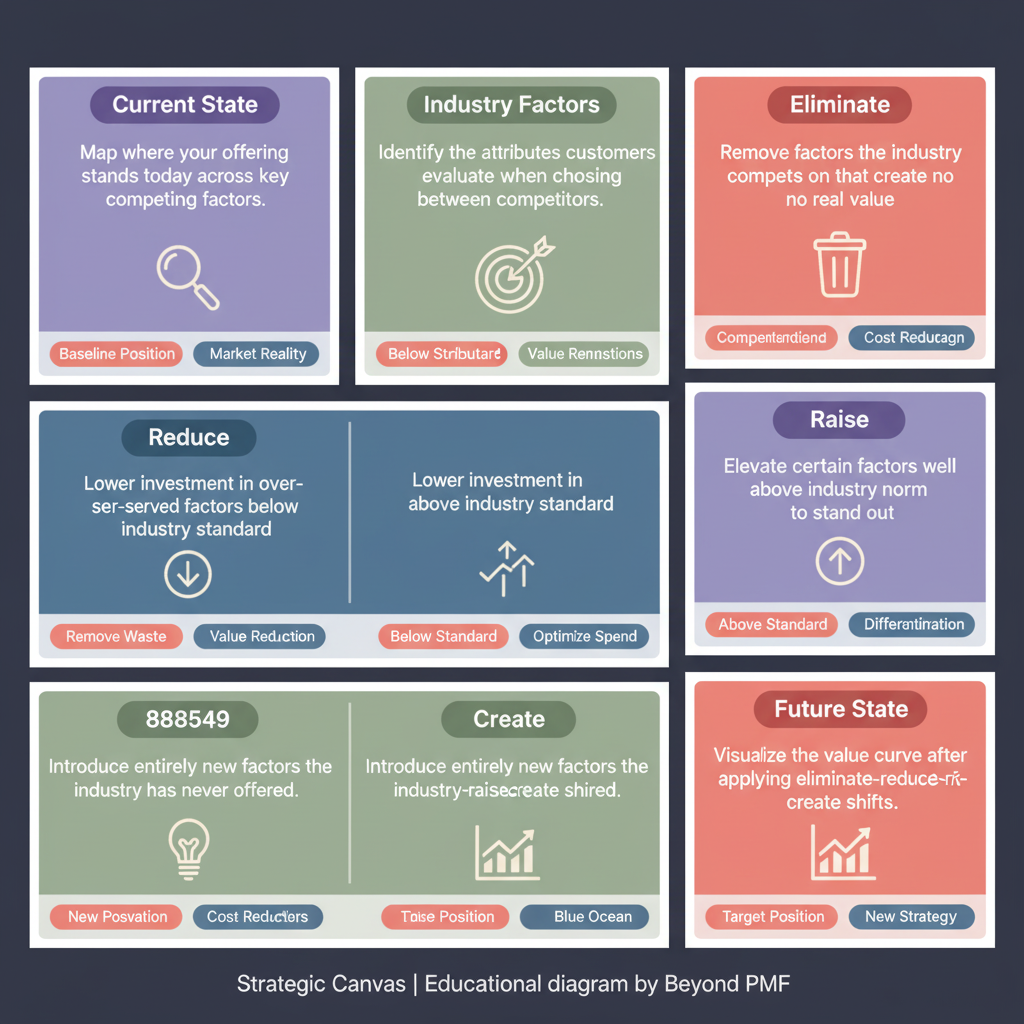
Strategic Canvas

The Strategic Canvas directly addresses the friction of unclear market direction and misalignment. It helps organizations map their current market position and identify new strategic opportunities for growth by visualizing and comparing factors impacting the business.

The Strategic Canvas is a central diagnostic and action framework for building a compelling blue ocean strategy. It serves as a visual depiction of the current market space. By plotting the key factors that the industry competes on and invests in, companies can easily see the areas where competition is most intense and where opportunities for blue oceans lie. This framework helps organizations break away from the competition by redefining market boundaries, thereby creating a leap in value for both the company and its customers.

Steps / Detailed Description

  • Identify the industry’s key factors of competition.
  • Assess the current state of play in the industry by plotting competitors on these key factors.
  • Determine the company's current state on the canvas versus competitors.
  • Explore ways to eliminate, reduce, raise, and create factors to craft a new value curve.
  • Draw the new strategic profile that shows how the company's offering will stand apart.

Best Practices

  • Thoroughly research and validate all market data used.
  • Engage a wide range of stakeholders for diverse perspectives.
  • Regularly update the strategic canvas to reflect changes in the market.

Pros

  • Provides a clear visual differentiation between competitors.
  • Helps identify new opportunities for growth outside of existing competitive factors.
  • Facilitates strategic thinking and innovation.

Cons

  • May oversimplify complex market dynamics.
  • Requires accurate and comprehensive market data to be effective.
  • Can lead to strategic missteps if not carefully executed.

When to Use

  • When entering a new market or industry.
  • When seeking to differentiate from competitors in a crowded market.

When Not to Use

  • In highly unstable or unpredictable markets.
  • When immediate results are required, as strategic shifts may take time to yield results.

Related Frameworks

Lifecycle

Maturity Level

Time to Implement

2–4 Weeks
3–6 Months
1–2 Weeks
3–6 Months
1–2 Months
3–6 Months
1–2 Weeks
Less Than 1 Day
1–2 Weeks
Longer Than 6 Months
1–2 Weeks
Longer Than 6 Months
1–2 Weeks
3–6 Months
1–2 Weeks
1–2 Weeks
1–2 Weeks
1–2 Weeks
1–2 Days
1–2 Weeks
1–2 Weeks
1–2 Weeks
1–2 Weeks
1–2 Weeks
1–2 Weeks
3–6 Months
1–2 Weeks
1–2 Weeks
1–2 Weeks
3–6 Months
1–2 Weeks
1–2 Weeks
2–4 Weeks
1–2 Weeks
1–2 Days
1–2 Weeks
Longer Than 6 Months
3–6 Months
Longer Than 6 Months
1–2 Weeks
Longer Than 6 Months
3–6 Months
Less Than 1 Day
3–6 Months
1–2 Months
3–6 Months
Longer Than 6 Months
3–6 Months
Less Than 1 Day
1–2 Weeks
3–6 Months
3–6 Months
1–2 Weeks
3–6 Months
1–2 Weeks
1–2 Weeks
1–2 Days
1–2 Weeks
1–2 Months
Longer Than 6 Months
1–2 Weeks
Longer Than 6 Months
1–2 Weeks
3–6 Months
1–2 Weeks
Less Than 1 Day
1–2 Weeks
3–6 Months
1–2 Weeks
3–6 Months
1–2 Weeks
1–2 Weeks
Longer Than 6 Months
Less Than 1 Day
3–6 Months
Longer Than 6 Months
1–2 Months
1–2 Weeks
Longer Than 6 Months
1–2 Weeks
3–6 Months
1–2 Weeks
1–2 Weeks
3–6 Months
Less Than 1 Day
1–2 Weeks
1–2 Weeks
3–6 Months
3–6 Months
Less Than 1 Day
1–2 Weeks
Longer Than 6 Months
1–2 Months
1–2 Weeks
1–2 Weeks
1–2 Weeks
Longer Than 6 Months

Copyright Information

Autor:
W. Chan Kim, RenΓ©e Mauborgne
2005
Publication:
Blue Ocean Strategy