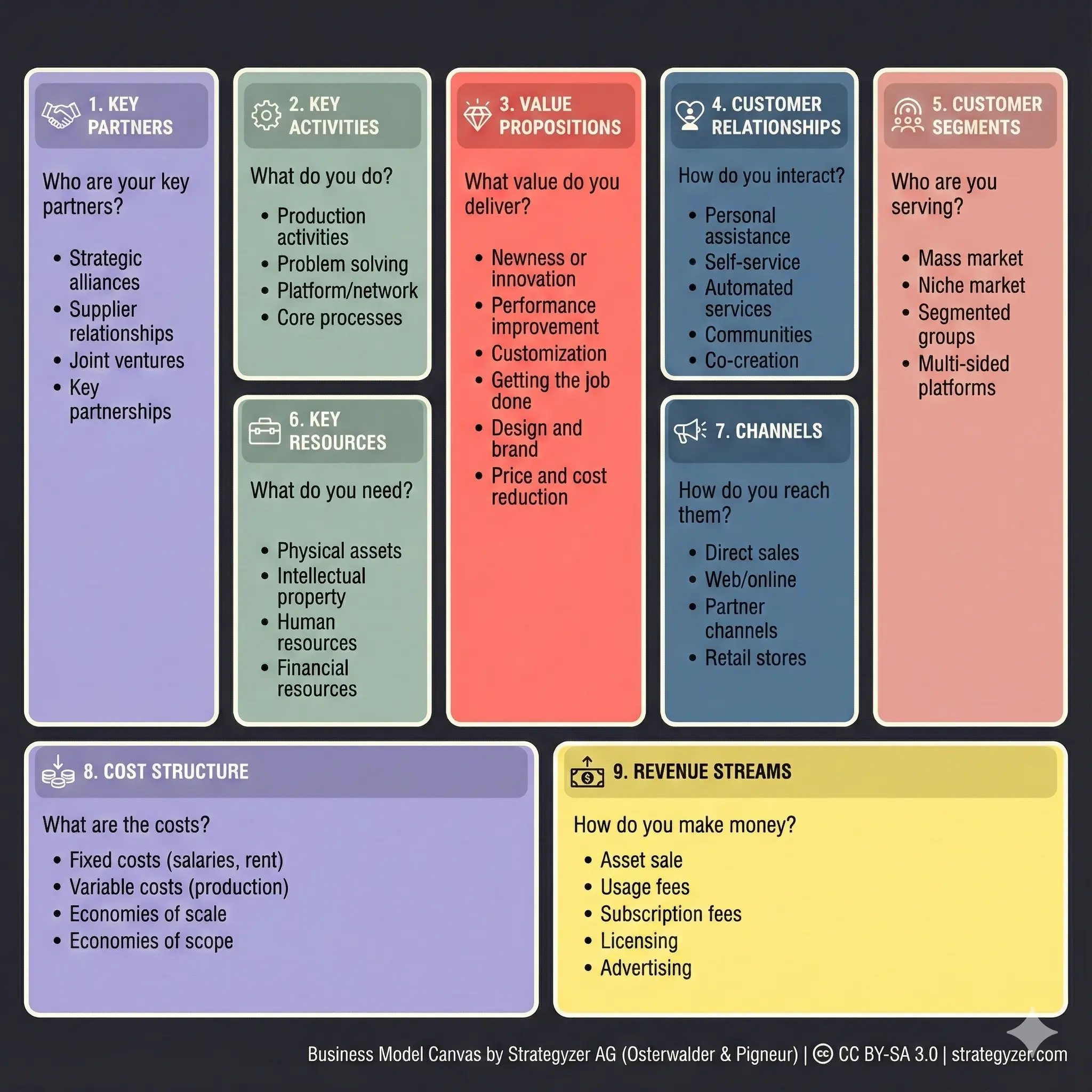
Business Model Canvas

The Business Model Canvas primarily addresses strategic friction by providing a framework to define and analyze a business model. It helps clarify direction, assess market alignment, and refine the overall vision of the business.

The Business Model Canvas is a visual chart with elements describing a firm's value proposition, infrastructure, customers, and finances. It assists firms in aligning their activities by illustrating potential trade-offs. The framework's flexibility allows it to be used by startups and established businesses alike, providing a clear method to communicate business ideas and strategies.

Steps / Detailed Description

Define your value propositions to clarify what makes your product or service attractive to customers. | Identify customer segments to determine who your business serves. | Map out channels to outline how your offerings are delivered to customers. | Establish customer relationships to specify the type of relationship you establish with different customer segments. | Determine revenue streams to identify how the business makes money from each customer segment. | List key resources to detail the assets required to offer and deliver the previously described elements. | Describe key activities to outline the most important actions the company must take to operate successfully. | Identify key partnerships to list the network of suppliers and partners that make the business model work. | Define cost structure to describe all costs incurred to operate the business model.

Best Practices

Regularly update the canvas to reflect changes in the business environment | Use it as a living document, not a one-time strategy tool | Involve stakeholders from different parts of the business to gain diverse insights

Pros

Provides a clear overview of the business model | Encourages strategic thinking and alignment | Facilitates understanding and discussion across different teams

Cons

May oversimplify the complexities of some businesses | Requires frequent updates as business conditions change | Can be less effective without thorough market and business analysis

When to Use

When starting a new business or product line | When planning strategic shifts or reassessing existing business models

When Not to Use

For detailed financial planning or operational logistics | When a quick, tactical decision is needed without the need for deep strategic analysis

Related Frameworks

Lifecycle

Scope

Scope not defined

Maturity Level

Maturity level not specified

Time to Implement

2–4 Weeks
3–6 Months
1–2 Weeks
3–6 Months
1–2 Months
3–6 Months
1–2 Weeks
Less Than 1 Day
1–2 Weeks
Longer Than 6 Months
1–2 Weeks
Longer Than 6 Months
1–2 Weeks
3–6 Months
1–2 Weeks
1–2 Weeks
1–2 Weeks
1–2 Weeks
1–2 Days
1–2 Weeks
1–2 Weeks
1–2 Weeks
1–2 Weeks
1–2 Weeks
1–2 Weeks
3–6 Months
1–2 Weeks
1–2 Weeks
1–2 Weeks
3–6 Months
1–2 Weeks
1–2 Weeks
2–4 Weeks
1–2 Weeks
1–2 Days
1–2 Weeks
Longer Than 6 Months
3–6 Months
Longer Than 6 Months
1–2 Weeks
Longer Than 6 Months
3–6 Months
Less Than 1 Day
3–6 Months
1–2 Months
3–6 Months
Longer Than 6 Months
3–6 Months
Less Than 1 Day
1–2 Weeks
3–6 Months
3–6 Months
1–2 Weeks
3–6 Months
1–2 Weeks
1–2 Weeks
1–2 Days
1–2 Weeks
1–2 Months
Longer Than 6 Months
1–2 Weeks
Longer Than 6 Months
1–2 Weeks
3–6 Months
1–2 Weeks
Less Than 1 Day
1–2 Weeks
3–6 Months
1–2 Weeks
3–6 Months
1–2 Weeks
1–2 Weeks
Longer Than 6 Months
Less Than 1 Day
3–6 Months
Longer Than 6 Months
1–2 Months
1–2 Weeks
Longer Than 6 Months
1–2 Weeks
3–6 Months
1–2 Weeks
1–2 Weeks
3–6 Months
Less Than 1 Day
1–2 Weeks
1–2 Weeks
3–6 Months
3–6 Months
Less Than 1 Day
1–2 Weeks
Longer Than 6 Months
1–2 Months
1–2 Weeks
1–2 Weeks
1–2 Weeks
Longer Than 6 Months

Copyright Information

Autor:
Alexander Osterwalder, Yves Pigneur
2008
Publication:
Strategyzer AG