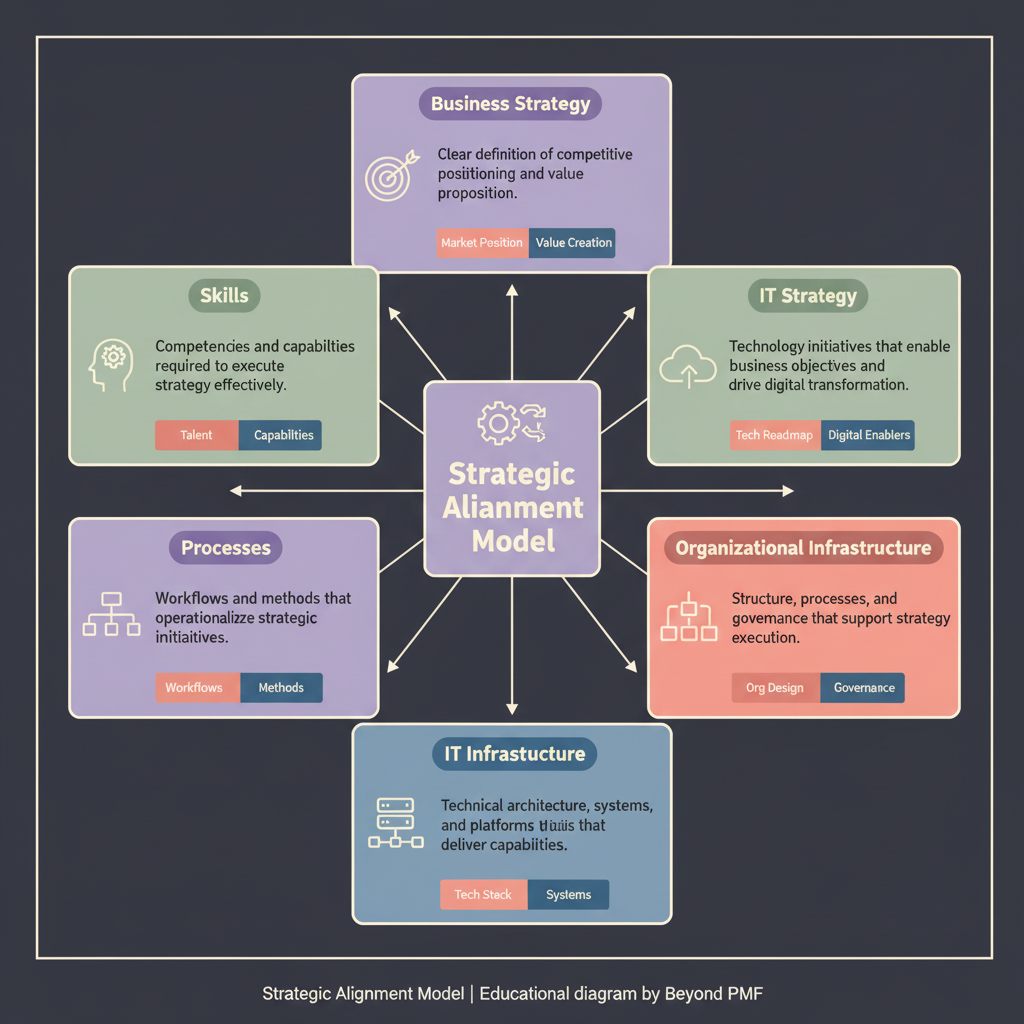
Strategic Alignment Model

https://ik.imagekit.io/beyondpmf/frameworks/strategic-alignment-model.png
The Strategic Alignment Model primarily addresses the friction caused by misaligned IT and business strategies. It aims to resolve unclear direction and conflicting priorities that can arise when these two critical areas of an organization are not working in harmony.

The Strategic Alignment Model (SAM) is a framework designed to ensure that an organization's information technology supports its business objectives. This model emphasizes the importance of aligning IT strategy with business strategy to drive innovation, operational efficiency, and competitive advantage. It provides a structured approach to assess and adjust alignments between business and IT strategies, ensuring they are mutually supportive and geared towards achieving the organization's strategic goals.

Steps / Detailed Description

Define business strategy: Establish clear business objectives and strategic goals. | Assess current IT capabilities: Evaluate existing IT infrastructure and its ability to support the business strategy. | Identify alignment gaps: Determine discrepancies between current IT capabilities and business needs. | Develop alignment strategy: Create a plan to align IT capabilities with business objectives, including adjustments in IT infrastructure, resources, and processes. | Implement changes: Execute the alignment strategy, making necessary changes to IT to support business goals. | Monitor and adjust: Continuously monitor the alignment and make adjustments as business strategies evolve or new technologies emerge.

Best Practices

Regularly review and update the alignment as strategies evolve | Ensure strong communication channels between IT and business units | Involve leadership to foster commitment and provide direction

Pros

Enhances strategic coherence between IT and business goals | Improves organizational performance by optimizing IT resources | Increases agility in responding to market changes

Cons

Can be resource-intensive in terms of time and costs | Requires high level of commitment and communication across departments | May lead to short-term disruptions during implementation

When to Use

When undergoing significant changes in business strategy | When IT is not effectively supporting business objectives

When Not to Use

In very small organizations where IT and business strategies are naturally aligned | When rapid, temporary solutions are needed without long-term strategic focus

Related Frameworks

Lifecycle

Not tied to a specific lifecycle stage

Scope

Scope not defined

Maturity Level

Maturity level not specified

Time to Implement

2–4 Weeks
3–6 Months
1–2 Weeks
3–6 Months
1–2 Months
3–6 Months
1–2 Weeks
Less Than 1 Day
1–2 Weeks
Longer Than 6 Months
1–2 Weeks
Longer Than 6 Months
1–2 Weeks
3–6 Months
1–2 Weeks
1–2 Weeks
1–2 Weeks
1–2 Weeks
1–2 Days
1–2 Weeks
1–2 Weeks
1–2 Weeks
1–2 Weeks
1–2 Weeks
1–2 Weeks
3–6 Months
1–2 Weeks
1–2 Weeks
1–2 Weeks
3–6 Months
1–2 Weeks
1–2 Weeks
2–4 Weeks
1–2 Weeks
1–2 Days
1–2 Weeks
Longer Than 6 Months
3–6 Months
Longer Than 6 Months
1–2 Weeks
Longer Than 6 Months
3–6 Months
Less Than 1 Day
3–6 Months
1–2 Months
3–6 Months
Longer Than 6 Months
3–6 Months
Less Than 1 Day
1–2 Weeks
3–6 Months
3–6 Months
1–2 Weeks
3–6 Months
1–2 Weeks
1–2 Weeks
1–2 Days
1–2 Weeks
1–2 Months
Longer Than 6 Months
1–2 Weeks
Longer Than 6 Months
1–2 Weeks
3–6 Months
1–2 Weeks
Less Than 1 Day
1–2 Weeks
3–6 Months
1–2 Weeks
3–6 Months
1–2 Weeks
1–2 Weeks
Longer Than 6 Months
Less Than 1 Day
3–6 Months
Longer Than 6 Months
1–2 Months
1–2 Weeks
Longer Than 6 Months
1–2 Weeks
3–6 Months
1–2 Weeks
1–2 Weeks
3–6 Months
Less Than 1 Day
1–2 Weeks
1–2 Weeks
3–6 Months
3–6 Months
Less Than 1 Day
1–2 Weeks
Longer Than 6 Months
1–2 Months
1–2 Weeks
1–2 Weeks
1–2 Weeks
Longer Than 6 Months

Copyright Information

Autor:
John F. Rockart and Michael Earl
1989
Publication:
Sloan Management Review