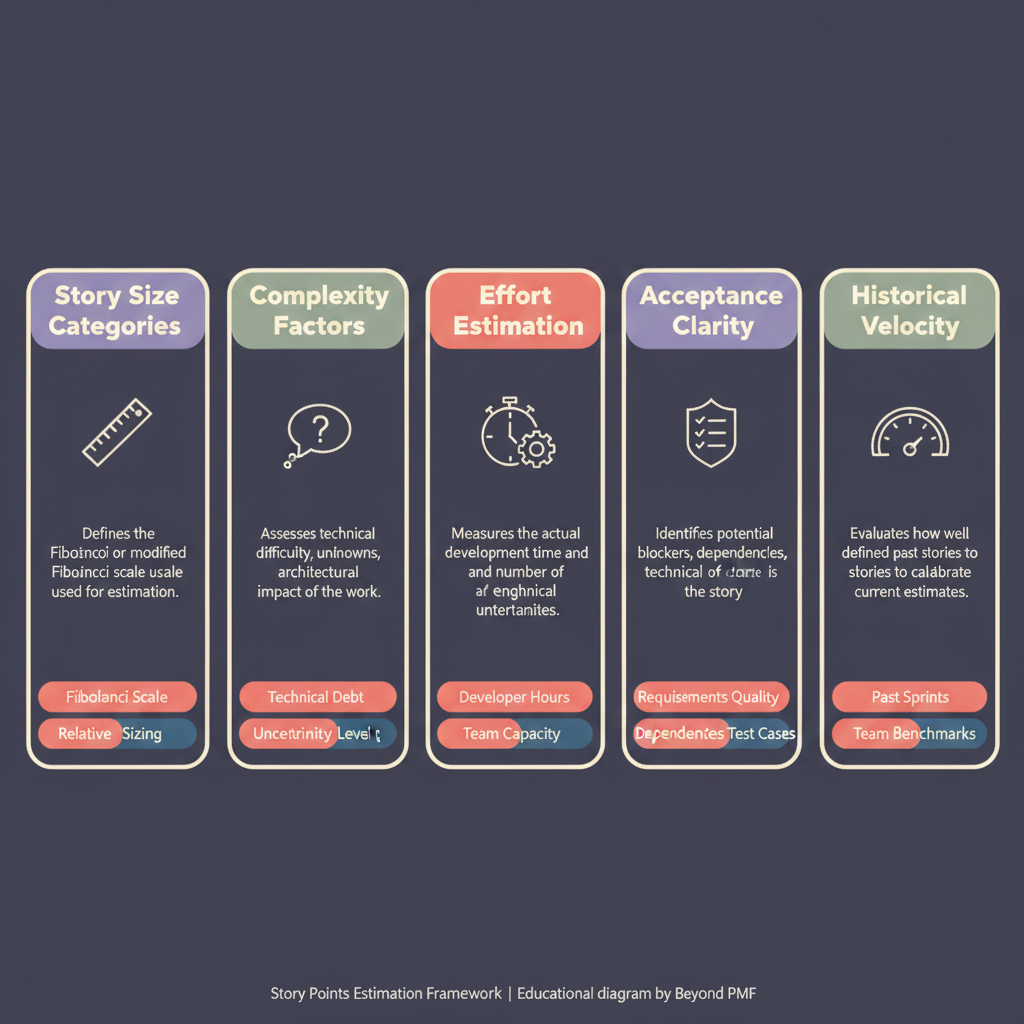
Story Points Estimation Framework

https://ik.imagekit.io/beyondpmf/frameworks/story-points-estimation-framework.png
The Story Points Estimation Framework addresses friction related to the speed and quality of delivering user stories in agile projects. It helps teams plan and estimate the effort required for implementation, directly impacting the execution of work and customer-facing delivery.

The Story Points Estimation Framework is a popular technique in Agile software development used to estimate the complexity of a user story. Instead of estimating the time it will take to complete a task, this framework uses 'story points', a unit of measure that encapsulates the effort, complexity, and risk associated with a story. This approach helps teams prioritize tasks and manage their workload more effectively, promoting a smoother project flow and better resource allocation.

Steps / Detailed Description

Define User Stories: Break down the project into small, manageable user stories. | Classify Complexity: Assess the complexity and effort required for each story, considering factors like risk and uncertainty. | Assign Story Points: Use a predefined scale (e.g., Fibonacci sequence) to assign points to each story based on its complexity. | Planning Poker: Engage the team in a consensus-based estimation game to finalize story points. | Calibrate and Adjust: Regularly review and adjust estimations based on team velocity and past sprints.

Best Practices

Ensure full team participation in estimation sessions | Regularly re-evaluate and adjust story points as necessary | Use historical data to guide future estimations

Pros

Encourages team consensus and collaboration | Focuses on relative effort rather than time | Adapts to team changes and historical velocity

Cons

Can be subjective and vary between teams | Requires experience to do effectively | Not suitable for all types of projects

When to Use

Agile software development projects | Projects where tasks have varying levels of complexity

When Not to Use

Highly predictable, routine tasks | Projects requiring precise time-based estimates

Related Frameworks

Categories

Lifecycle

Scope

Scope not defined

Maturity Level

Maturity level not specified

Time to Implement

2–4 Weeks
3–6 Months
1–2 Weeks
3–6 Months
1–2 Months
3–6 Months
1–2 Weeks
Less Than 1 Day
1–2 Weeks
Longer Than 6 Months
1–2 Weeks
Longer Than 6 Months
1–2 Weeks
3–6 Months
1–2 Weeks
1–2 Weeks
1–2 Weeks
1–2 Weeks
1–2 Days
1–2 Weeks
1–2 Weeks
1–2 Weeks
1–2 Weeks
1–2 Weeks
1–2 Weeks
3–6 Months
1–2 Weeks
1–2 Weeks
1–2 Weeks
3–6 Months
1–2 Weeks
1–2 Weeks
2–4 Weeks
1–2 Weeks
1–2 Days
1–2 Weeks
Longer Than 6 Months
3–6 Months
Longer Than 6 Months
1–2 Weeks
Longer Than 6 Months
3–6 Months
Less Than 1 Day
3–6 Months
1–2 Months
3–6 Months
Longer Than 6 Months
3–6 Months
Less Than 1 Day
1–2 Weeks
3–6 Months
3–6 Months
1–2 Weeks
3–6 Months
1–2 Weeks
1–2 Weeks
1–2 Days
1–2 Weeks
1–2 Months
Longer Than 6 Months
1–2 Weeks
Longer Than 6 Months
1–2 Weeks
3–6 Months
1–2 Weeks
Less Than 1 Day
1–2 Weeks
3–6 Months
1–2 Weeks
3–6 Months
1–2 Weeks
1–2 Weeks
Longer Than 6 Months
Less Than 1 Day
3–6 Months
Longer Than 6 Months
1–2 Months
1–2 Weeks
Longer Than 6 Months
1–2 Weeks
3–6 Months
1–2 Weeks
1–2 Weeks
3–6 Months
Less Than 1 Day
1–2 Weeks
1–2 Weeks
3–6 Months
3–6 Months
Less Than 1 Day
1–2 Weeks
Longer Than 6 Months
1–2 Months
1–2 Weeks
1–2 Weeks
1–2 Weeks
Longer Than 6 Months

Copyright Information

Autor:
Public Domain
N/A
Publication:
Generic Business Tool