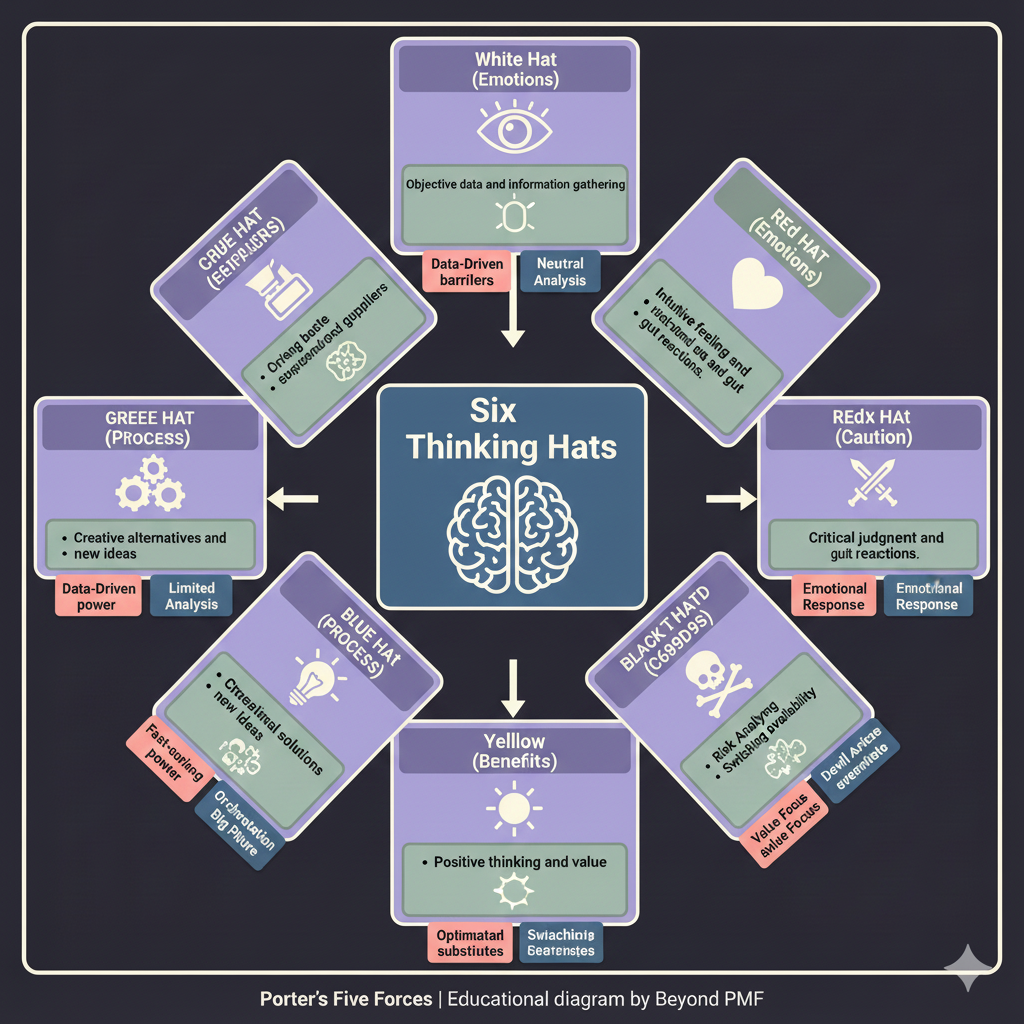
The Six Thinking Hats, developed by Edward de Bono, is a framework designed to enhance the process of decision-making and problem-solving in groups. Each 'hat' represents a different perspective or approach to thinking, encouraging participants to switch their way of thinking to view problems from multiple angles. This method helps in reducing conflict, ensuring more thorough exploration of ideas, and fostering constructive and creative thinking. It is widely used in business meetings, educational settings, and workshops to facilitate effective communication and innovative solutions.
White Hat: Focus on available data and information, looking objectively at the facts. | Red Hat: Express emotions and feelings and share fears, likes, and dislikes without explanation. | Black Hat: Consider the difficulties and potential problems. Why something may not work. | Yellow Hat: Think optimistically and explore the values and benefits; why something will work. | Green Hat: Think creatively, suggesting alternatives, possibilities, and new ideas. | Blue Hat: Manage the thinking process, ensuring that the Six Thinking Hats guidelines are followed, and summarizing and concluding.
Ensure all participants understand the role of each hat | Rotate hats to get a variety of perspectives | Use the Blue Hat to manage the process effectively
Promotes comprehensive exploration of issues | Minimizes confrontations by separating ego from performance | Encourages creativity and innovation
May be time-consuming to apply all hats | Requires training and practice to be effective | Can be overly simplistic for complex decisions
When needing to overcome deadlock in decision-making | When diverse perspectives are needed to solve a problem
In situations requiring quick, decisive action | When the group is not familiar with the framework