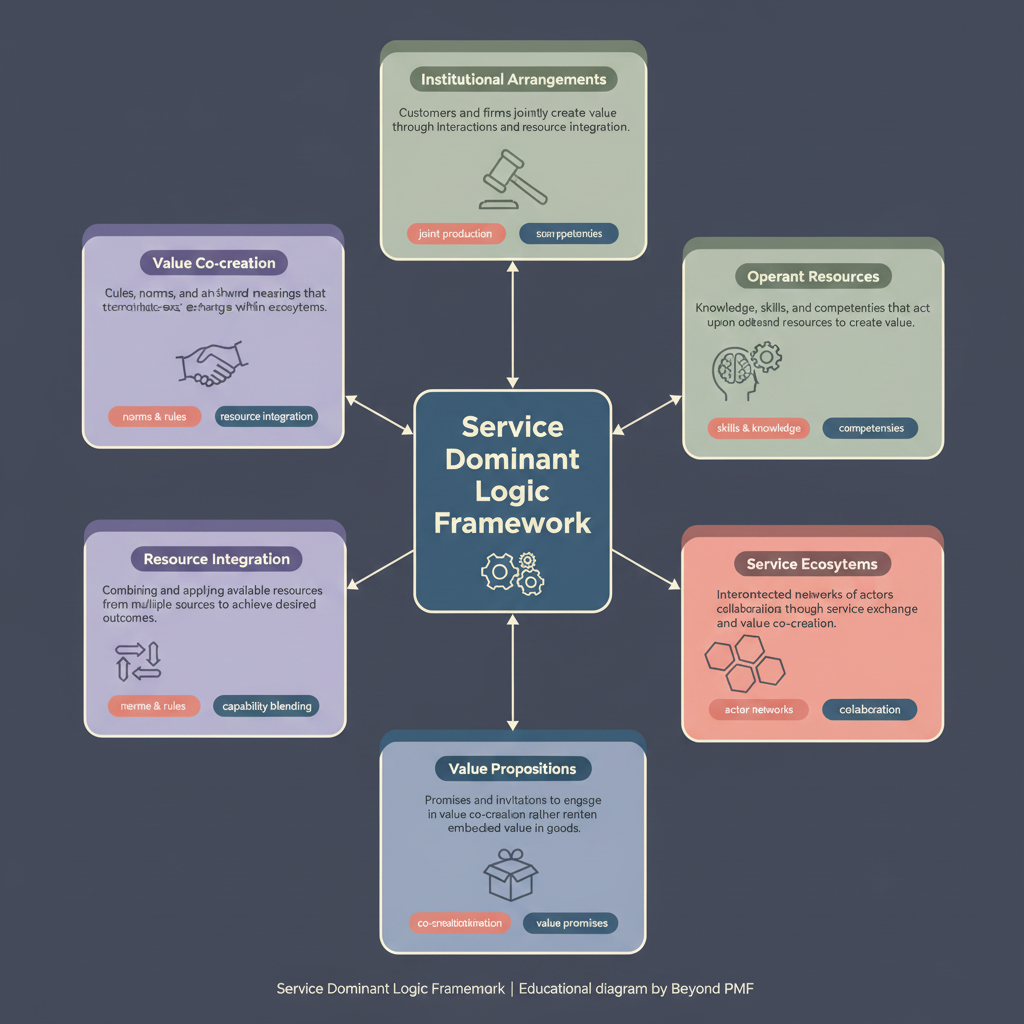
Service Dominant Logic Framework

https://ik.imagekit.io/beyondpmf/frameworks/service-dominant-logic-framework.png
The Service Dominant Logic Framework fundamentally challenges a traditional goods-dominant perspective, which can create friction in a company's strategic direction. It guides businesses in redefining their value proposition and strategy to focus on service, customer value co-creation, and market alignment.

The Service Dominant Logic Framework is a business approach that views service, rather than goods, as the fundamental basis of economic exchange. This perspective prioritizes the intangible aspects of products and services, such as customer experience and interaction, over the tangible. It is used to enhance value creation through collaborative processes and is beneficial for developing deeper customer relationships and more sustainable business models.

Steps / Detailed Description

Identify core competencies that can be transformed into service offerings. | Engage customers to understand their needs and expectations. | Design service processes that facilitate interaction and value co-creation. | Implement feedback mechanisms to continuously improve service offerings. | Measure the impact of service-dominant strategies on customer satisfaction and business performance.

Best Practices

Foster a company-wide service-oriented culture | Regularly update and train staff on customer interaction techniques | Utilize technology to enhance service delivery and feedback collection

Pros

Enhances customer engagement and loyalty | Facilitates sustainable competitive advantage | Promotes innovation through customer insights

Cons

Requires cultural and organizational change | Can be resource-intensive to implement | Difficult to quantify benefits in the short term

When to Use

In industries where differentiation based on physical products is limited | When aiming to build long-term customer relationships

When Not to Use

In markets dominated by price competition and commoditized goods | When quick, transactional sales are the primary business goal

Related Frameworks

Lifecycle

Not tied to a specific lifecycle stage

Scope

Scope not defined

Maturity Level

Maturity level not specified

Time to Implement

2–4 Weeks
3–6 Months
1–2 Weeks
3–6 Months
1–2 Months
3–6 Months
1–2 Weeks
Less Than 1 Day
1–2 Weeks
Longer Than 6 Months
1–2 Weeks
Longer Than 6 Months
1–2 Weeks
3–6 Months
1–2 Weeks
1–2 Weeks
1–2 Weeks
1–2 Weeks
1–2 Days
1–2 Weeks
1–2 Weeks
1–2 Weeks
1–2 Weeks
1–2 Weeks
1–2 Weeks
3–6 Months
1–2 Weeks
1–2 Weeks
1–2 Weeks
3–6 Months
1–2 Weeks
1–2 Weeks
2–4 Weeks
1–2 Weeks
1–2 Days
1–2 Weeks
Longer Than 6 Months
3–6 Months
Longer Than 6 Months
1–2 Weeks
Longer Than 6 Months
3–6 Months
Less Than 1 Day
3–6 Months
1–2 Months
3–6 Months
Longer Than 6 Months
3–6 Months
Less Than 1 Day
1–2 Weeks
3–6 Months
3–6 Months
1–2 Weeks
3–6 Months
1–2 Weeks
1–2 Weeks
1–2 Days
1–2 Weeks
1–2 Months
Longer Than 6 Months
1–2 Weeks
Longer Than 6 Months
1–2 Weeks
3–6 Months
1–2 Weeks
Less Than 1 Day
1–2 Weeks
3–6 Months
1–2 Weeks
3–6 Months
1–2 Weeks
1–2 Weeks
Longer Than 6 Months
Less Than 1 Day
3–6 Months
Longer Than 6 Months
1–2 Months
1–2 Weeks
Longer Than 6 Months
1–2 Weeks
3–6 Months
1–2 Weeks
1–2 Weeks
3–6 Months
Less Than 1 Day
1–2 Weeks
1–2 Weeks
3–6 Months
3–6 Months
Less Than 1 Day
1–2 Weeks
Longer Than 6 Months
1–2 Months
1–2 Weeks
1–2 Weeks
1–2 Weeks
Longer Than 6 Months

Copyright Information

Autor:
Robert F. Lusch and Stephen L. Vargo
2004
Publication:
Journal of Marketing