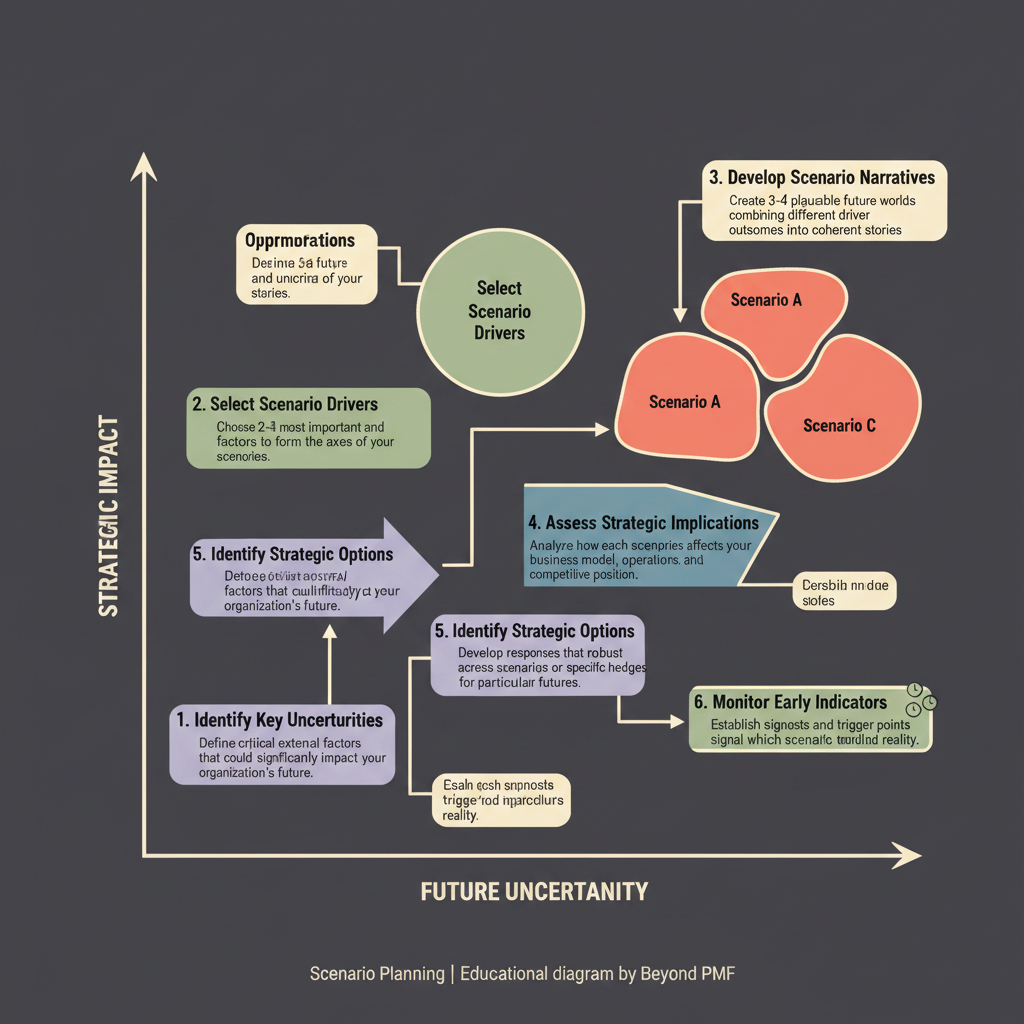
Scenario Planning

https://ik.imagekit.io/beyondpmf/frameworks/scenario-planning.png
Scenario Planning directly addresses the friction of unclear direction and lack of strategic foresight. It helps organizations build flexible plans by considering multiple plausible future states, mitigating the risk of being blindsided by unexpected changes in the market or environment.

Scenario Planning involves identifying external trends and uncertainties to create several plausible future scenarios. This framework helps organizations anticipate possible futures and develop strategies that are robust under a variety of conditions. It is particularly beneficial for enhancing strategic thinking and decision-making under uncertainty, allowing businesses to adapt more effectively to potential changes in their environment.

Steps / Detailed Description

Identify key decision factors and external forces. | Research and gather data on trends and uncertainties. | Develop a range of plausible scenarios based on this data. | Analyze the impact of each scenario on the organization. | Formulate strategic options and plans for each scenario. | Implement monitoring systems to track indicators related to scenarios.

Best Practices

Involve a diverse group of stakeholders for comprehensive perspectives. | Regularly update scenarios as new information becomes available. | Focus on actionable insights rather than just theoretical scenarios.

Pros

Enhances flexibility in strategic planning. | Improves resilience by preparing for multiple outcomes. | Encourages innovative thinking by exploring various futures.

Cons

Can be time-consuming and resource-intensive. | May lead to analysis paralysis if not managed well. | Relies heavily on the accuracy of future assumptions.

When to Use

In industries experiencing high levels of uncertainty. | When long-term strategic planning is essential.

When Not to Use

In highly stable environments with predictable outcomes. | When quick decision-making is required.

Related Frameworks

Scope

Scope not defined

Maturity Level

Maturity level not specified

Time to Implement

2–4 Weeks
3–6 Months
1–2 Weeks
3–6 Months
1–2 Months
3–6 Months
1–2 Weeks
Less Than 1 Day
1–2 Weeks
Longer Than 6 Months
1–2 Weeks
Longer Than 6 Months
1–2 Weeks
3–6 Months
1–2 Weeks
1–2 Weeks
1–2 Weeks
1–2 Weeks
1–2 Days
1–2 Weeks
1–2 Weeks
1–2 Weeks
1–2 Weeks
1–2 Weeks
1–2 Weeks
3–6 Months
1–2 Weeks
1–2 Weeks
1–2 Weeks
3–6 Months
1–2 Weeks
1–2 Weeks
2–4 Weeks
1–2 Weeks
1–2 Days
1–2 Weeks
Longer Than 6 Months
3–6 Months
Longer Than 6 Months
1–2 Weeks
Longer Than 6 Months
3–6 Months
Less Than 1 Day
3–6 Months
1–2 Months
3–6 Months
Longer Than 6 Months
3–6 Months
Less Than 1 Day
1–2 Weeks
3–6 Months
3–6 Months
1–2 Weeks
3–6 Months
1–2 Weeks
1–2 Weeks
1–2 Days
1–2 Weeks
1–2 Months
Longer Than 6 Months
1–2 Weeks
Longer Than 6 Months
1–2 Weeks
3–6 Months
1–2 Weeks
Less Than 1 Day
1–2 Weeks
3–6 Months
1–2 Weeks
3–6 Months
1–2 Weeks
1–2 Weeks
Longer Than 6 Months
Less Than 1 Day
3–6 Months
Longer Than 6 Months
1–2 Months
1–2 Weeks
Longer Than 6 Months
1–2 Weeks
3–6 Months
1–2 Weeks
1–2 Weeks
3–6 Months
Less Than 1 Day
1–2 Weeks
1–2 Weeks
3–6 Months
3–6 Months
Less Than 1 Day
1–2 Weeks
Longer Than 6 Months
1–2 Months
1–2 Weeks
1–2 Weeks
1–2 Weeks
Longer Than 6 Months

Copyright Information

Autor:
Royal Dutch Shell
1970s
Publication:
Royal Dutch Shell