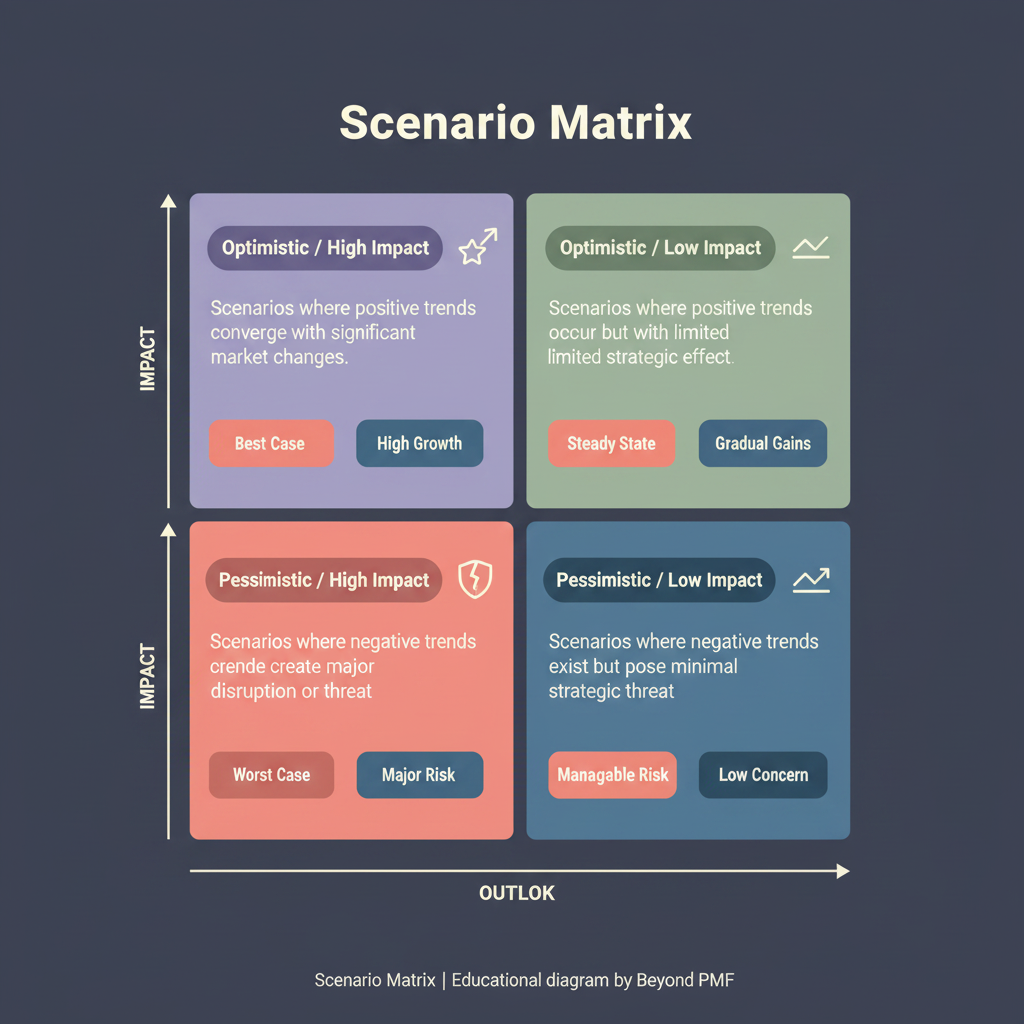
The Scenario Matrix framework allows organizations to map out possible future scenarios by crossing two critical uncertainties. Each axis represents a different dimension with extremes at either end, creating four quadrants that depict potential scenarios. This visualization aids in strategic planning by enabling businesses to prepare for various possible futures, enhancing adaptability and strategic alignment.
Identify two key uncertainties that could impact your business. | Define the extremes for each uncertainty to form the axes of the matrix. | Develop detailed descriptions for each of the four resulting quadrants. | Analyze the implications of each scenario for strategic planning. | Develop strategies tailored to each scenario to mitigate risks and leverage opportunities.
Choose uncertainties that are truly critical and have a high degree of uncertainty. | Involve stakeholders from various parts of the organization for diverse perspectives. | Regularly update scenarios as external conditions change.
Facilitates comprehensive exploration of potential futures. | Enhances strategic adaptability to different possible outcomes. | Helps in identifying risk mitigation strategies and opportunities.
Can be overly simplistic if not enough variables are considered. | Depends heavily on the accuracy of the identified uncertainties. | May lead to planning fatigue if too many scenarios are considered.
In strategic planning sessions to prepare for future uncertainties. | When entering new markets or launching new products.
When the future is relatively certain and stable. | For detailed operational planning.