SAFe (Scaled Agile Framework)

https://ik.imagekit.io/beyondpmf/frameworks/safe-scaled-agile-framework.png
SAFe primarily addresses friction related to organizational design and cross-functional alignment within large enterprises. It provides a framework for structuring teams and workflows to enable effective collaboration and communication across different departments and teams.

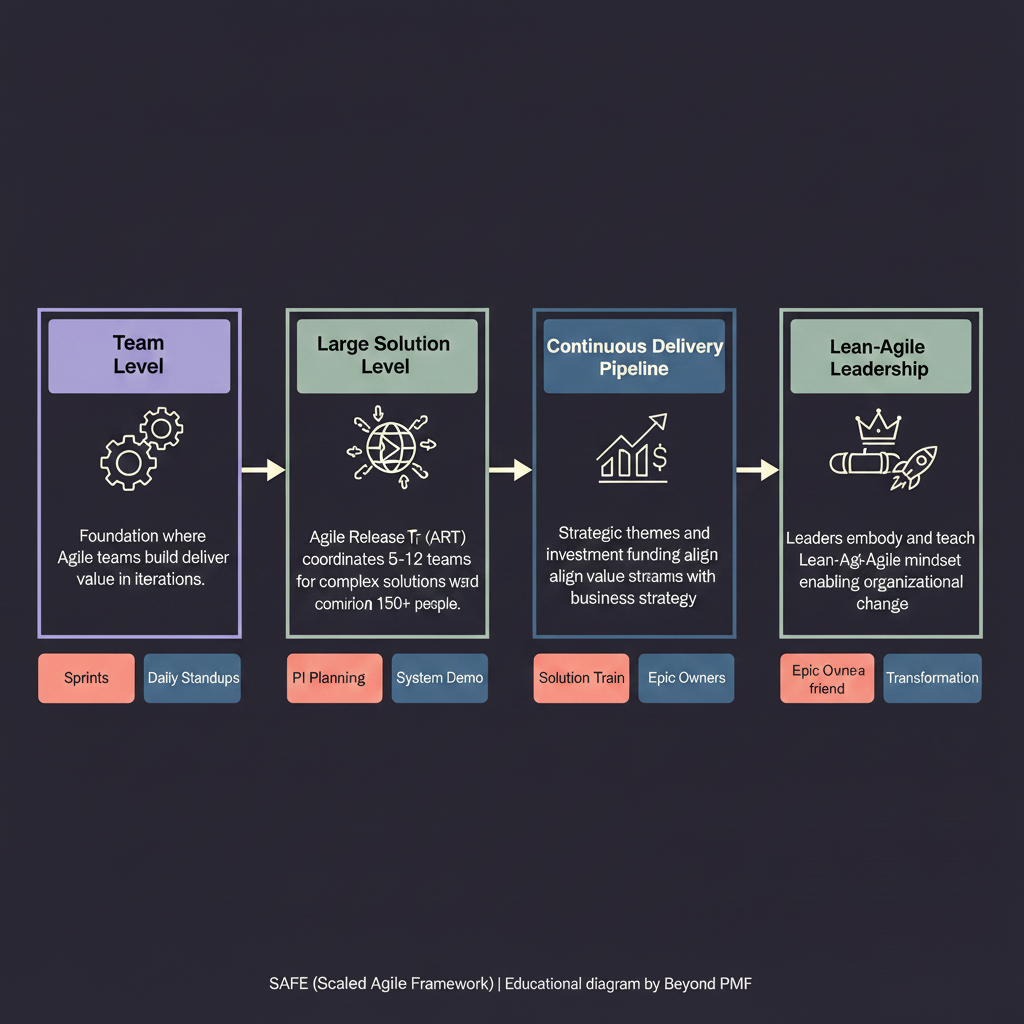
The Scaled Agile Framework (SAFe) is a framework for scaling agile practices across large enterprises. It provides a structured approach for aligning strategy with execution, allowing organizations to manage complex projects across multiple teams. SAFe combines principles from Agile, lean, and product development flow to promote faster time-to-market, increased productivity, and improved quality.

Steps / Detailed Description

Implement Lean-Agile Leadership: Embrace a mindset of lean and agile practices at all levels of the organization. | Create a Lean Portfolio: Align project portfolios with enterprise strategy, funding, and agile operations. | Establish Agile Release Trains (ARTs): Organize cross-functional teams into ARTs that deliver value in a coordinated manner. | Build Solutions with Agile Product Delivery: Focus on delivering high-quality, customer-centric solutions using DevOps, Continuous Delivery, and Release on Demand. | Adopt a Continuous Learning Culture: Encourage learning and innovation through relentless improvement and a Lean-Agile mindset.

Best Practices

Train and empower Lean-Agile leaders at all levels. | Establish clear roles and responsibilities. | Regularly evaluate progress and adapt processes as needed.

Pros

Facilitates large-scale coordination | Improves alignment between business and IT | Enhances transparency and productivity

Cons

Can be overly complex and rigid | Requires significant organizational change | May be difficult to implement in smaller organizations

When to Use

Large organizations with multiple teams | Complex projects requiring coordination across teams

When Not to Use

Small projects or startups | Organizations with a strong resistance to change

Related Frameworks

Categories

Lifecycle

Scope

Scope not defined

Maturity Level

Maturity level not specified

Time to Implement

2–4 Weeks
3–6 Months
1–2 Weeks
3–6 Months
1–2 Months
3–6 Months
1–2 Weeks
Less Than 1 Day
1–2 Weeks
Longer Than 6 Months
1–2 Weeks
Longer Than 6 Months
1–2 Weeks
3–6 Months
1–2 Weeks
1–2 Weeks
1–2 Weeks
1–2 Weeks
1–2 Days
1–2 Weeks
1–2 Weeks
1–2 Weeks
1–2 Weeks
1–2 Weeks
1–2 Weeks
3–6 Months
1–2 Weeks
1–2 Weeks
1–2 Weeks
3–6 Months
1–2 Weeks
1–2 Weeks
2–4 Weeks
1–2 Weeks
1–2 Days
1–2 Weeks
Longer Than 6 Months
3–6 Months
Longer Than 6 Months
1–2 Weeks
Longer Than 6 Months
3–6 Months
Less Than 1 Day
3–6 Months
1–2 Months
3–6 Months
Longer Than 6 Months
3–6 Months
Less Than 1 Day
1–2 Weeks
3–6 Months
3–6 Months
1–2 Weeks
3–6 Months
1–2 Weeks
1–2 Weeks
1–2 Days
1–2 Weeks
1–2 Months
Longer Than 6 Months
1–2 Weeks
Longer Than 6 Months
1–2 Weeks
3–6 Months
1–2 Weeks
Less Than 1 Day
1–2 Weeks
3–6 Months
1–2 Weeks
3–6 Months
1–2 Weeks
1–2 Weeks
Longer Than 6 Months
Less Than 1 Day
3–6 Months
Longer Than 6 Months
1–2 Months
1–2 Weeks
Longer Than 6 Months
1–2 Weeks
3–6 Months
1–2 Weeks
1–2 Weeks
3–6 Months
Less Than 1 Day
1–2 Weeks
1–2 Weeks
3–6 Months
3–6 Months
Less Than 1 Day
1–2 Weeks
Longer Than 6 Months
1–2 Months
1–2 Weeks
1–2 Weeks
1–2 Weeks
Longer Than 6 Months

Copyright Information

Autor:
Dean Leffingwell
2011
Publication:
Scaled Agile, Inc.