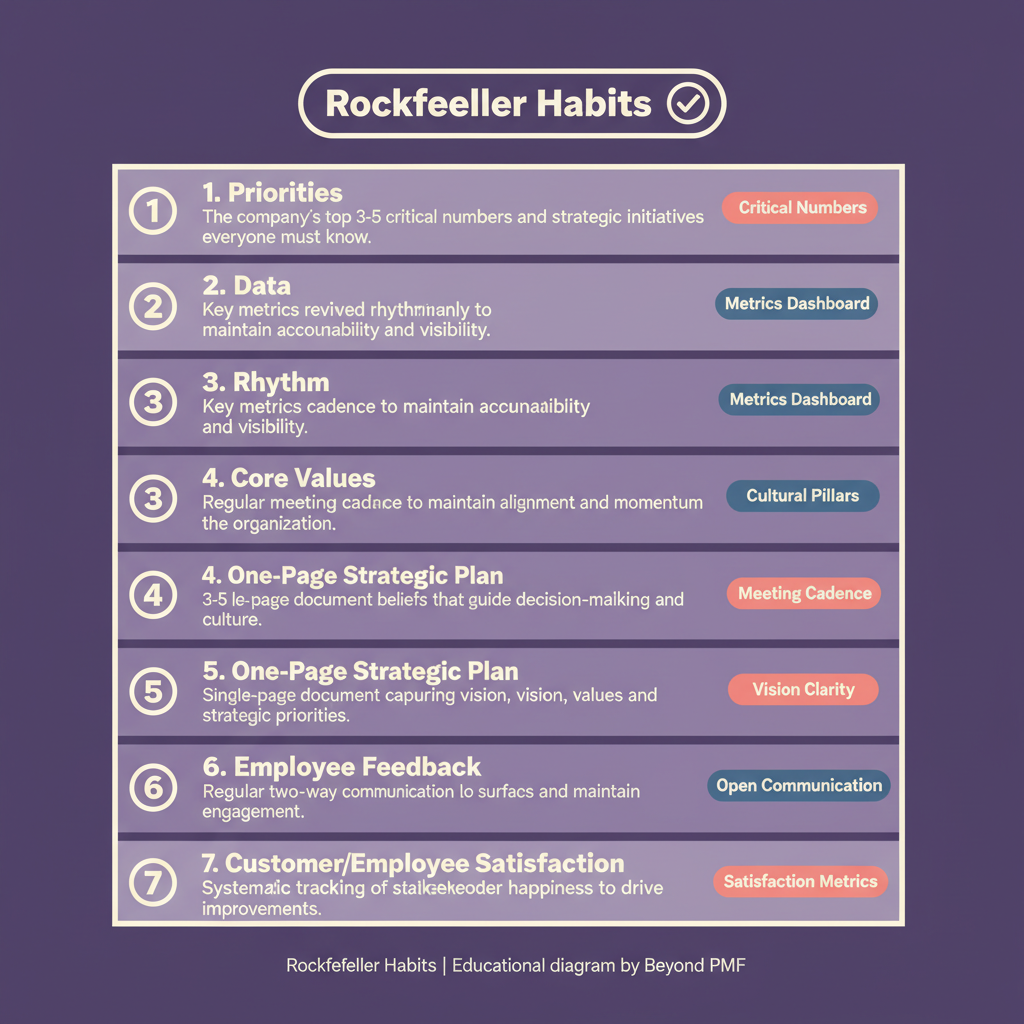
Rockefeller Habits

https://ik.imagekit.io/beyondpmf/frameworks/rockefeller-habits.png
The Rockefeller Habits focus on establishing core practices and processes to improve efficiency and scalability. They address issues related to workflows, coordination, and operational governance within a business.

The Rockefeller Habits framework is based on the leadership and management principles used by John D. Rockefeller, one of the most successful businessmen in history. It focuses on prioritizing, setting measurable goals, and establishing a rhythm of execution to drive scalability and efficiency within an organization. The framework is widely adopted for its structured approach to improving strategic planning, communication, and accountability across all levels of a company.

Steps / Detailed Description

Establish the executive team's priorities and a clear Big Hairy Audacious Goal (BHAG). | Set measurable quarterly and annual objectives for the company. | Implement a structured communication rhythm to align the team and address issues efficiently. | Develop a culture of accountability by having clear metrics for performance tracking. | Foster an environment of continuous learning and improvement.

Best Practices

Regularly review and adjust priorities to stay aligned with market conditions. | Ensure all team members are fully trained on the framework's principles. | Use technology to track progress and facilitate communication.

Pros

Improves strategic alignment and focus | Enhances accountability and performance tracking | Facilitates effective communication and problem-solving

Cons

Can be rigid and inflexible in dynamic markets | May require significant time investment to implement effectively | Potentially overwhelming for smaller teams

When to Use

When scaling a business for growth | When needing to improve organizational alignment and execution

When Not to Use

In highly volatile industries where flexibility is crucial | When the organization is not ready to commit to a structured framework

Related Frameworks

Lifecycle

Not tied to a specific lifecycle stage

Scope

Scope not defined

Maturity Level

Maturity level not specified

Time to Implement

2–4 Weeks
3–6 Months
1–2 Weeks
3–6 Months
1–2 Months
3–6 Months
1–2 Weeks
Less Than 1 Day
1–2 Weeks
Longer Than 6 Months
1–2 Weeks
Longer Than 6 Months
1–2 Weeks
3–6 Months
1–2 Weeks
1–2 Weeks
1–2 Weeks
1–2 Weeks
1–2 Days
1–2 Weeks
1–2 Weeks
1–2 Weeks
1–2 Weeks
1–2 Weeks
1–2 Weeks
3–6 Months
1–2 Weeks
1–2 Weeks
1–2 Weeks
3–6 Months
1–2 Weeks
1–2 Weeks
2–4 Weeks
1–2 Weeks
1–2 Days
1–2 Weeks
Longer Than 6 Months
3–6 Months
Longer Than 6 Months
1–2 Weeks
Longer Than 6 Months
3–6 Months
Less Than 1 Day
3–6 Months
1–2 Months
3–6 Months
Longer Than 6 Months
3–6 Months
Less Than 1 Day
1–2 Weeks
3–6 Months
3–6 Months
1–2 Weeks
3–6 Months
1–2 Weeks
1–2 Weeks
1–2 Days
1–2 Weeks
1–2 Months
Longer Than 6 Months
1–2 Weeks
Longer Than 6 Months
1–2 Weeks
3–6 Months
1–2 Weeks
Less Than 1 Day
1–2 Weeks
3–6 Months
1–2 Weeks
3–6 Months
1–2 Weeks
1–2 Weeks
Longer Than 6 Months
Less Than 1 Day
3–6 Months
Longer Than 6 Months
1–2 Months
1–2 Weeks
Longer Than 6 Months
1–2 Weeks
3–6 Months
1–2 Weeks
1–2 Weeks
3–6 Months
Less Than 1 Day
1–2 Weeks
1–2 Weeks
3–6 Months
3–6 Months
Less Than 1 Day
1–2 Weeks
Longer Than 6 Months
1–2 Months
1–2 Weeks
1–2 Weeks
1–2 Weeks
Longer Than 6 Months

Copyright Information

Autor:
Verne Harnish
N/A
Publication:
Gazelles