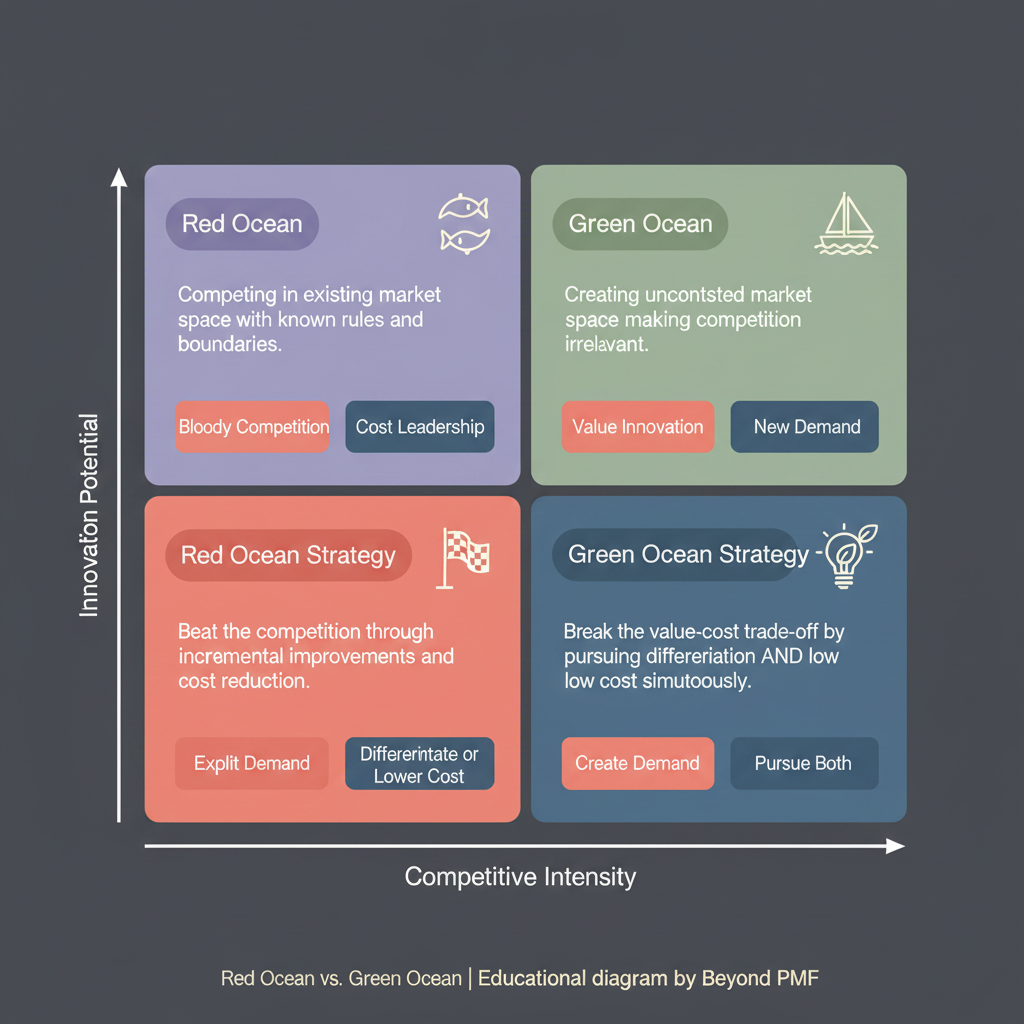
Red Ocean vs. Green Ocean

https://ik.imagekit.io/beyondpmf/frameworks/red-ocean-vs-green-ocean.png
The Red Ocean vs. Green Ocean framework addresses the primary friction of unclear market direction and lack of market alignment. It provides a strategic lens for identifying and choosing between competitive, established markets (Red Oceans) and creating new market spaces (Green Oceans) with novel offerings.

The Red Ocean vs. Green Ocean framework helps businesses identify and strategize according to the type of market environment they operate in. Red Oceans are competitive, crowded sectors where companies fight to outperform rivals and capture existing demand, often leading to reduced profits and growth. In contrast, Green Oceans represent unexplored areas or industries without intense competition, offering new demand and opportunities for highly profitable growth. This framework guides firms in deciding whether to compete in existing markets or to innovate and create new markets.

Steps / Detailed Description

Identify current market conditions and classify them as either Red or Green Ocean. | Analyze competitive factors in Red Oceans and opportunities for innovation in Green Oceans. | Develop strategic moves based on the analysis to either navigate Red Oceans more effectively or to explore and establish presence in Green Oceans.

Best Practices

Conduct thorough market research to accurately identify Red and Green Oceans. | Balance efforts between optimizing in Red Oceans and innovating for Green Oceans. | Regularly review and reassess market conditions as they can shift over time.

Pros

Provides clear distinction between competitive and non-competitive markets. | Encourages innovation by highlighting the benefits of entering less crowded markets. | Helps in strategic decision making by focusing on market conditions and potential.

Cons

May oversimplify the complexity of market dynamics. | Risk of underestimating competition in Green Oceans as they mature. | Can lead to neglect of potential opportunities in Red Oceans due to perceived competitiveness.

When to Use

When entering a new market or launching a new product. | When reevaluating business strategies in response to stagnant growth.

When Not to Use

In highly dynamic markets where the distinction between Red and Green Oceans is blurred. | When immediate short-term gains are a priority over long-term strategic positioning.

Related Frameworks

Scope

Scope not defined

Maturity Level

Maturity level not specified

Time to Implement

2–4 Weeks
3–6 Months
1–2 Weeks
3–6 Months
1–2 Months
3–6 Months
1–2 Weeks
Less Than 1 Day
1–2 Weeks
Longer Than 6 Months
1–2 Weeks
Longer Than 6 Months
1–2 Weeks
3–6 Months
1–2 Weeks
1–2 Weeks
1–2 Weeks
1–2 Weeks
1–2 Days
1–2 Weeks
1–2 Weeks
1–2 Weeks
1–2 Weeks
1–2 Weeks
1–2 Weeks
3–6 Months
1–2 Weeks
1–2 Weeks
1–2 Weeks
3–6 Months
1–2 Weeks
1–2 Weeks
2–4 Weeks
1–2 Weeks
1–2 Days
1–2 Weeks
Longer Than 6 Months
3–6 Months
Longer Than 6 Months
1–2 Weeks
Longer Than 6 Months
3–6 Months
Less Than 1 Day
3–6 Months
1–2 Months
3–6 Months
Longer Than 6 Months
3–6 Months
Less Than 1 Day
1–2 Weeks
3–6 Months
3–6 Months
1–2 Weeks
3–6 Months
1–2 Weeks
1–2 Weeks
1–2 Days
1–2 Weeks
1–2 Months
Longer Than 6 Months
1–2 Weeks
Longer Than 6 Months
1–2 Weeks
3–6 Months
1–2 Weeks
Less Than 1 Day
1–2 Weeks
3–6 Months
1–2 Weeks
3–6 Months
1–2 Weeks
1–2 Weeks
Longer Than 6 Months
Less Than 1 Day
3–6 Months
Longer Than 6 Months
1–2 Months
1–2 Weeks
Longer Than 6 Months
1–2 Weeks
3–6 Months
1–2 Weeks
1–2 Weeks
3–6 Months
Less Than 1 Day
1–2 Weeks
1–2 Weeks
3–6 Months
3–6 Months
Less Than 1 Day
1–2 Weeks
Longer Than 6 Months
1–2 Months
1–2 Weeks
1–2 Weeks
1–2 Weeks
Longer Than 6 Months

Copyright Information

Autor:
W. Chan Kim and RenΓ©e Mauborgne
2005
Publication:
Blue Ocean Strategy