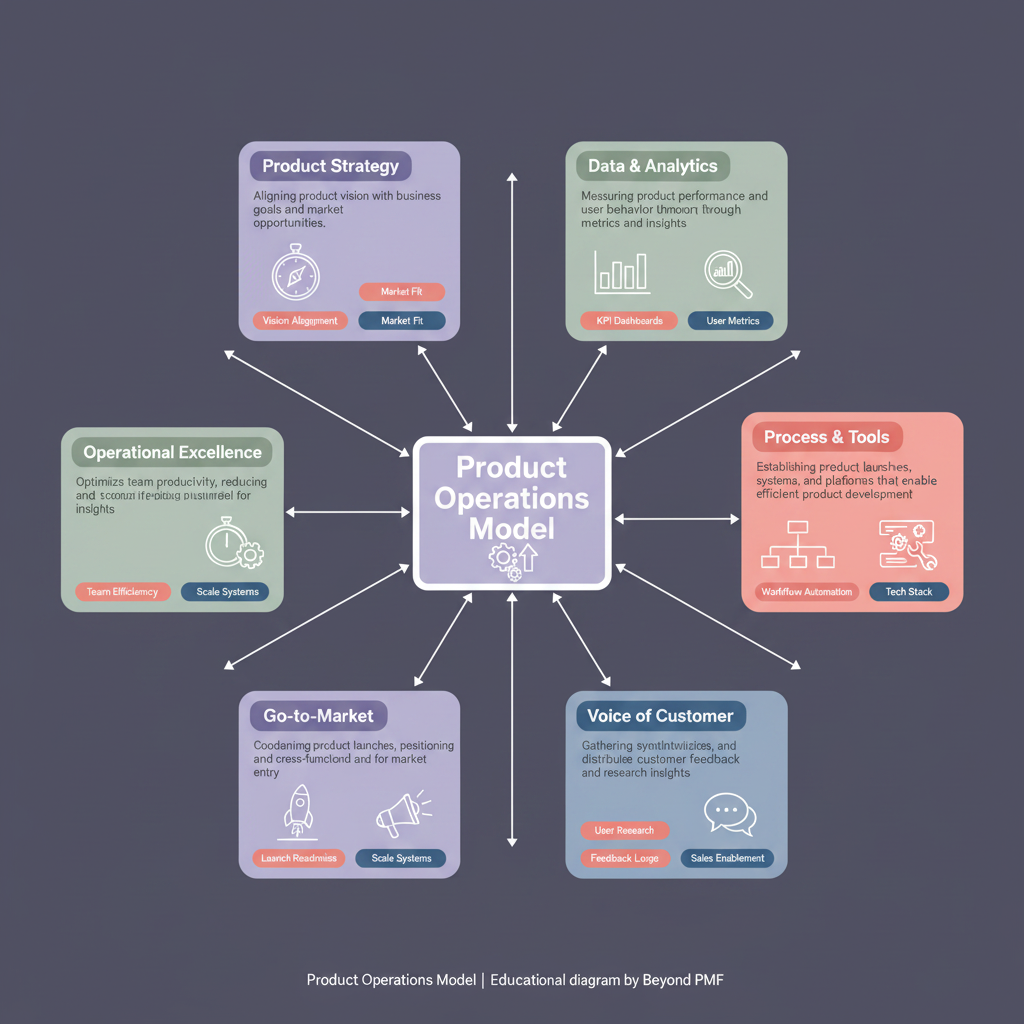
The Product Operations Model is a framework designed to optimize the product management process by aligning product strategy with execution. It focuses on improving collaboration among product teams, enhancing data-driven decision-making, and ensuring that products are developed and managed efficiently. This model is crucial for organizations looking to scale their product offerings while maintaining quality and meeting market demands.
Define product vision and strategy: Establish clear objectives and long-term goals for the product. | Align product and business goals: Ensure that the product supports the overall business strategy and objectives. | Implement data-driven decision-making: Utilize data to inform product decisions, from development to deployment. | Optimize product lifecycle processes: Streamline operations from ideation through to launch and iteration. | Foster cross-functional collaboration: Encourage communication and cooperation between product, marketing, sales, and customer support teams.
Regularly review and update the product strategy to reflect changing market conditions | Invest in tools and technologies that enhance data collection and analysis | Promote a culture of continuous learning and adaptation among product teams
Enhances strategic alignment between product management and business objectives | Improves efficiency and speed in product development cycles | Facilitates better decision-making through data-driven insights
Can be resource-intensive to implement and maintain | Requires high level of coordination and communication across departments | May lead to rigidity in processes, reducing flexibility in fast-changing markets
When scaling product offerings in a growing company | When needing to align multiple product teams towards common business goals
In very small startups where formal processes may hinder rapid innovation | When the market environment is extremely volatile and requires high flexibility