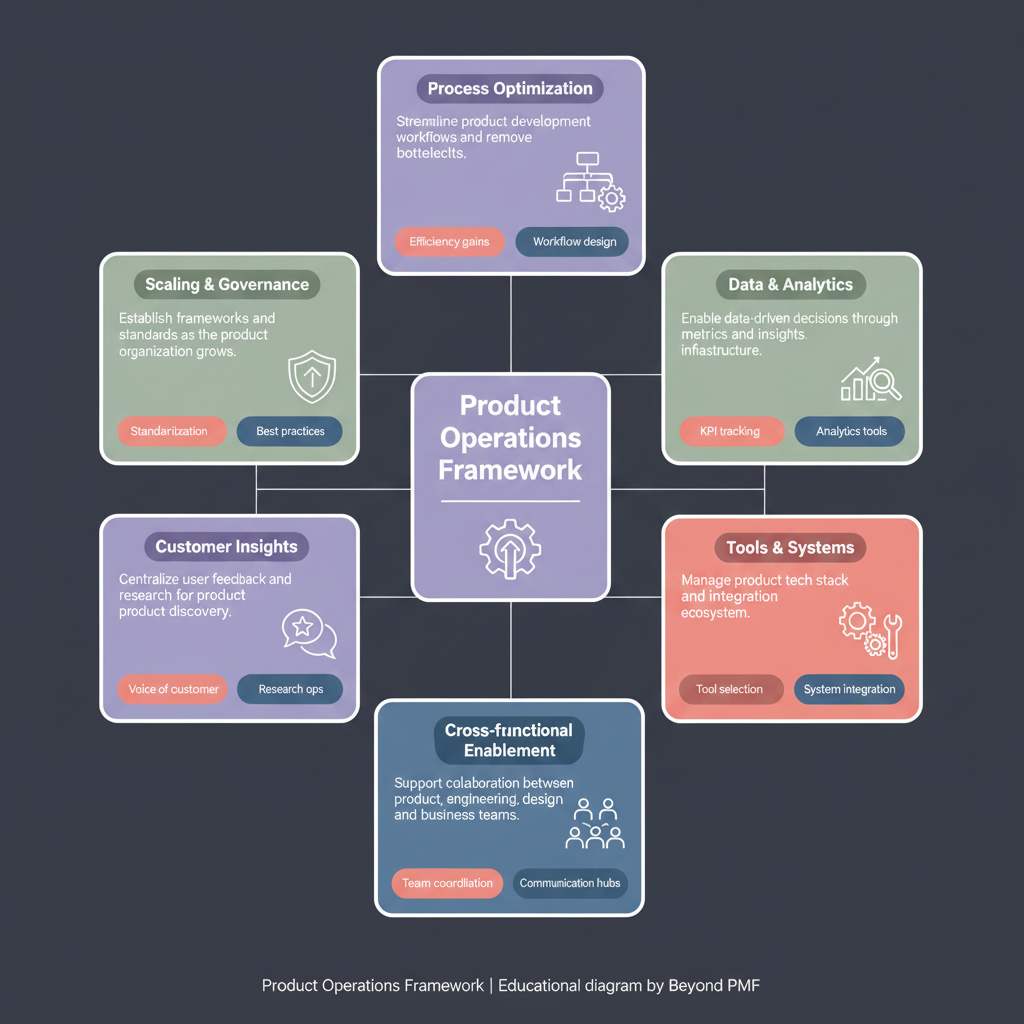
Product Operations Framework

https://ik.imagekit.io/beyondpmf/frameworks/product-operations-framework.png
The Product Operations Framework aims to improve efficiency in product management. This framework likely tackles issues in processes, workflows, and coordination within the product development lifecycle to streamline operations.

The Product Operations Framework is a comprehensive methodology that focuses on optimizing the product lifecycle processes within an organization. It integrates cross-functional teams and leverages data-driven insights to improve product development, launch, and scaling. This framework is crucial for companies looking to enhance product quality, reduce time-to-market, and increase customer satisfaction through systematic and efficient operational practices.

Steps / Detailed Description

Define product operations goals and align them with business objectives. | Establish cross-functional teams including product managers, marketing, sales, and customer support. | Implement tools and systems for data collection and analysis to inform product decisions. | Develop and standardize processes for product development, launch, and iteration. | Continuously monitor performance and iterate based on feedback and data insights.

Best Practices

Regularly review and update the operations framework to adapt to new challenges. | Ensure clear communication and documentation of processes. | Invest in training and development for team members on the framework.

Pros

Improves alignment between product teams and business goals | Enhances speed and efficiency in product development cycles | Facilitates better data-driven decision making

Cons

Can be resource-intensive to implement | Requires high level of coordination across departments | Potential resistance to change within established teams

When to Use

When scaling product offerings | When needing to improve product lifecycle efficiency

When Not to Use

In very small startups with limited resources | When product operations are already highly optimized and efficient

Related Frameworks

Lifecycle

Not tied to a specific lifecycle stage

Scope

Scope not defined

Maturity Level

Maturity level not specified

Time to Implement

2–4 Weeks
3–6 Months
1–2 Weeks
3–6 Months
1–2 Months
3–6 Months
1–2 Weeks
Less Than 1 Day
1–2 Weeks
Longer Than 6 Months
1–2 Weeks
Longer Than 6 Months
1–2 Weeks
3–6 Months
1–2 Weeks
1–2 Weeks
1–2 Weeks
1–2 Weeks
1–2 Days
1–2 Weeks
1–2 Weeks
1–2 Weeks
1–2 Weeks
1–2 Weeks
1–2 Weeks
3–6 Months
1–2 Weeks
1–2 Weeks
1–2 Weeks
3–6 Months
1–2 Weeks
1–2 Weeks
2–4 Weeks
1–2 Weeks
1–2 Days
1–2 Weeks
Longer Than 6 Months
3–6 Months
Longer Than 6 Months
1–2 Weeks
Longer Than 6 Months
3–6 Months
Less Than 1 Day
3–6 Months
1–2 Months
3–6 Months
Longer Than 6 Months
3–6 Months
Less Than 1 Day
1–2 Weeks
3–6 Months
3–6 Months
1–2 Weeks
3–6 Months
1–2 Weeks
1–2 Weeks
1–2 Days
1–2 Weeks
1–2 Months
Longer Than 6 Months
1–2 Weeks
Longer Than 6 Months
1–2 Weeks
3–6 Months
1–2 Weeks
Less Than 1 Day
1–2 Weeks
3–6 Months
1–2 Weeks
3–6 Months
1–2 Weeks
1–2 Weeks
Longer Than 6 Months
Less Than 1 Day
3–6 Months
Longer Than 6 Months
1–2 Months
1–2 Weeks
Longer Than 6 Months
1–2 Weeks
3–6 Months
1–2 Weeks
1–2 Weeks
3–6 Months
Less Than 1 Day
1–2 Weeks
1–2 Weeks
3–6 Months
3–6 Months
Less Than 1 Day
1–2 Weeks
Longer Than 6 Months
1–2 Months
1–2 Weeks
1–2 Weeks
1–2 Weeks
Longer Than 6 Months

Copyright Information

Autor:
Unknown
N/A
Publication:
Unknown