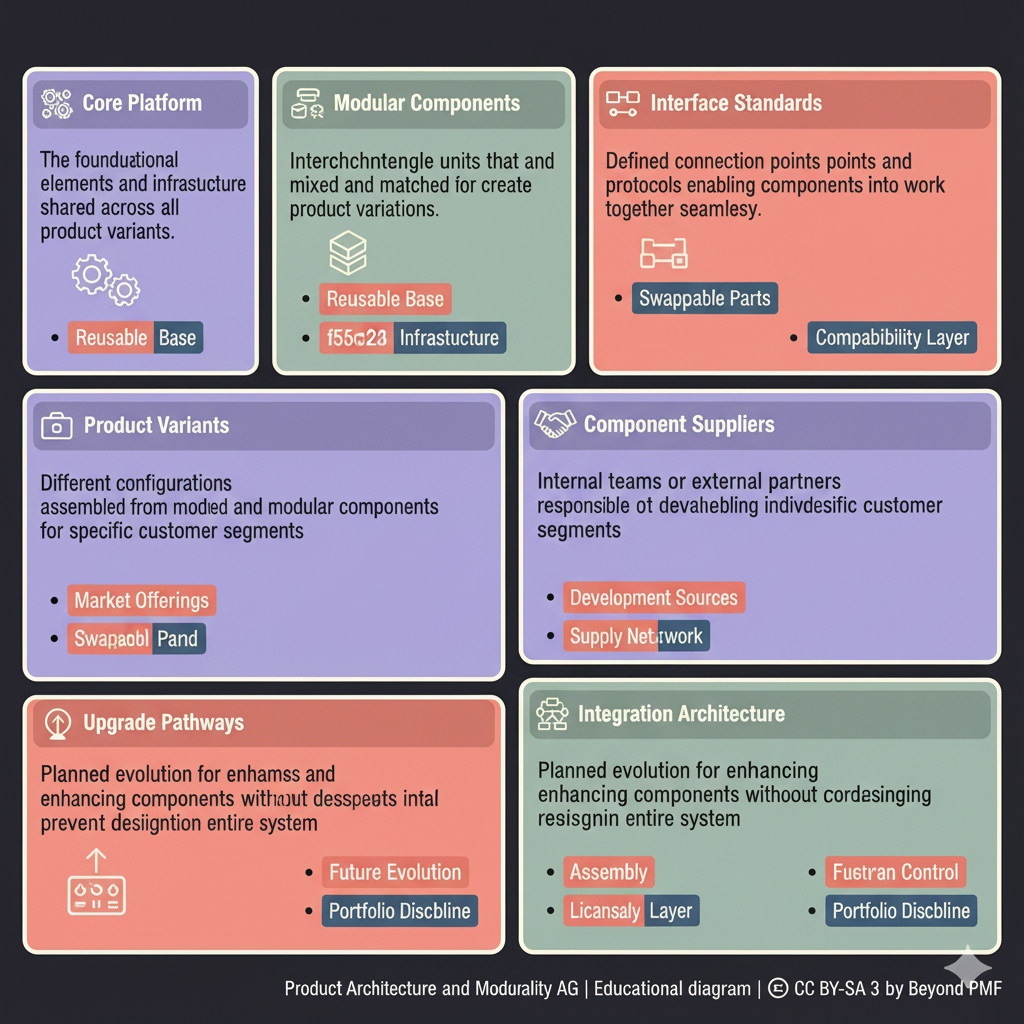
Product Architecture and Modularity

https://ik.imagekit.io/beyondpmf/frameworks/product-architecture-and-modularity.png
Product Architecture and Modularity primarily addresses structural friction by focusing on how a product is organized. This includes defining modules, their interactions, and the roles and responsibilities involved in creating and integrating those modules. By improving product structure, it aims to reduce complexity and improve collaboration.

Product Architecture and Modularity refers to the conceptualization and design process of structuring a product as a collection of distinct modules or components. This framework is used to enhance flexibility in design, manufacturing, and maintenance. It allows companies to customize products according to customer needs, streamline production processes, and facilitate easier upgrades and repairs. The modular design also supports rapid product iterations and scalability, adapting to changes in technology and market demands.

Steps / Detailed Description

Define the overall functionality and performance requirements of the product. | Identify potential modules by grouping related functions together. | Design interfaces between modules to ensure compatibility and independence. | Develop individual modules, focusing on their specific functionalities. | Test modules independently and in combination with others to ensure overall system integrity. | Iterate design based on testing feedback and evolving requirements.

Best Practices

Maintain clear documentation of module interfaces | Regularly update modules to leverage technological advancements | Ensure rigorous testing of modules both independently and as a whole system

Pros

Enhanced product customization and flexibility | Simplified manufacturing and assembly processes | Easier maintenance and upgradeability

Cons

Potential increase in initial design complexity | Risk of reduced performance due to module interfaces | Possible higher costs from maintaining module standards

When to Use

When designing products that require flexibility and customization | When aiming for scalability and ease of upgrades in product lines

When Not to Use

For products where high performance is critical and cannot be compromised by modularity | When the market demands are stable and the product lifecycle is short

Related Frameworks

Lifecycle

Not tied to a specific lifecycle stage

Scope

Scope not defined

Maturity Level

Maturity level not specified

Time to Implement

2–4 Weeks
3–6 Months
1–2 Weeks
3–6 Months
1–2 Months
3–6 Months
1–2 Weeks
Less Than 1 Day
1–2 Weeks
Longer Than 6 Months
1–2 Weeks
Longer Than 6 Months
1–2 Weeks
3–6 Months
1–2 Weeks
1–2 Weeks
1–2 Weeks
1–2 Weeks
1–2 Days
1–2 Weeks
1–2 Weeks
1–2 Weeks
1–2 Weeks
1–2 Weeks
1–2 Weeks
3–6 Months
1–2 Weeks
1–2 Weeks
1–2 Weeks
3–6 Months
1–2 Weeks
1–2 Weeks
2–4 Weeks
1–2 Weeks
1–2 Days
1–2 Weeks
Longer Than 6 Months
3–6 Months
Longer Than 6 Months
1–2 Weeks
Longer Than 6 Months
3–6 Months
Less Than 1 Day
3–6 Months
1–2 Months
3–6 Months
Longer Than 6 Months
3–6 Months
Less Than 1 Day
1–2 Weeks
3–6 Months
3–6 Months
1–2 Weeks
3–6 Months
1–2 Weeks
1–2 Weeks
1–2 Days
1–2 Weeks
1–2 Months
Longer Than 6 Months
1–2 Weeks
Longer Than 6 Months
1–2 Weeks
3–6 Months
1–2 Weeks
Less Than 1 Day
1–2 Weeks
3–6 Months
1–2 Weeks
3–6 Months
1–2 Weeks
1–2 Weeks
Longer Than 6 Months
Less Than 1 Day
3–6 Months
Longer Than 6 Months
1–2 Months
1–2 Weeks
Longer Than 6 Months
1–2 Weeks
3–6 Months
1–2 Weeks
1–2 Weeks
3–6 Months
Less Than 1 Day
1–2 Weeks
1–2 Weeks
3–6 Months
3–6 Months
Less Than 1 Day
1–2 Weeks
Longer Than 6 Months
1–2 Months
1–2 Weeks
1–2 Weeks
1–2 Weeks
Longer Than 6 Months

Copyright Information

Autor:
Generic Business Tool
N/A
Publication:
Generic Business Tool