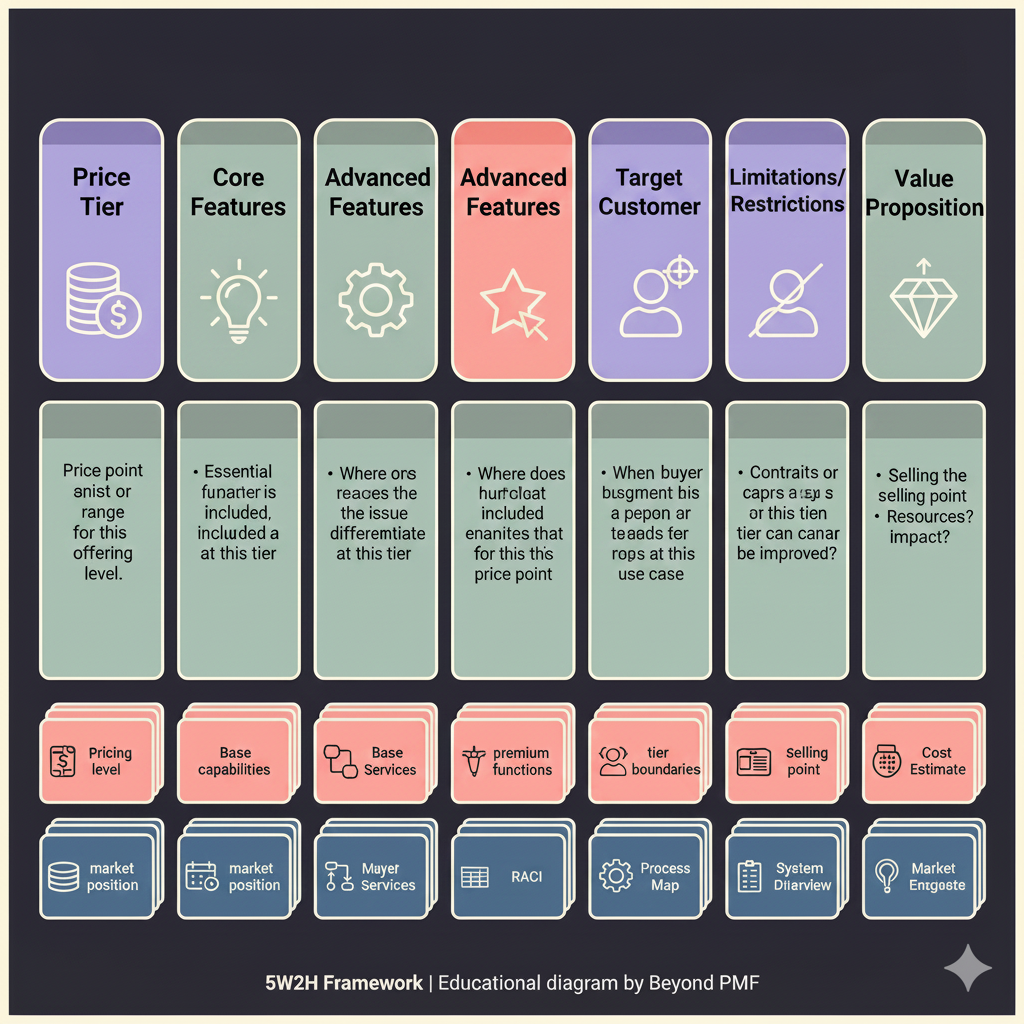
Price-Feature Ladder

https://ik.imagekit.io/beyondpmf/frameworks/price-feature-ladder.png
The Price-Feature Ladder primarily addresses the strategic friction of market alignment and business model by helping companies position their products in the market and determine pricing based on feature sets. It guides decisions about value proposition and revenue generation.

The Price-Feature Ladder framework assists businesses in structuring their pricing strategy by aligning price points with the features offered in their products or services. This method helps in creating multiple product versions that cater to varying customer needs and budgets, thus maximizing market coverage and profitability. The framework is particularly beneficial in competitive markets where product differentiation based on features can significantly impact consumer choice.

Steps / Detailed Description

Identify key features that differentiate products in the market. | Segment these features based on their value to the customer. | Develop tiered product versions, each with a distinct set of features. | Assign a price point to each tier, reflecting the value of the features included.

Best Practices

Clearly communicate the value of each tier to avoid customer confusion. | Regularly review and adjust features and pricing based on market feedback. | Ensure distinct and meaningful differences between each tier.

Pros

Facilitates targeted marketing by aligning product offerings with customer segments. | Maximizes revenue by capturing more value from feature-rich products. | Enhances customer satisfaction by providing options that fit various needs and budgets.

Cons

Can lead to complexity in product management and marketing. | Risk of cannibalization between different product tiers. | May alienate customers if perceived as unfair pricing.

When to Use

Launching a new product line with variable features. | Entering a highly competitive market where feature-based differentiation is crucial.

When Not to Use

In markets where cost leadership is more important than feature differentiation. | When the product cannot be easily segmented into different feature sets.

Related Frameworks

Scope

Scope not defined

Maturity Level

Maturity level not specified

Time to Implement

2–4 Weeks
3–6 Months
1–2 Weeks
3–6 Months
1–2 Months
3–6 Months
1–2 Weeks
Less Than 1 Day
1–2 Weeks
Longer Than 6 Months
1–2 Weeks
Longer Than 6 Months
1–2 Weeks
3–6 Months
1–2 Weeks
1–2 Weeks
1–2 Weeks
1–2 Weeks
1–2 Days
1–2 Weeks
1–2 Weeks
1–2 Weeks
1–2 Weeks
1–2 Weeks
1–2 Weeks
3–6 Months
1–2 Weeks
1–2 Weeks
1–2 Weeks
3–6 Months
1–2 Weeks
1–2 Weeks
2–4 Weeks
1–2 Weeks
1–2 Days
1–2 Weeks
Longer Than 6 Months
3–6 Months
Longer Than 6 Months
1–2 Weeks
Longer Than 6 Months
3–6 Months
Less Than 1 Day
3–6 Months
1–2 Months
3–6 Months
Longer Than 6 Months
3–6 Months
Less Than 1 Day
1–2 Weeks
3–6 Months
3–6 Months
1–2 Weeks
3–6 Months
1–2 Weeks
1–2 Weeks
1–2 Days
1–2 Weeks
1–2 Months
Longer Than 6 Months
1–2 Weeks
Longer Than 6 Months
1–2 Weeks
3–6 Months
1–2 Weeks
Less Than 1 Day
1–2 Weeks
3–6 Months
1–2 Weeks
3–6 Months
1–2 Weeks
1–2 Weeks
Longer Than 6 Months
Less Than 1 Day
3–6 Months
Longer Than 6 Months
1–2 Months
1–2 Weeks
Longer Than 6 Months
1–2 Weeks
3–6 Months
1–2 Weeks
1–2 Weeks
3–6 Months
Less Than 1 Day
1–2 Weeks
1–2 Weeks
3–6 Months
3–6 Months
Less Than 1 Day
1–2 Weeks
Longer Than 6 Months
1–2 Months
1–2 Weeks
1–2 Weeks
1–2 Weeks
Longer Than 6 Months

Copyright Information

Autor:
Public Domain
N/A
Publication:
Generic Business Tool