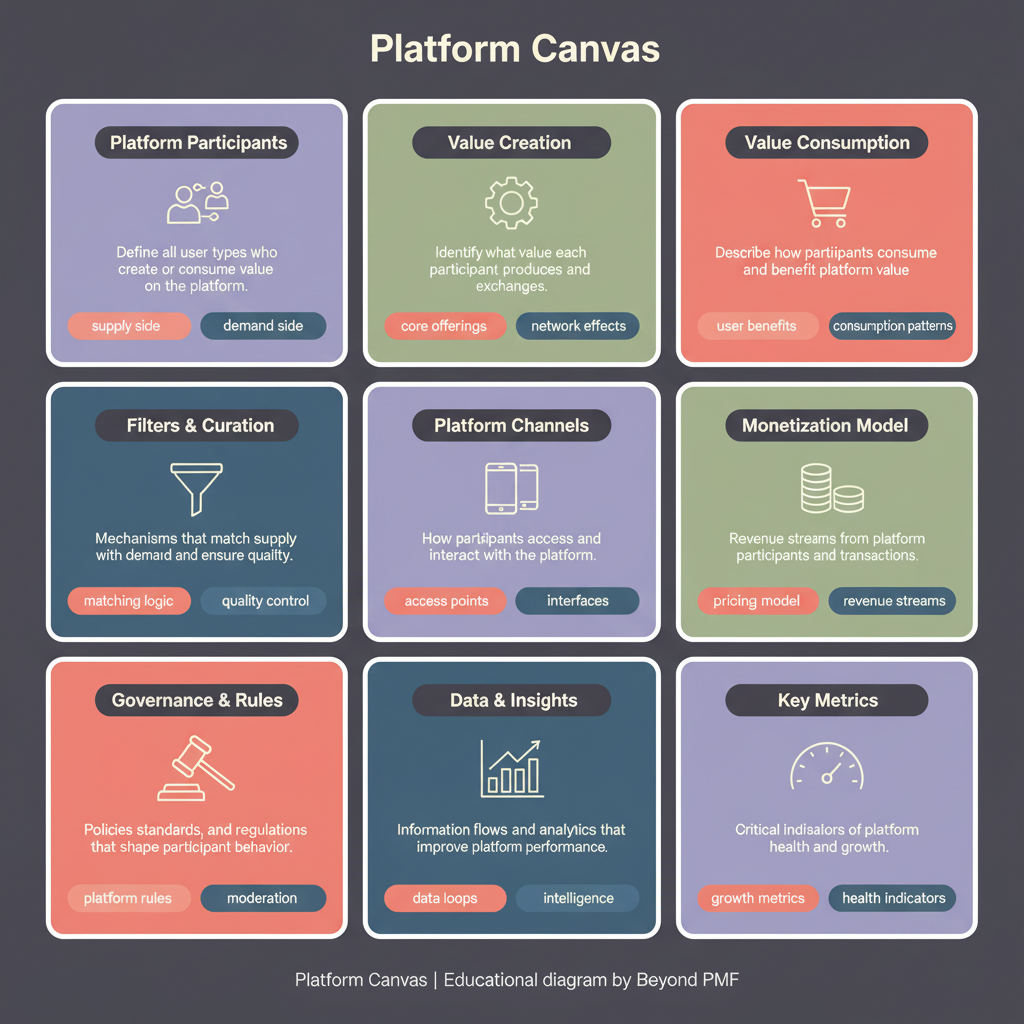
Platform Canvas

The Platform Canvas addresses the strategic friction of defining and aligning the core components of a platform business model. It helps clarify direction and ensure market alignment by mapping essential elements.

The Platform Canvas is a framework designed to help businesses conceptualize and structure a platform-based business model. It focuses on identifying key stakeholders, their interactions, and the value they create and consume. The framework aids in visualizing the flow of value and information, making it easier to pinpoint opportunities and challenges within the platform ecosystem. It is particularly beneficial for businesses looking to leverage network effects and scale through platform strategies.

Steps / Detailed Description

Identify core participants: Determine who the primary users of the platform are and their roles. | Map out interactions: Outline how these participants interact with each other and the platform. | Define value units: Specify what is being exchanged or shared on the platform, such as goods, services, or information. | Establish value creation: Identify how each interaction leads to value creation and capture. | Design governance rules: Set rules and standards that govern participant interactions and platform usage. | Plan monetization strategy: Develop strategies for revenue generation within the platform ecosystem.

Best Practices

Regularly update the canvas as the platform evolves. | Engage with key stakeholders during the canvas development to gain insights. | Use the canvas in conjunction with other business strategy tools for comprehensive analysis.

Pros

Facilitates a clear understanding of complex platform dynamics. | Helps in identifying potential revenue streams and value propositions. | Enhances strategic decision-making by visualizing participant interactions and value flows.

Cons

May oversimplify the complexities of real-world interactions. | Can be less effective for non-platform business models. | Requires deep market and participant insight to be effective.

When to Use

Developing or refining a platform-based business model. | Exploring new market opportunities for a platform.

When Not to Use

Businesses with simple, linear supply chains. | When quick, tactical decisions are needed without detailed analysis.

Related Frameworks

Scope

Scope not defined

Maturity Level

Maturity level not specified

Time to Implement

2–4 Weeks
3–6 Months
1–2 Weeks
3–6 Months
1–2 Months
3–6 Months
1–2 Weeks
Less Than 1 Day
1–2 Weeks
Longer Than 6 Months
1–2 Weeks
Longer Than 6 Months
1–2 Weeks
3–6 Months
1–2 Weeks
1–2 Weeks
1–2 Weeks
1–2 Weeks
1–2 Days
1–2 Weeks
1–2 Weeks
1–2 Weeks
1–2 Weeks
1–2 Weeks
1–2 Weeks
3–6 Months
1–2 Weeks
1–2 Weeks
1–2 Weeks
3–6 Months
1–2 Weeks
1–2 Weeks
2–4 Weeks
1–2 Weeks
1–2 Days
1–2 Weeks
Longer Than 6 Months
3–6 Months
Longer Than 6 Months
1–2 Weeks
Longer Than 6 Months
3–6 Months
Less Than 1 Day
3–6 Months
1–2 Months
3–6 Months
Longer Than 6 Months
3–6 Months
Less Than 1 Day
1–2 Weeks
3–6 Months
3–6 Months
1–2 Weeks
3–6 Months
1–2 Weeks
1–2 Weeks
1–2 Days
1–2 Weeks
1–2 Months
Longer Than 6 Months
1–2 Weeks
Longer Than 6 Months
1–2 Weeks
3–6 Months
1–2 Weeks
Less Than 1 Day
1–2 Weeks
3–6 Months
1–2 Weeks
3–6 Months
1–2 Weeks
1–2 Weeks
Longer Than 6 Months
Less Than 1 Day
3–6 Months
Longer Than 6 Months
1–2 Months
1–2 Weeks
Longer Than 6 Months
1–2 Weeks
3–6 Months
1–2 Weeks
1–2 Weeks
3–6 Months
Less Than 1 Day
1–2 Weeks
1–2 Weeks
3–6 Months
3–6 Months
Less Than 1 Day
1–2 Weeks
Longer Than 6 Months
1–2 Months
1–2 Weeks
1–2 Weeks
1–2 Weeks
Longer Than 6 Months

Copyright Information

Autor:
Unknown
N/A
Publication:
Unknown