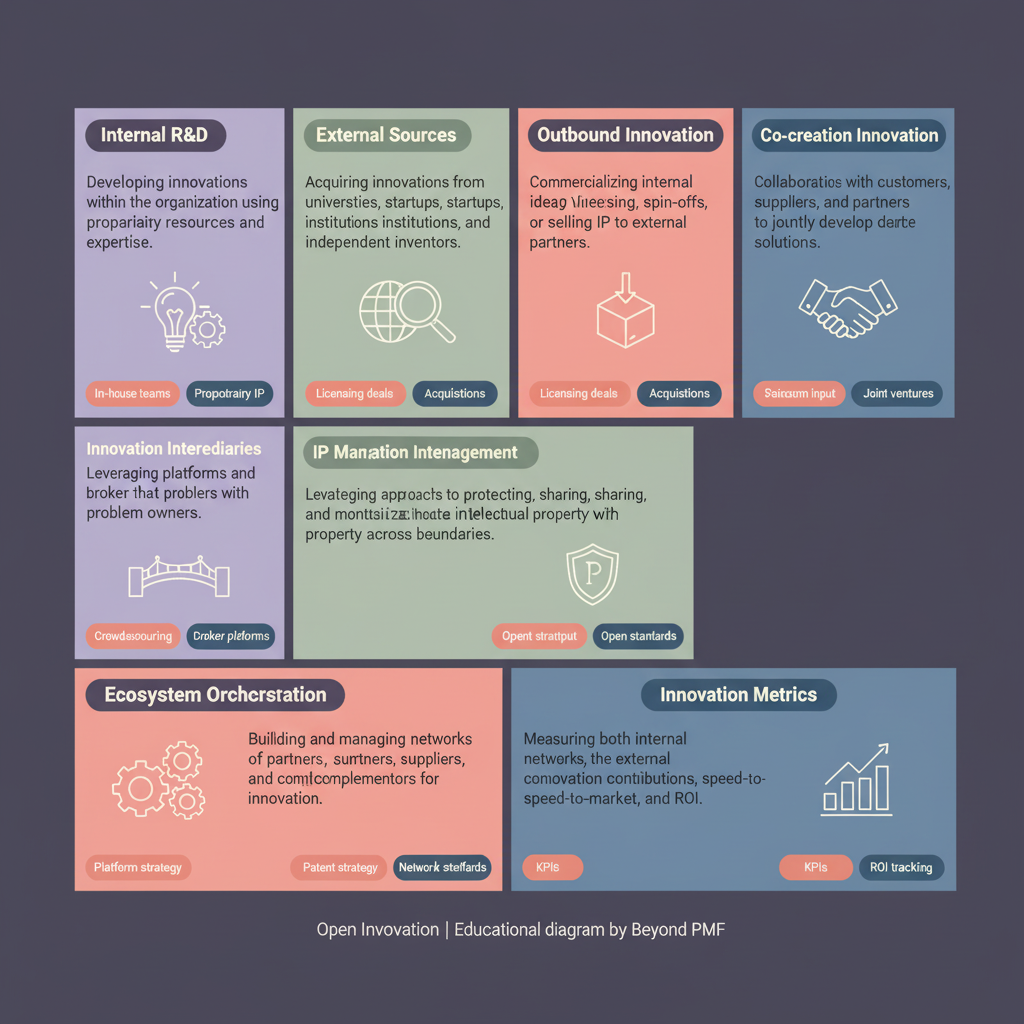
Open Innovation

https://ik.imagekit.io/beyondpmf/frameworks/open-innovation.png
Open Innovation primarily addresses strategic friction by fundamentally changing how a company approaches innovation. It tackles the traditional closed-off approach and provides a new business model, enabling companies to utilize external ideas to advance technology and market alignment.

Open Innovation is a paradigm that assumes firms can and should use external ideas as well as internal ideas, and internal and external paths to market, as the firms look to advance their technology. This approach contrasts with the traditional model where innovation is driven solely within the company. Open Innovation allows companies to reduce costs, accelerate time-to-market, increase differentiation in the market, and create new revenue streams.

Steps / Detailed Description

Define the innovation challenge and goals. | Identify external sources of innovation such as startups, academia, or other industries. | Engage with potential partners through collaborations, joint ventures, or acquisitions. | Integrate external innovations with internal R&D efforts. | Commercialize the combined innovations for market deployment.

Best Practices

Establish clear guidelines for intellectual property rights. | Maintain strong communication with external partners. | Continuously evaluate and adapt collaboration strategies.

Pros

Accelerates innovation by accessing more ideas and technologies. | Reduces research and development costs. | Expands market reach and access to new markets.

Cons

Potential loss of control over intellectual property. | Integration challenges between external and internal innovations. | Dependence on external entities for critical innovations.

When to Use

When looking to break into new markets or sectors. | When internal R&D is unable to keep up with market demands.

When Not to Use

When the company has highly sensitive intellectual property. | When the external innovation ecosystem is underdeveloped.

Related Frameworks

Lifecycle

Scope

Scope not defined

Maturity Level

Maturity level not specified

Time to Implement

2–4 Weeks
3–6 Months
1–2 Weeks
3–6 Months
1–2 Months
3–6 Months
1–2 Weeks
Less Than 1 Day
1–2 Weeks
Longer Than 6 Months
1–2 Weeks
Longer Than 6 Months
1–2 Weeks
3–6 Months
1–2 Weeks
1–2 Weeks
1–2 Weeks
1–2 Weeks
1–2 Days
1–2 Weeks
1–2 Weeks
1–2 Weeks
1–2 Weeks
1–2 Weeks
1–2 Weeks
3–6 Months
1–2 Weeks
1–2 Weeks
1–2 Weeks
3–6 Months
1–2 Weeks
1–2 Weeks
2–4 Weeks
1–2 Weeks
1–2 Days
1–2 Weeks
Longer Than 6 Months
3–6 Months
Longer Than 6 Months
1–2 Weeks
Longer Than 6 Months
3–6 Months
Less Than 1 Day
3–6 Months
1–2 Months
3–6 Months
Longer Than 6 Months
3–6 Months
Less Than 1 Day
1–2 Weeks
3–6 Months
3–6 Months
1–2 Weeks
3–6 Months
1–2 Weeks
1–2 Weeks
1–2 Days
1–2 Weeks
1–2 Months
Longer Than 6 Months
1–2 Weeks
Longer Than 6 Months
1–2 Weeks
3–6 Months
1–2 Weeks
Less Than 1 Day
1–2 Weeks
3–6 Months
1–2 Weeks
3–6 Months
1–2 Weeks
1–2 Weeks
Longer Than 6 Months
Less Than 1 Day
3–6 Months
Longer Than 6 Months
1–2 Months
1–2 Weeks
Longer Than 6 Months
1–2 Weeks
3–6 Months
1–2 Weeks
1–2 Weeks
3–6 Months
Less Than 1 Day
1–2 Weeks
1–2 Weeks
3–6 Months
3–6 Months
Less Than 1 Day
1–2 Weeks
Longer Than 6 Months
1–2 Months
1–2 Weeks
1–2 Weeks
1–2 Weeks
Longer Than 6 Months

Copyright Information

Autor:
Henry Chesbrough
2003
Publication:
Harvard Business School Press