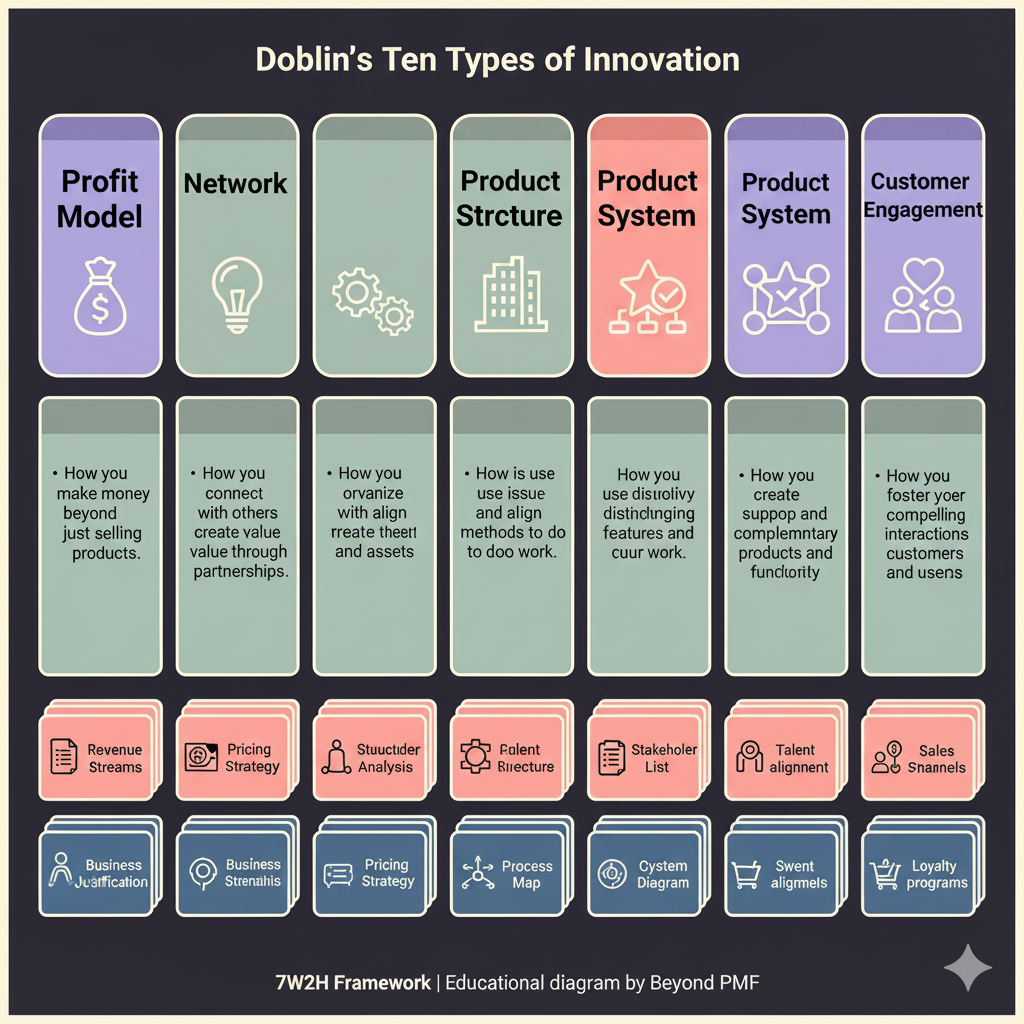
Doblin's Ten Types of Innovation

https://ik.imagekit.io/beyondpmf/frameworks/doblins-ten-types-of-innovation.png
Doblin's framework helps organizations identify diverse opportunities for innovation, addressing the strategic challenge of finding new avenues for competitive advantage and value creation. It provides a structured approach to explore a wider range of possibilities beyond just product features or technology.

Doblin's Ten Types of Innovation framework provides a comprehensive approach to business innovation by categorizing it into ten distinct types. These types range from product and service innovations to business model and process improvements, offering a holistic view of potential innovation strategies. The framework helps organizations identify opportunities for differentiation and competitive advantage, encouraging a systematic exploration of all aspects of business operations.

Steps / Detailed Description

Identify the current state of innovation in your organization. | Understand the ten types of innovation and how they apply to your business. | Analyze the market and competitive landscape to identify innovation opportunities. | Develop strategies for each of the ten types to maximize potential. | Implement innovations with cross-functional teams. | Evaluate the impact of innovations and refine strategies accordingly.

Best Practices

Start with a thorough assessment of your current innovation landscape. | Focus on integrating multiple types of innovation for synergistic effects. | Regularly review and adapt innovations based on market feedback and changes.

Pros

Provides a comprehensive view of innovation opportunities. | Encourages systematic and strategic thinking. | Enhances differentiation and competitive advantage.

Cons

Can be overwhelming due to its breadth. | Requires significant resources to implement effectively. | May lead to a focus on innovation for its own sake, rather than market-driven needs.

When to Use

When seeking to overhaul or enhance a company’s innovation strategy. | When entering a new market or launching new products.

When Not to Use

In very small businesses or startups with limited resources. | When quick, tactical changes are required rather than comprehensive strategic overhauls.

Related Frameworks

Lifecycle

Scope

Scope not defined

Maturity Level

Maturity level not specified

Time to Implement

2–4 Weeks
3–6 Months
1–2 Weeks
3–6 Months
1–2 Months
3–6 Months
1–2 Weeks
Less Than 1 Day
1–2 Weeks
Longer Than 6 Months
1–2 Weeks
Longer Than 6 Months
1–2 Weeks
3–6 Months
1–2 Weeks
1–2 Weeks
1–2 Weeks
1–2 Weeks
1–2 Days
1–2 Weeks
1–2 Weeks
1–2 Weeks
1–2 Weeks
1–2 Weeks
1–2 Weeks
3–6 Months
1–2 Weeks
1–2 Weeks
1–2 Weeks
3–6 Months
1–2 Weeks
1–2 Weeks
2–4 Weeks
1–2 Weeks
1–2 Days
1–2 Weeks
Longer Than 6 Months
3–6 Months
Longer Than 6 Months
1–2 Weeks
Longer Than 6 Months
3–6 Months
Less Than 1 Day
3–6 Months
1–2 Months
3–6 Months
Longer Than 6 Months
3–6 Months
Less Than 1 Day
1–2 Weeks
3–6 Months
3–6 Months
1–2 Weeks
3–6 Months
1–2 Weeks
1–2 Weeks
1–2 Days
1–2 Weeks
1–2 Months
Longer Than 6 Months
1–2 Weeks
Longer Than 6 Months
1–2 Weeks
3–6 Months
1–2 Weeks
Less Than 1 Day
1–2 Weeks
3–6 Months
1–2 Weeks
3–6 Months
1–2 Weeks
1–2 Weeks
Longer Than 6 Months
Less Than 1 Day
3–6 Months
Longer Than 6 Months
1–2 Months
1–2 Weeks
Longer Than 6 Months
1–2 Weeks
3–6 Months
1–2 Weeks
1–2 Weeks
3–6 Months
Less Than 1 Day
1–2 Weeks
1–2 Weeks
3–6 Months
3–6 Months
Less Than 1 Day
1–2 Weeks
Longer Than 6 Months
1–2 Months
1–2 Weeks
1–2 Weeks
1–2 Weeks
Longer Than 6 Months

Copyright Information

Autor:
Doblin (Deloitte)
2007
Publication:
Doblin (Deloitte)