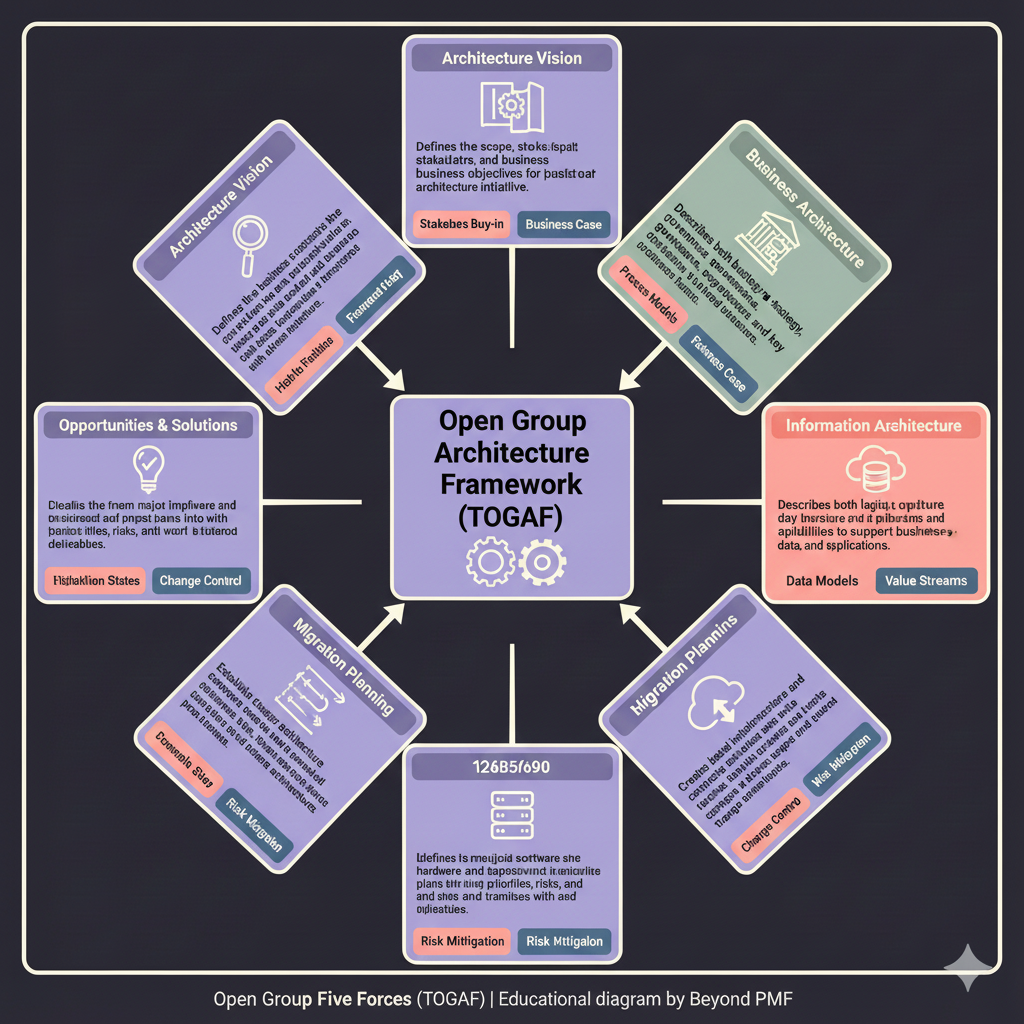
The Open Group Architecture Framework (TOGAF) is a framework for enterprise architecture that provides a comprehensive approach to the design, planning, implementation, and governance of an enterprise information architecture. TOGAF is designed to help organizations align IT goals with overall business goals, while helping to organize cross-departmental IT efforts. TOGAF's comprehensive approach improves efficiency, supports agility, and reduces costs by standardizing and simplifying the IT architecture process.
Preliminary Phase: Define the scope, establish the architecture team, and secure management support. | Phase A: Architecture Vision: Develop a high-level vision of the intended outcome and its business implications. | Phase B: Business Architecture: Document the business strategy, governance, organization, and key business processes. | Phase C: Information Systems Architectures: Develop architectures for data and applications. | Phase D: Technology Architecture: Define the hardware, software, and network infrastructure needed to support the deployment of core business applications. | Phase E: Opportunities and Solutions: Identify delivery vehicles for the architecture defined in the previous phases. | Phase F: Migration Planning: Create a detailed plan to move from the baseline to the target architecture. | Phase G: Implementation Governance: Oversee the implementation process and ensure alignment with the architecture goals. | Phase H: Architecture Change Management: Manage changes to the new architecture to maintain its integrity over time. | Requirements Management: Continuously manage requirements to ensure they are met during the architecture development process.
Ensure strong leadership and commitment from top management. | Regularly update and maintain the architecture to reflect changing business needs. | Engage all stakeholders throughout the process to ensure alignment and buy-in.
Provides a structured approach to architectural planning that aligns with business goals. | Facilitates efficient use of resources by standardizing processes. | Enhances system interoperability and reduces IT costs through consistent standards.
Can be complex and time-consuming to implement fully. | Requires significant commitment and cooperation across all departments. | May be overkill for small or less complex organizations.
When overhauling the IT infrastructure of a large organization. | When aligning IT and business strategies is a priority.
For small-scale IT projects that do not require complex architecture. | When rapid deployment is more critical than thorough planning.